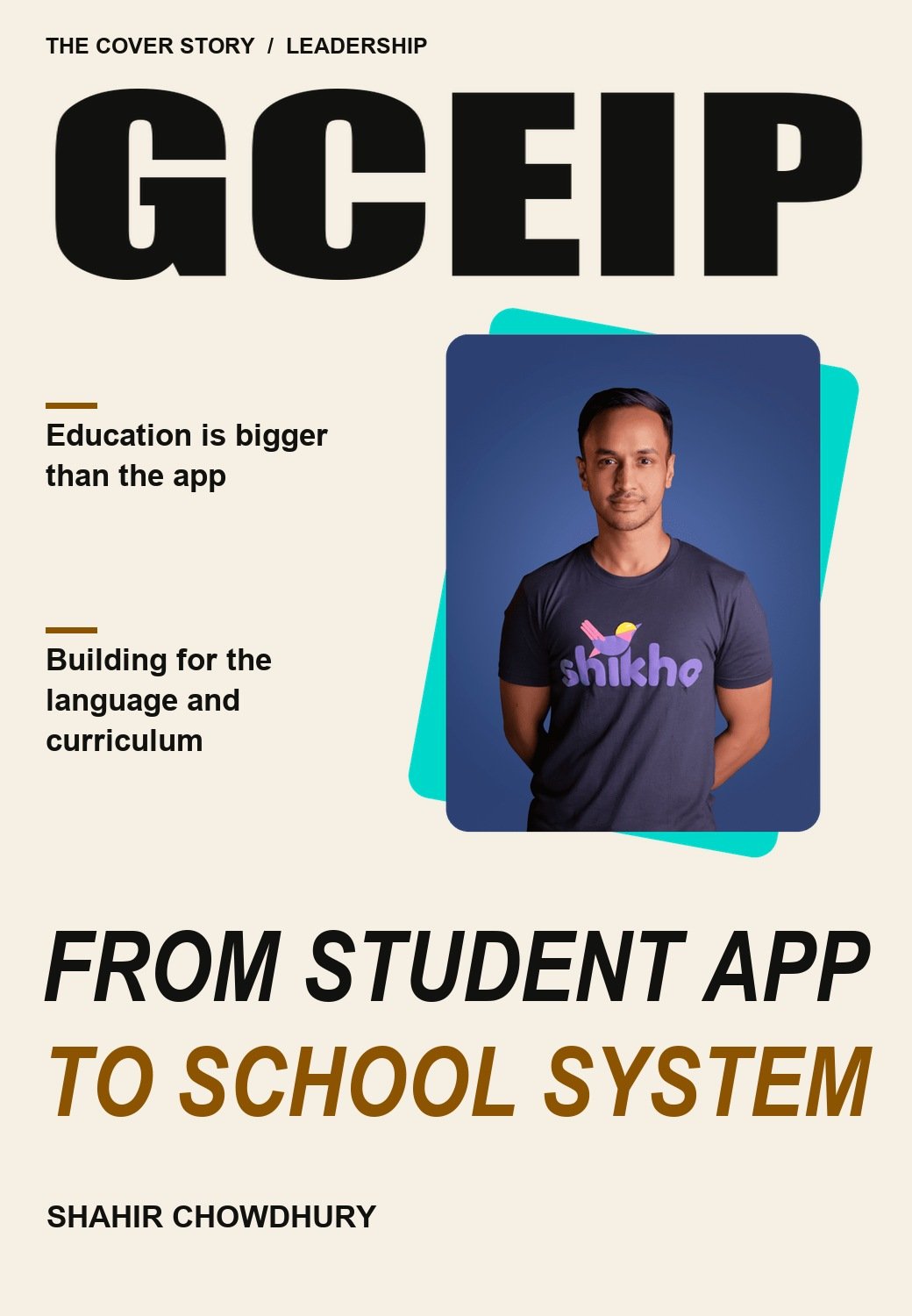
An education platform can win students one by one, but the wider system depends on teachers, school leaders and the institutions that manage learning. Shahir Chowdhury co-founded Shikho in Bangladesh to deliver curriculum-aligned education through digital products, particularly for students learning in Bangla. The company now faces a larger question: can the tools created for individual learners become useful infrastructure for classrooms, campuses and training providers? That is a more demanding transformation than adding new content to a consumer application.
Building for the language and curriculum
Shikho’s original proposition responded to a clear local need. General-purpose online educational content does not automatically match Bangladesh’s curriculum, language or the exam pressures faced by students and families. The platform developed mobile-first learning experiences, assessments and lessons aligned with the national curriculum. That localisation is strategically important. Educational technology succeeds when the teacher or student can use it inside the learning process they actually face, rather than in an idealised system designed elsewhere. At the same time, curriculum alignment creates continuing duties to update content, maintain quality and respond to student needs.
A November 2026 financing milestone
On November 8, 2026, Bangladesh business publication Future Startup reported that Shikho announced a BDT 8.75 crore strategic financing round, approximately US$700,000, involving investors connected with STS Group and returning backer Wavemaker Partners. The round followed a separate 2025 funding announcement involving Startup Bangladesh. Shikho said the 2026 capital would support an enterprise strategy aimed at schools, colleges, universities and training institutions. The financing announcement describes a planned expansion; it does not establish that the intended institutional deployments are complete.
The difficult shift from B2C to institutions
Selling a digital course to a student differs substantially from selling a service to a school. Institutional customers need training, administration, procurement approvals, privacy safeguards, integration with staff routines and evidence that tools improve teaching rather than increase workload. Shahir and his team must therefore add enterprise sales, implementation and support capabilities to a company originally built around direct learner engagement. Schools cannot measure success only through app downloads; they need more credible indicators such as learner participation, teacher time saved and performance within real curriculum settings.
Safeguarding a classroom product
Institutional adoption also changes who is responsible when a lesson, assessment or AI answer is wrong. Teachers need a way to inspect and correct material before it reaches a class. Parents need clear explanations of how pupil information is used. School administrators need to know who can access records and how long those records are retained. These are requirements Shikho will have to satisfy during implementation. They also take time from the staff who introduce a new system, so support and training must be included in the commercial offer.
GCEIP Analysis
Shikho is trying to sell institution-wide services using a product base developed for individual learners. An AI tutor can be useful, but education outcomes depend on teaching practice, safeguarding, assessment design and reliable access. The November 2026 investment establishes a fresh milestone for evaluating the strategy. Evidence of signed institutions, successful classroom deployments and sustained learning outcomes will be needed before anyone can conclude that the institutional pivot has succeeded.
GCEIP View
Shahir Chowdhury’s entrepreneurial journey captures the next question in digital education: how to make strong learning tools part of the education system rather than an alternative outside it. Shikho has a clear local-language foundation and a recently announced institutional ambition. The important work ahead is to prove that teachers and students benefit together. If the model succeeds, it could make Bangla-first educational technology more accessible through the organisations already serving learners every day.
Key facts
Who is Shahir Chowdhury?
Shahir Chowdhury is the founder and CEO of Bangladesh education-technology company Shikho.
What is Shikho changing in 2026?
Shikho announced an institutional education strategy supported by a BDT 8.75 crore financing round in November 2026.
If this story is about you or your company, you are welcome to link to it. Copy either snippet below into your website, press page, email signature or post.
About this feature
This is a GCEIP editorial feature. Publication does not confer nomination, finalist, winner or honouree status.
iFarmer links finance, agricultural inputs, advice and routes to market in one platform. Co-founder Fahad Ifaz is building a business around the needs of farmers who are often underserved by formal systems.
The founder who challenged India's fragmented hotel industry is now leading PRISM through a much larger transformation. With Motel 6 reshaping its international business and a proposed IPO approaching, Ritesh Agarwal faces a different test of leadership: building a financially resilient global hospitality company.
The entrepreneur who built a global podcast audience is now attempting to create a business ecosystem spanning media, technology, investment and creator-led enterprises.
From solving daily delivery challenges for restaurant chains to building an on-demand refrigerated logistics platform, the founder of JustDeliveries is helping reshape how India's food businesses grow.