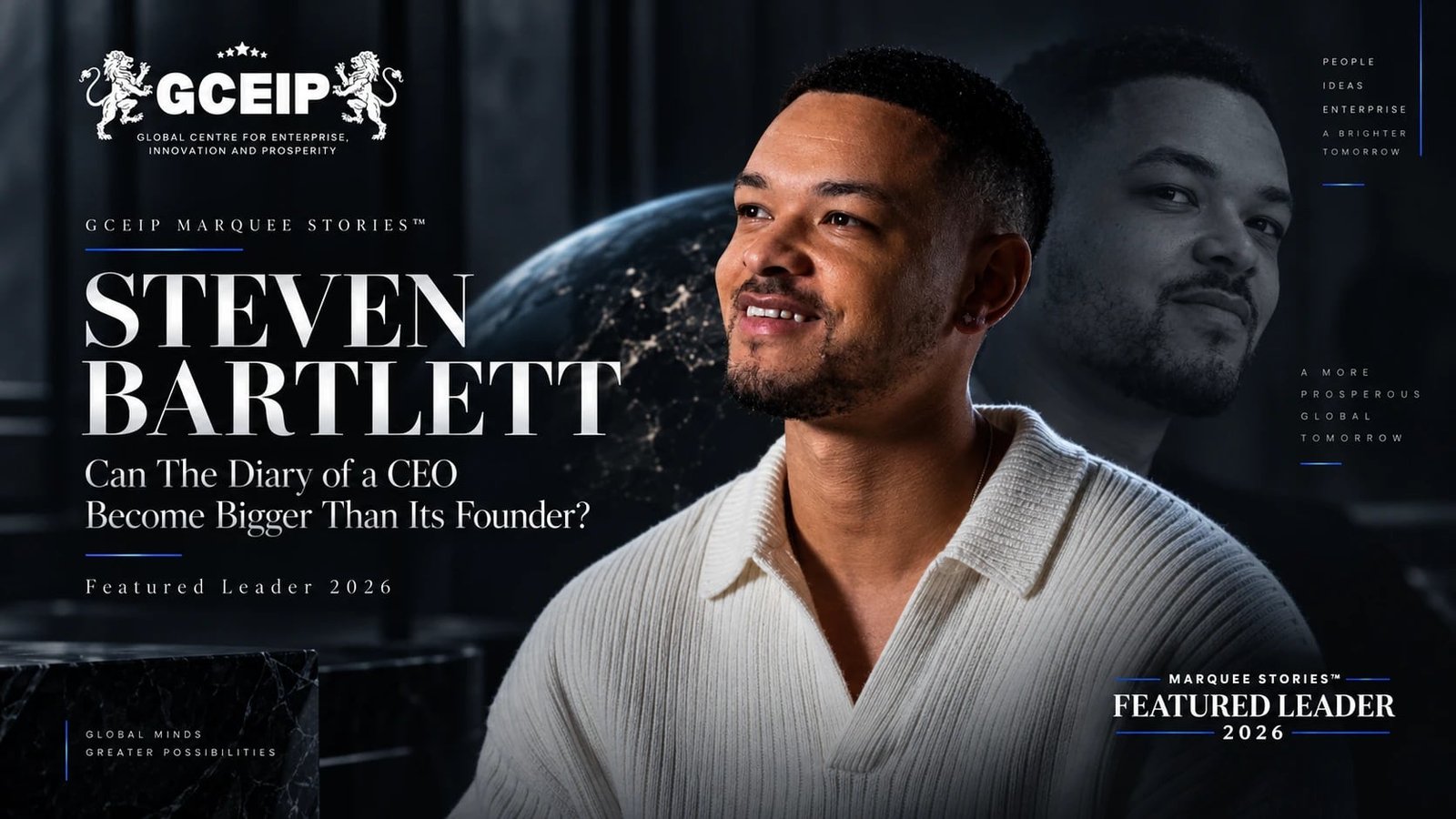
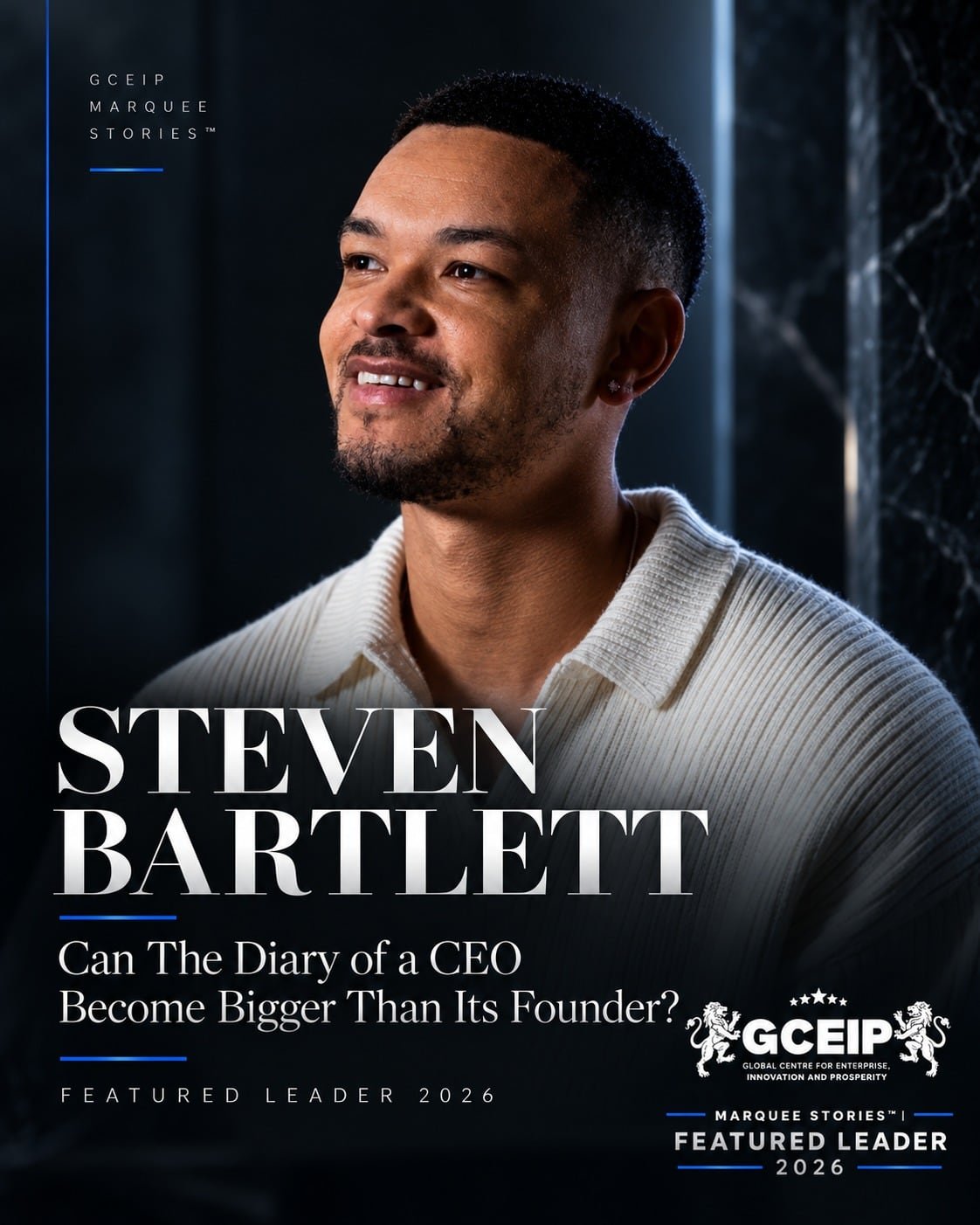
Steven Bartlett: Can The Diary of a CEO Become Bigger Than Its Founder?
The entrepreneur who built a global podcast audience is now attempting to create a business ecosystem spanning media, technology, investment and creator-led enterprises.
SB
Steven BartlettFounder · Steven.com · United Kingdom
The Cover Story editorial team ·
Twenty million YouTube subscribers. A company valued at $425 million. And a new ambition involving up to $400 million in creator-led businesses.
Building a business is one achievement. Building one that can grow beyond you is another.
For most entrepreneurs, these numbers would represent the ultimate achievement.
For Steven Bartlett, they may be the beginning of a far more consequential chapter.
Millions around the world recognise Bartlett as the voice behind The Diary of a CEO, the podcast that has transformed lengthy conversations with entrepreneurs, scientists, celebrities and thinkers into a remarkable international media franchise.
But something bigger is emerging behind the microphone.
Bartlett is attempting to build an enterprise capable of creating, developing and commercialising multiple creator-led businesses—not simply one extraordinarily successful podcast.
Through Steven.com, he has assembled media production, technology, investment and audience-development capabilities within an increasingly interconnected business structure.
In October 2025, Steven.com announced an eight-figure investment round at a valuation of $425 million.
Less than a year later, the company announced OBSN, a new venture with Authentic Brands Group, intended to help build and scale creator-led media companies and brands.
The ambition is considerable.
But it presents a challenge that goes to the heart of modern entrepreneurship.
How do you build a business around your personal influence—and then make that business bigger than yourself?
That is what makes Steven Bartlett's next chapter worth watching.
The Entrepreneur Who Understood the Economics of Attention
Bartlett's success did not begin with podcasting.
His earlier entrepreneurial experience included Social Chain, the social-media marketing business he co-founded during the rise of social platforms as powerful commercial distribution channels.
That experience provided an important insight into how business influence was changing.
Traditional brands spent heavily to reach customers through established media institutions.
Digital platforms were creating a different possibility.
An individual capable of understanding audiences, building communities and consistently attracting attention could develop considerable influence without owning a newspaper, television network or conventional advertising business.
Attention was becoming more accessible.
But turning attention into sustainable commercial value required a different set of skills.
Bartlett's next major venture, The Diary of a CEO, demonstrated the potential of combining those capabilities.
Launched in 2017, the podcast developed from founder-focused discussions into a broader format examining entrepreneurship, personal development, psychology, health and the experiences of influential public figures.
Its success reflects more than the popularity of individual guests.
The programme established a recognisable approach: extended conversations, personal questions and a willingness to explore the experiences behind public achievement.
For an audience increasingly surrounded by short-form content, the format offered something different.
Depth became part of its appeal.
Consistency helped create familiarity.
And Bartlett himself became the personality connecting the expanding range of conversations.
By October 2026, The Diary of a CEO had reached approximately 20 million YouTube subscribers, according to reporting by Business Insider.
That audience has become the foundation of a significant business.
But it also introduces the challenge of what happens when a media property becomes closely associated with one individual.
From a Successful Podcast to a $425 Million Business
In October 2025, Bartlett announced that Steven.com had completed an eight-figure funding round led by Slow Ventures and Apeiron Investment Group.
The transaction valued the company at $425 million.
That figure represents the valuation attached to the investment round—not annual revenue or realised profit.
The importance of the funding lay in the business model it was intended to accelerate.
Steven.com brought together several operating capabilities, including FlightStory, FlightCast and FlightFund.
FlightStory develops and supports creator-led media properties.
FlightCast provides technology infrastructure for podcasting and creator businesses.
FlightFund represents the group's investment activities.
Together, these businesses indicate an ambition extending beyond media production.
The strategy is to help creators develop the capabilities needed to build commercially sustainable organisations around their audiences.
A successful creator may already know how to attract millions of views.
But building a lasting enterprise requires far more.
It requires operational teams, intellectual property, customer relationships, commercial partnerships, distribution, technology, product development and access to capital.
These capabilities have traditionally been scattered across multiple organisations.
Steven.com wants to bring more of them into one ecosystem.
Bartlett is attempting to move from building an audience to building the infrastructure that helps audiences become enterprises.
That distinction changes the scale of the opportunity.
It also changes the risks.
The $400 Million Ambition: A New Chapter for the Creator Economy
September 2026 marked another important development.
Steven.com and Authentic Brands Group announced the launch of OBSN, a venture intended to combine creator-led media expertise with the capabilities required to develop and scale businesses around influential creators.
Authentic brings experience in brand ownership, licensing, commercial partnerships and global distribution.
Steven.com contributes its understanding of creators, audiences, content and technology.
The partnership's stated ambition is to deploy up to $400 million into creator-led businesses over the coming years.
That is a proposed investment ambition, not an amount already deployed.
The underlying commercial thesis is nevertheless compelling.
Millions of people may follow a creator because they trust their judgment, enjoy their content or identify with their perspective.
That relationship can provide a powerful starting point for a business.
But an audience is not automatically a customer base.
A popular creator is not automatically an effective product developer.
And a successful sponsorship campaign does not necessarily establish a durable consumer brand.
The difficult work begins when attention must be translated into repeatable commercial performance.
Products must meet customer expectations.
Operations must work.
Distribution must scale.
And the business must create value beyond the immediate popularity of the person who introduced it.
OBSN is an attempt to bring the necessary expertise, infrastructure and commercial capabilities together.
It also includes a media and experiences platform serving the wider creator economy.
For Bartlett, this represents a significant expansion of his original entrepreneurial proposition.
The podcast demonstrated his ability to build attention and trust at scale.
The new venture tests whether those capabilities can become part of a repeatable enterprise-building model.
The Biggest Challenge: Becoming Less Dependent on Steven Bartlett
There is a fascinating contradiction at the centre of Bartlett's business.
His personality has been one of its greatest competitive advantages.
His voice, curiosity, interviewing style and reputation have helped attract an extraordinary audience.
Yet the long-term growth of the wider company requires an organisation capable of operating beyond his daily participation.
This challenge is familiar to entrepreneurs across industries.
A founder creates a successful business through personal effort.
Customers come to associate the business with the founder.
The organisation expands.
Eventually, the same individual whose commitment created the success can become a constraint on further growth.
For creator-led businesses, this problem can become especially pronounced.
The audience expects the creator to remain visible.
Commercial partners want access to the personality behind the platform.
Production schedules depend on the founder's availability.
And new ventures may require the individual's involvement to attract initial attention.
Bartlett has spoken openly about developing a business that can endure over a much longer period.
In an October 2026 interview with Business Insider, he explained that he approaches decisions with a 50-year horizon.
An important part of that philosophy involves protecting the curiosity that makes his work sustainable.
Another involves structuring Steven.com so that additional businesses and creative properties can develop beyond his personal output.
FlightStory's work with other creators reflects that ambition.
The group has also explored artificial intelligence in production, translation and new media formats.
But technology alone cannot solve the founder-dependency problem.
The deeper challenge is organisational.
Can the company create systems, teams and leadership structures capable of building successful businesses without requiring Bartlett to remain involved in every significant activity?
If that happens, Steven.com could become considerably more valuable as an institution than as an extension of one individual's personal brand.
The Numbers Reveal the Opportunity—and the Risk
There is already evidence of substantial commercial development.
In September 2026, Financial Times reporting described how The Diary of a CEO still accounted for more than 80% of revenue across Bartlett's holding group.
That figure is revealing.
On one hand, it demonstrates the commercial importance of the podcast.
On the other, it illustrates how much of the wider company's economic activity remains concentrated in its original flagship property.
For an organisation aiming to support multiple creators and businesses, diversification is not simply an attractive strategy.
It is an important measure of progress.
The success of Steven.com will increasingly depend on whether businesses beyond The Diary of a CEO can establish meaningful, sustainable revenue streams.
The company's valuation and announced investment ambitions indicate investor confidence and strategic ambition.
They do not, by themselves, demonstrate that the broader operating model has been proven.
That distinction matters.
An ambitious business vision becomes credible over time through execution, financial performance and the strength of its individual operating companies.
For Steven.com, those are the measures that will determine whether its expansion becomes a durable transformation.
Influence, Trust and the Responsibility of Scale
Bartlett's journey also raises another important question.
What happens to editorial responsibility when a creator's influence becomes commercially significant?
The Diary of a CEO has attracted scrutiny over health-related claims made by certain guests.
In December 2024, a BBC investigation questioned the handling of potentially harmful health misinformation in podcast episodes.
The production company defended its commitment to researching guests and allowing freedom of expression.
Subsequent reporting has described efforts to strengthen editorial review and fact-checking procedures.
Bartlett's relationships with consumer brands and investments have also prompted questions about commercial disclosure.
These issues demonstrate the complexity of building businesses around personal trust.
The same credibility that creates commercial opportunities also brings greater responsibility.
As a creator expands into investment, products, media and commercial partnerships, audiences need to understand when content intersects with financial interests.
Transparency and editorial standards become essential business considerations.
The larger an influence-led enterprise becomes, the more important it is that trust rests on institutional systems—not only personal reputation.
For Bartlett, that will remain a defining requirement of the next phase.
GCEIP Analysis: The Creator Economy Is Becoming an Enterprise Economy
Steven Bartlett's business evolution reflects a much wider transformation in global entrepreneurship.
The first generation of digital creators competed primarily for attention.
They built audiences, generated views and developed relationships with advertisers.
The next generation is increasingly exploring ownership.
Ownership of intellectual property.
Ownership of audience relationships.
Ownership of commercial infrastructure.
And ownership of the businesses that emerge from those relationships.
Steven.com represents an ambitious interpretation of this shift.
Three strategic decisions stand out.
First, Bartlett built distribution before pursuing broader diversification.
The success of The Diary of a CEO created an audience and a recognisable media property that could support additional opportunities.
Second, he has invested in infrastructure rather than relying exclusively on sponsorship income.
Media production, creator technology and investment activities offer opportunities to participate more directly in the economics of the creator businesses the group supports.
Third, he is attempting to build an enterprise that can ultimately become less dependent on his direct participation.
This may be the most consequential challenge of all.
The ability to build one highly successful personal media property is rare.
The ability to create an organisation that repeatedly develops successful properties and businesses would represent a different level of achievement.
Whether Steven.com can accomplish that remains an open business question.
But the strategy deserves attention because it points towards a changing relationship between media, influence, entrepreneurship and enterprise ownership.
The Business Lesson: Your Personal Brand Should Create an Opportunity, Not a Dependency
There is an important lesson here for founders, CEOs and entrepreneurs beyond the media industry.
Personal reputation can be a powerful asset.
It can attract customers, talent, investors and business partners.
But personal influence becomes a limitation if the organisation cannot grow without the founder's constant involvement.
The more demanding task is to convert individual capabilities into organisational capabilities.
That means building leadership teams, repeatable operating systems, strong customer relationships and revenue streams that do not depend entirely on one person's daily availability.
For business leaders, the essential question is straightforward:
If you stepped away from day-to-day operations for six months, what would continue to grow—and what would immediately begin to struggle?
The answer can reveal where a company still needs to become an institution.
Bartlett's transformation offers an especially visible example of that challenge.
What Comes Next for Steven Bartlett?
Bartlett's next chapter will not be measured only by new podcast subscribers or increasingly prominent interview guests.
It will be measured by what Steven.com builds beyond its most famous property.
Can FlightStory develop multiple successful creator-led media franchises?
Can FlightCast establish a meaningful role in the technology infrastructure supporting creators?
Can OBSN help build sustainable businesses around influential individuals?
And can Steven.com develop greater commercial independence from the personality of its founder?
These questions will shape the company's next phase.
The opportunity is substantial, but so is the execution challenge.
For Bartlett, the greatest entrepreneurial achievement may ultimately lie beyond the business that made him famous.
The Diary of a CEO built Steven Bartlett's global influence. Steven.com is his attempt to turn that influence into an institution.
And that is a much bigger business story.
The Cover Story World View
Steven Bartlett represents an important evolution in modern business leadership.
His journey illustrates how personal influence can become a foundation for media entrepreneurship, technology development, investment and enterprise creation.
The expansion of Steven.com reflects an ambitious effort to convert that influence into a larger, more diversified business ecosystem.
The company's long-term significance will depend on the performance of its wider portfolio, the strength of its leadership and operating systems, and its ability to maintain the trust that helped establish its original success.
For GCEIP Marquee Stories™, Bartlett is a compelling example of a business leader confronting a challenge that successful founders eventually face.
Building a business is one achievement. Building one that can grow beyond you is another.
GCEIP MARQUEE STORIES™
Featured Leader 2026 | The Cover Story | United Kingdom
Global Centre for Enterprise, Innovation and Prosperity
Steven Bartlett is a British entrepreneur, the host of The Diary of a CEO and the founder of Steven.com. He previously co-founded the social-media marketing business Social Chain.
What is Steven.com?
Steven.com brings together Steven Bartlett's media production, technology and investment businesses, including FlightStory, FlightCast and FlightFund. In October 2025 it announced an eight-figure investment round led by Slow Ventures and Apeiron Investment Group at a valuation of $425 million.
What is OBSN?
OBSN is a venture announced in September 2026 by Steven.com and Authentic Brands Group to help build and scale creator-led media companies and brands. Its stated ambition is to deploy up to $400 million into creator-led businesses over the coming years. That is a proposed ambition, not an amount already deployed.
Is a GCEIP Marquee Story an award?
No. Marquee Stories is an editorial classification. A Marquee feature does not make its subject an award recipient.
GCEIP Marquee Stories™. This story is part of Marquee Stories, published under The Cover Story. A Marquee feature is an editorial classification and does not make its subject an award recipient.
Featured within GCEIP’s Transformational Leaders & Enterprises™ ecosystem. Explore the leadership story behind the recognition: Transformational Leaders and The Cover Story.
Know a leader or enterprise like this? Nominate them for Transformational Leaders & Enterprises™, in Dubai, Barcelona or London.
The founder who challenged India's fragmented hotel industry is now leading PRISM through a much larger transformation. With Motel 6 reshaping its international business and a proposed IPO approaching, Ritesh Agarwal faces a different test of leadership: building a financially resilient global hospitality company.
From solving daily delivery challenges for restaurant chains to building an on-demand refrigerated logistics platform, the founder of JustDeliveries is helping reshape how India's food businesses grow.
From Aachen to a wider European market, the German AI company is pursuing a fundamental business question: what if the real challenge of artificial intelligence is not the model, but the knowledge it needs to work?
From resort-style apartments and private pools to international expansion, branded residences and vertical integration, Imran Farooq has turned SAMANA Developers into one of Dubai’s fastest-rising property businesses — and is now building for a much larger stage.