Mansi Mahansaria: The Entrepreneur Building the Cold-Chain Network Behind India's Food Brands
From solving daily delivery challenges for restaurant chains to building an on-demand refrigerated logistics platform, the founder of JustDeliveries is helping reshape how India's food businesses grow.
MM
Mansi MahansariaFounder and CEO · JustDeliveries · India
The Cover Story editorial team ·
Every time a restaurant chain opens another outlet, something far more complicated begins behind the scenes.
A company does not become scalable simply because it has more customers. It becomes scalable when its operating systems can support those customers consistently.
Ingredients must arrive before the kitchens open. Frozen products must remain frozen. Freshness cannot be compromised. Delivery delays can disrupt an entire day's operations.
For growing food businesses, success depends on much more than great products, marketing or customer demand.
It depends on the infrastructure nobody sees.
Mansi Mahansaria, Founder and CEO of JustDeliveries, recognised this opportunity and decided to build a business around it.
Today, her company operates in one of India's most demanding yet essential industries: temperature-controlled logistics for food and beverage businesses.
From restaurant chains and food manufacturers to quick-service brands and emerging food businesses, JustDeliveries is developing the infrastructure that helps companies move perishable products safely and consistently.
But what makes Mahansaria's story interesting is not simply the logistics business she has built.
It is how she identified an operational problem, developed a specialised business model and continued adapting that model as new customer needs emerged.
The Opportunity Others Were Overlooking
India's food industry has been undergoing a significant transformation.
Restaurant chains are expanding, new food brands are entering the market, quick-commerce platforms are changing consumer expectations, and organised food distribution is becoming increasingly important.
Yet every additional outlet or distribution point introduces operational complexity.
A central kitchen serving five restaurants faces a very different challenge from one supplying fifty.
Every additional destination creates new requirements involving vehicle availability, delivery schedules, handling procedures, temperature control and coordination.
For businesses distributing perishable food, these requirements are particularly demanding.
A delay can affect product availability. A temperature deviation can compromise quality. Inconsistent logistics can undermine the customer experience a food brand has worked hard to establish.
Mahansaria saw an opportunity to provide something more valuable than an individual refrigerated vehicle.
She saw the need for a dependable logistics system designed specifically around the food industry's operating requirements.
That thinking became the foundation of JustDeliveries.
From an Entrepreneurial Idea to an Operating Business
Mahansaria's professional background includes chemical technology, business management and experience with established organisations.
But her entrepreneurial journey also reflects the importance of adapting when the first business model does not deliver the expected economics.
An earlier venture involving cake delivery exposed her to the challenges of transporting perishable products.
The broader opportunity eventually became clearer: rather than concentrate exclusively on individual consumer deliveries, she could build a specialised service for businesses with recurring distribution needs.
JustDeliveries emerged in 2018 with a focus on structured business-to-business logistics.
The model was built around an important insight.
Many food businesses need similar deliveries, across established routes, at predictable times.
By organising these movements professionally, a logistics company can create efficiencies that are difficult to achieve through fragmented transport arrangements.
Instead of merely connecting a business with a vehicle, JustDeliveries developed services around scheduling, route planning, temperature-controlled operations and delivery visibility.
This shift from transportation as an occasional transaction to logistics as an organised business service became central to its proposition.
The Test of Real Business Transformation
One of the clearest illustrations of JustDeliveries' approach is its work with Tibb's Frankie, the established Indian quick-service restaurant brand.
As Tibb's Frankie expanded beyond 50 outlets, its central kitchen needed to serve a growing network while maintaining consistency and reliable replenishment.
According to a case study published by JustDeliveries, fragmented transport coordination and limited visibility were creating operational pressure.
Three supervisors were spending significant time managing drivers and troubleshooting delivery issues.
The challenge was not simply moving food from one location to another.
It was developing a system that could support a larger restaurant network without continually increasing operational complexity.
The resulting arrangement introduced structured routes, planned delivery windows, centralised coordination and improved tracking.
According to the company's published case study, the partnership delivered improvements in operational visibility, reduced coordination requirements and logistics cost efficiencies of up to 22%.
This is a company-reported customer outcome, but it illustrates an important principle of business growth.
A company does not become scalable simply because it has more customers. It becomes scalable when its operating systems can support those customers consistently.
For an expanding restaurant business, a dependable logistics partner can become a critical part of that system.
And for JustDeliveries, solving such problems creates a reason for customers to maintain long-term relationships rather than purchase isolated transport services.
Building an Asset-Light Logistics Network
Another important aspect of Mahansaria's strategy is the structure of the business itself.
JustDeliveries operates through an asset-light, technology-enabled logistics model, working with vehicle and infrastructure partners rather than attempting to own every physical asset required for expansion.
This approach enables the company to concentrate on network coordination, customer relationships, operating procedures, technology and service quality.
But it also creates a demanding management responsibility.
The service must remain consistent even when deliveries involve multiple transport partners, drivers, customers and locations.
That requires processes capable of delivering reliable outcomes beyond the direct involvement of the founder.
The company has developed technology-enabled logistics management, vehicle tracking and temperature-monitoring capabilities to support this process.
Its website reports serving more than 500 food outlets across six or more cities.
The management team includes co-founder and Chief Operating Officer Pradeep Murugesan, reflecting the broader operational organisation required to manage growth.
For Mahansaria, scaling the business increasingly means building systems and teams capable of maintaining service standards as the network expands.
Funding Growth and Building National Ambition
In May 2025, JustDeliveries announced a ₹5.5 crore funding round co-led by VC Grid and NABVentures, with participation from other investors.
The company outlined plans to strengthen its technology capabilities and expand into additional Indian cities.
At the time of the funding announcement, its operations included Mumbai, Pune, Bengaluru, Delhi and Hyderabad.
The investment supported a business model focused on bringing greater structure to an industry where service quality, asset utilisation and operating efficiency remain significant challenges.
Funding provides resources, but it also raises expectations.
Expanding a cold-chain network requires dependable partners, trained operational teams, effective technology, consistent customer service and careful financial management.
More cities and more vehicles do not automatically translate into stronger economics.
The real test is whether a growing network can operate reliably and profitably.
That is the leadership challenge at the heart of JustDeliveries' next phase.
The Next Transformation: Refrigerated Logistics on Demand
JustDeliveries' newer venture, JD Instant, introduces another interesting dimension to the company's strategy.
While many established food companies require scheduled daily logistics, thousands of smaller businesses need temperature-controlled transport only occasionally.
A business might require an urgent stock transfer, a catering delivery, a quick-commerce replenishment or a one-time movement of temperature-sensitive products.
Arranging a suitable refrigerated vehicle for these requirements can involve several calls, availability checks and uncertain delivery arrangements.
JD Instant aims to simplify that experience through an app-based booking service.
The offering brings together vehicle booking, live tracking, temperature visibility and digital proof of delivery.
In a recent LinkedIn update, Mahansaria announced that JD Instant had completed its first 100 deliveries.
Importantly, she also acknowledged the contribution of team member Teesha Bokadia in driving the initiative from concept into operation.
The milestone is still early, but the business opportunity is noteworthy.
JustDeliveries began by addressing the recurring logistics requirements of food companies.
JD Instant extends that expertise into more flexible, occasional demand.
If developed successfully, the two services could address different customer segments while benefiting from a shared understanding of cold-chain operations.
The important challenge will be balancing vehicle availability, service quality and the economics of on-demand bookings.
GCEIP Analysis: Building the Businesses Behind Business Growth
India's startup ecosystem often celebrates consumer-facing innovation.
New products, retail brands, digital platforms and technology applications attract attention because consumers can see them directly.
But another generation of entrepreneurs is developing the business infrastructure that allows these visible companies to operate and expand.
Mansi Mahansaria belongs to that category.
Her business is not built around creating another food brand.
It is built around solving a problem that many food brands experience as they grow.
Three aspects of her strategy stand out.
First, specialisation. JustDeliveries has focused on the distinct requirements of food and beverage logistics rather than approaching transportation as a generic service.
Second, operating-model innovation. Its asset-light approach combines partner infrastructure with process coordination and technology.
Third, continued business-model development. JD Instant shows an attempt to use existing industry knowledge to serve a different pattern of customer demand.
These decisions provide a coherent foundation for understanding the company's evolution.
They also introduce difficult questions about scale, operational control and commercial sustainability.
The advantage of specialisation depends on being consistently better at serving the chosen market.
For a cold-chain operator, reliability is not a marketing promise alone. It is something that must be demonstrated through daily execution.
The Leadership Lesson: Find the Problem That Gets Bigger as Your Customer Grows
One of the most valuable lessons from Mahansaria's entrepreneurial journey is the importance of identifying problems that become more significant as customers expand.
A restaurant with three outlets might manage distribution informally.
A chain with fifty outlets requires a much more structured system.
The same pattern exists across other industries.
Healthcare networks need dependable patient operations. Manufacturers need reliable supplier systems. Retail brands need accurate inventory movement.
For entrepreneurs, this presents an important question:
What problem becomes harder for your customers every time their businesses become more successful?
A founder capable of solving that problem may build something more enduring than a product serving only a temporary market trend.
For business leaders, the question is equally important: which operational weaknesses could prevent the organisation from delivering its ambitions?
Sometimes, the next stage of growth depends less on acquiring another customer and more on strengthening the system serving those already won.
What Comes Next for Mansi Mahansaria?
Mahansaria's next challenge is to build on JustDeliveries' established enterprise logistics operations while developing the opportunities presented by JD Instant.
The company's growth will depend on maintaining reliable service, improving technology-enabled coordination and ensuring that expanding demand translates into sustainable economics.
The wider opportunity remains substantial.
As India's food businesses expand across more outlets, channels and cities, demand for dependable supply-chain infrastructure will continue to evolve.
JustDeliveries is positioning itself to participate in that transformation.
For Mansi Mahansaria, the entrepreneurial journey has moved beyond identifying a market gap.
The next chapter is about turning a specialised logistics business into an increasingly dependable platform for India's growing food economy.
The Cover Story World View
Mansi Mahansaria represents a generation of emerging Indian entrepreneurs building essential infrastructure rather than simply competing for consumer attention.
Her experience demonstrates how identifying an overlooked operational challenge can become the foundation for a differentiated business.
JustDeliveries' development also illustrates the value of adapting a business model as new customer requirements emerge.
The company's long-term significance will depend on whether its operational capabilities, partner network and technology continue delivering measurable value at greater scale.
In a business environment that often celebrates what customers see, Mahansaria's story offers a reminder of something equally important.
Some of the most consequential businesses are the ones making everyone else's growth possible.
GCEIP — Global Centre for Enterprise, Innovation and Prosperity
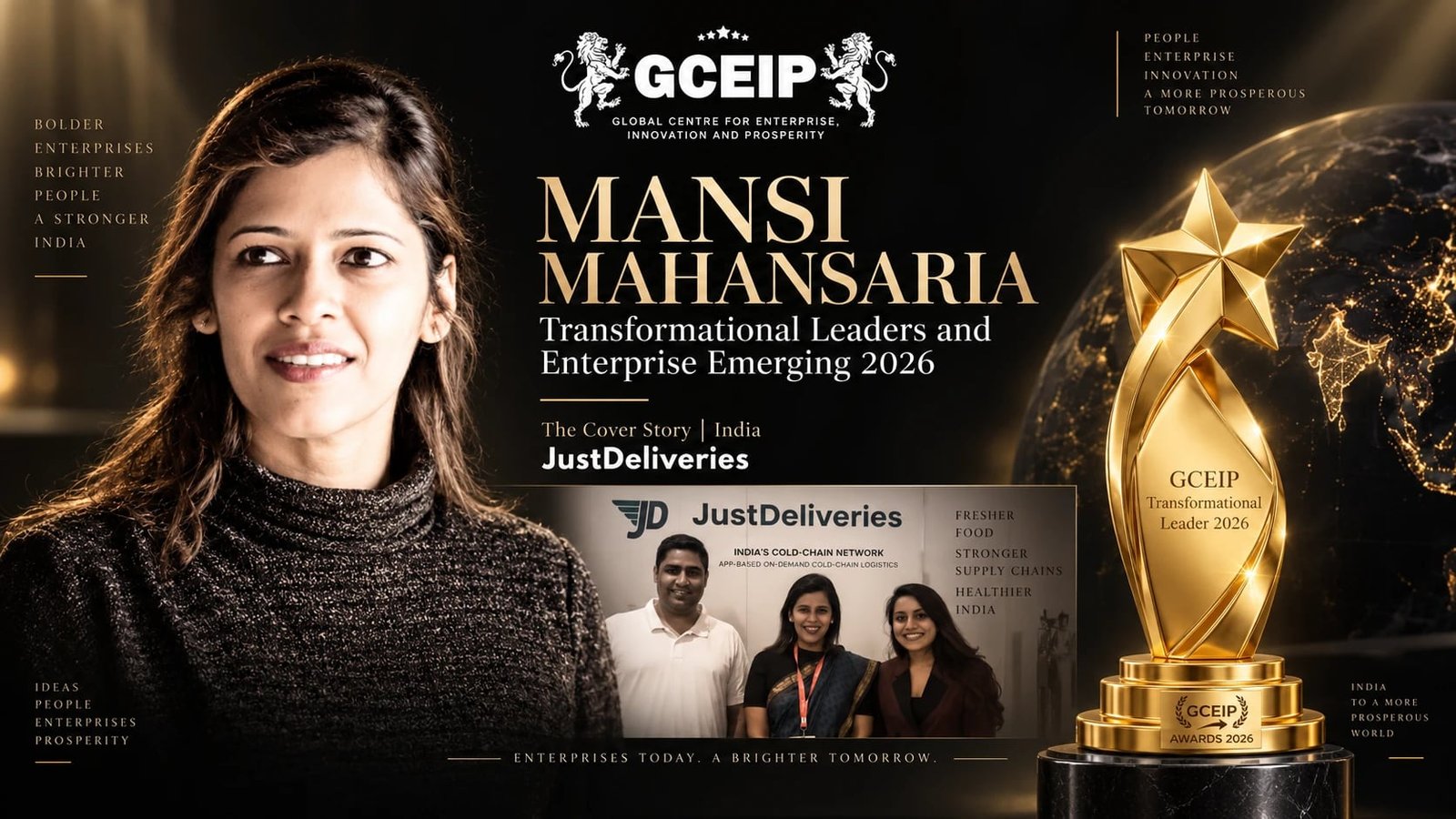
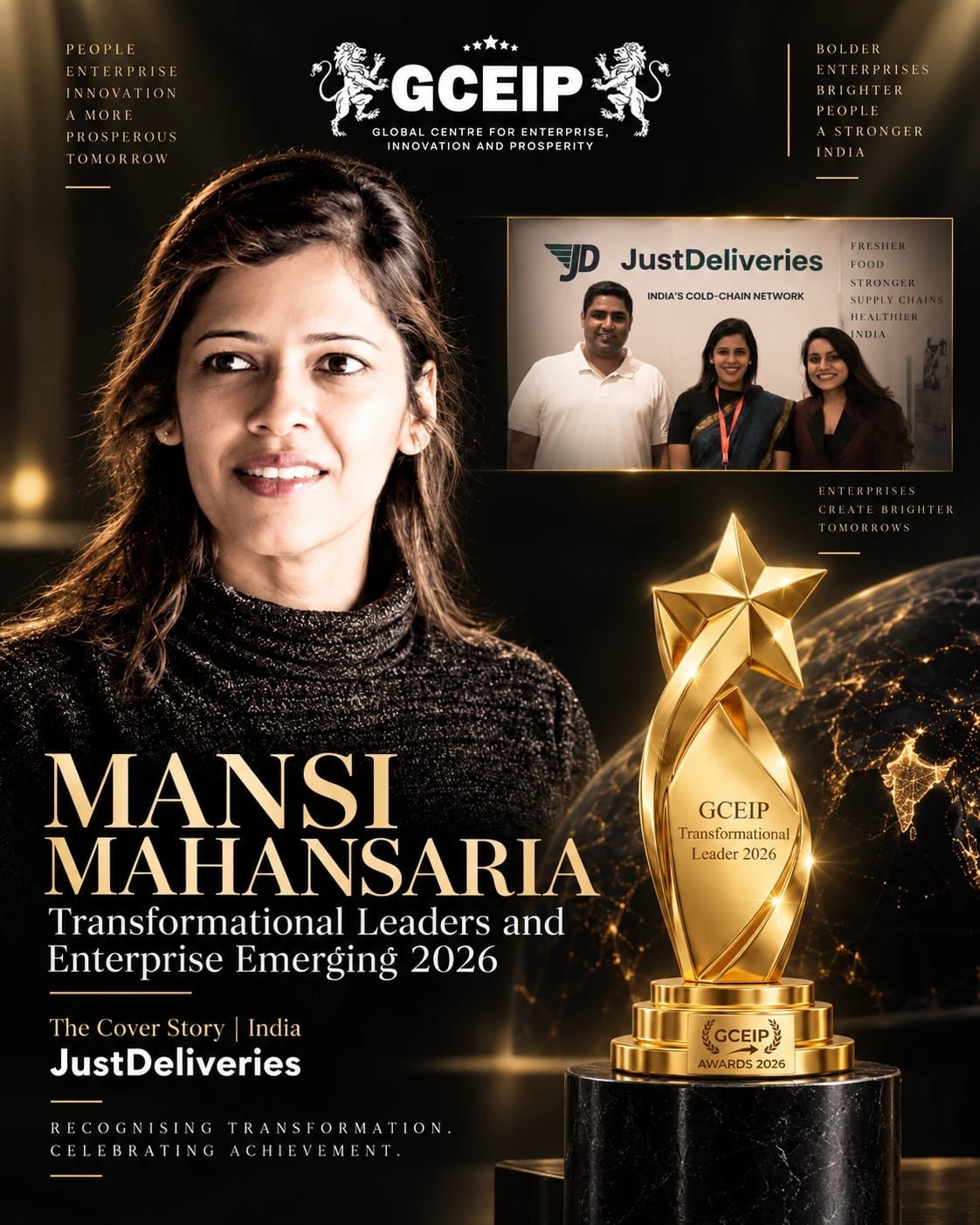
Transformational Leaders and Enterprise Emerging | 2026
Mansi Mahansaria is the founder and CEO of JustDeliveries, an Indian temperature-controlled logistics company for food and beverage businesses.
What does JustDeliveries do?
JustDeliveries provides asset-light, technology-enabled cold-chain logistics for food and beverage businesses in India, including structured business-to-business deliveries, route planning, temperature monitoring and vehicle tracking.
What is JD Instant?
JD Instant is JustDeliveries' app-based, on-demand refrigerated logistics service, combining vehicle booking, live tracking, temperature visibility and digital proof of delivery. Mansi Mahansaria announced that it had completed its first 100 deliveries.
When did JustDeliveries start and how has it been funded?
JustDeliveries emerged in 2018. In May 2025 it announced a ₹5.5 crore funding round co-led by VC Grid and NABVentures.
Featured within GCEIP’s Transformational Leaders & Enterprises™ ecosystem. Explore the leadership story behind the recognition: Transformational Leaders and The Cover Story.
Know a leader or enterprise like this? Nominate them for Transformational Leaders & Enterprises™, in Dubai, Barcelona or London.
From continuous glucose monitoring and smart rings to blood biomarkers, women’s health and real-time biointelligence, Bengaluru-based Ultrahuman is attempting something far more ambitious than building another wearable. It wants to create a computing platform that understands the human body continuously.
From resort-style apartments and private pools to international expansion, branded residences and vertical integration, Imran Farooq has turned SAMANA Developers into one of Dubai’s fastest-rising property businesses — and is now building for a much larger stage.
From strengthening India’s chronic-therapy leadership to integrating major acquisitions and shaping a broader growth agenda, Aman Mehta is emerging as one of the key next-generation leaders in Indian pharmaceuticals.

 Ultrahuman · Health-tech and wearables