For decades, personal computing has become steadily more intimate.
Its strongest proposition may not be "track more". It is: understand yourself better.
The computer moved from the desk to the laptop. Then into the pocket. Then onto the wrist.
Ultrahuman believes the next important step is not simply another screen. It is technology that understands the person wearing it.
That idea has taken the Bengaluru company from continuous glucose monitoring into smart rings, blood testing, environmental sensing and increasingly artificial intelligence.
Its ambition is no longer easy to describe as a wearable business.
Ultrahuman is trying to build what it calls a human-computer interface for health: a connected system capable of understanding sleep, recovery, cardiovascular signals, metabolism, blood biomarkers, reproductive health and the environment surrounding the user — and converting those signals into actions people can understand.
In September 2026, that vision attracted another US$70 million in financing — $65 million in primary equity and $5 million in debt — with participation from Qualcomm Ventures, Labcorp, Alpha Wave, Blume Ventures, Nexus Venture Partners, Alteria Capital and others, at a reported valuation of approximately $365 million, about three times its 2023 valuation.
The funding arrived at a particularly interesting moment.
Ultrahuman has moved beyond being an Indian health-tech startup trying to break into the global wearables market. Its smart-ring products are now used internationally, with the company reporting active ring users across more than 180 countries and over 125 million nights of sleep tracked through its platform.
The next stage is significantly harder.
It must transform a collection of health devices into a coherent global brand — and a coherent intelligence system around the human body.
From Runnr to Understanding Metabolism
Ultrahuman was founded by Mohit Kumar and Vatsal Singhal, entrepreneurs who had previously built food-delivery company Runnr before it was acquired by Zomato in 2017.
Their second company moved into a completely different field. Health.
Kumar has described part of the original inspiration as coming from exposure to athletes using data extensively to understand training, recovery and performance.
The insight was powerful. Elite athletes were making decisions based on physiological information that most ordinary people could not easily access.
Could that level of feedback eventually become available to everyone?
Ultrahuman initially focused heavily on metabolic health. Its M1 continuous glucose-monitoring platform allowed users to understand how food, exercise, sleep and other behaviours affected their glucose responses.
That was a relatively unconventional proposition at the time. Continuous glucose monitors had historically been associated primarily with diabetes management.
Ultrahuman helped popularise the idea that real-time metabolic information could also be useful as a broader wellness and behaviour-change tool.
But glucose was only one signal. And that realisation shaped everything that followed.
The company began building an ecosystem rather than a single product.
The Ring That Changed the Brand
The launch and subsequent evolution of the Ultrahuman Ring transformed the company’s visibility.
A smart ring offered something that many health-conscious consumers wanted: continuous tracking without wearing a screen-heavy smartwatch throughout the day and night.
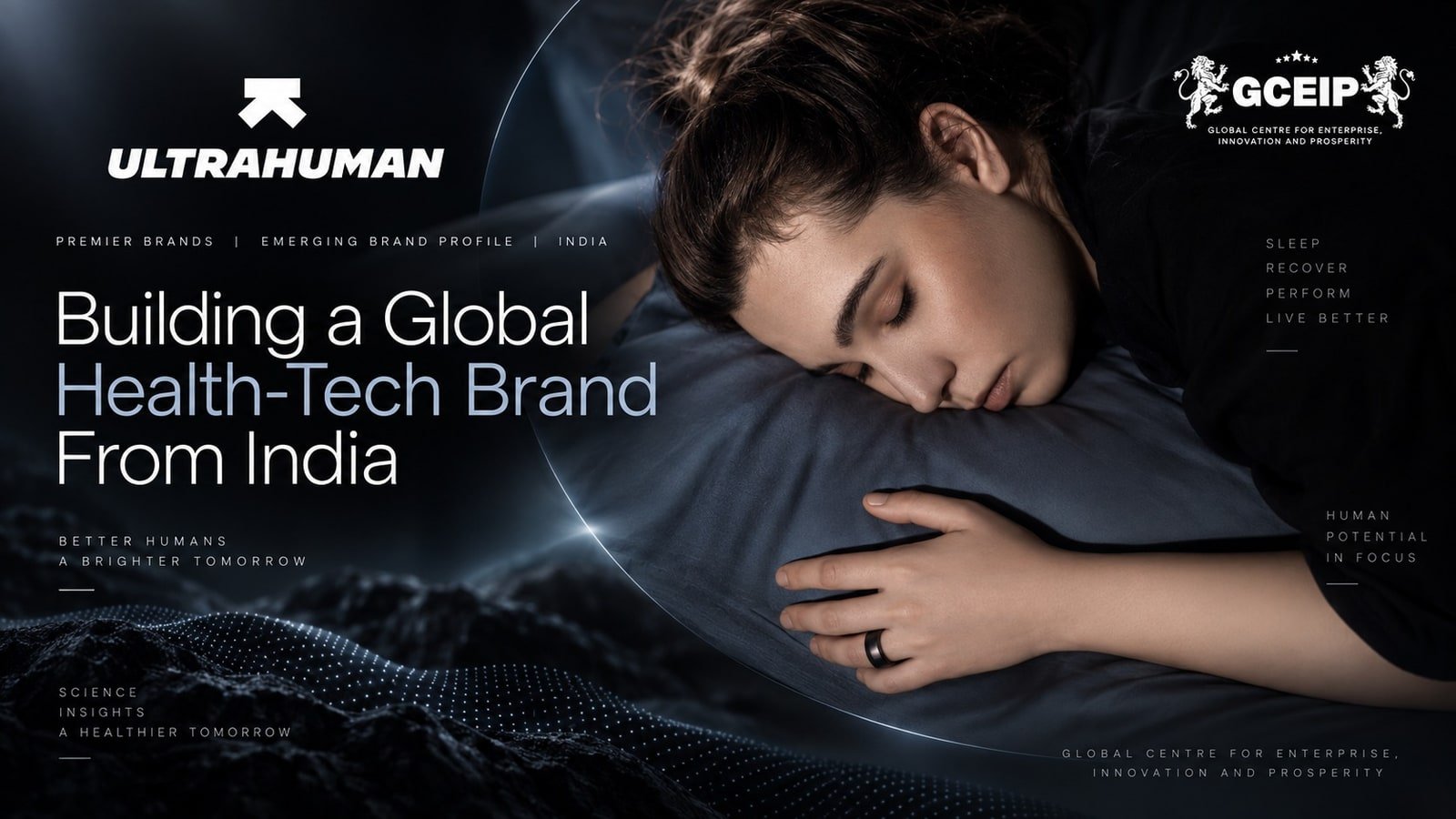
The current Ring AIR weighs as little as approximately 2.4 grams, tracks areas including sleep, recovery, movement and physiological signals, and — crucially for the brand’s competitive positioning — does not require a mandatory recurring subscription for its core experience.
That subscription philosophy matters.
Wearable hardware increasingly comes with software memberships layered on top. Ultrahuman made the absence of mandatory subscription fees part of the value proposition.
The product became both technology and statement: health data should remain useful without forcing the user into another recurring bill.
In February 2026, Ultrahuman pushed further with Ring PRO. The new device was announced with battery life of up to 15 days, substantially more onboard data storage and a charging case extending the overall power proposition.
But hardware specifications were only part of the launch. The more strategically important addition was Jade.
From Tracking Data to Explaining It
The wearable industry has become extremely good at collecting numbers. Heart rate. Steps. Sleep stages. Skin temperature. HRV. Workout load. Recovery scores.
The emerging problem is no longer a shortage of data. It is too much data without enough interpretation.
Ultrahuman’s answer is Jade, its real-time biointelligence system.
Rather than expecting users to interpret multiple charts independently, the idea is to connect signals across the broader Ultrahuman ecosystem and make health information more conversational, contextual and actionable.
A poor night’s sleep may look different when viewed alongside glucose response. Recovery may become more meaningful when compared with blood biomarkers. Cycle data may change the interpretation of temperature and performance signals. Environmental conditions may help explain why sleep quality changed.
This is where Ultrahuman’s strategic direction becomes more interesting than the smart-ring category itself.
The ring is a sensor. The potential long-term product is the intelligence layer sitting above all the sensors.
That is the much larger market Ultrahuman now appears to be pursuing.
Building a Health Stack
The company’s product architecture increasingly resembles a health stack.
At the centre sits the Ring. Around it are multiple complementary data sources.
Blood Vision analyses more than 100 blood markers and is designed to connect biochemical results with ongoing wearable information. Continuous glucose-monitoring products provide another metabolic layer. Ultrahuman Home measures aspects of the user’s environment around sleep and recovery. Women’s-health capabilities have expanded significantly. And the software layer attempts to connect the signals.
The strategic concept is relatively straightforward: no single biomarker explains human health.
A resting heart rate means something. A blood marker means something. A glucose spike means something. Sleep consistency means something.
But when the signals are interpreted together over time, they can potentially provide a far richer picture.
Ultrahuman is betting that longitudinal health context will become much more valuable than isolated measurements.
That is also why the brand increasingly talks about health intelligence rather than simply wearable technology.
Women’s Health Becomes a Serious Product Layer
One of Ultrahuman’s most significant recent expansions has been women’s health.
In August 2025, the company acquired viO HealthTech, the business behind OvuSense fertility technology, allowing it to incorporate more sophisticated cycle and ovulation insights into its wearable platform.
Its Cycle & Ovulation Pro offering uses technology adapted from OvuSense’s clinically developed algorithms — delivering ovulation confirmation with more than 90 per cent accuracy — and is positioned around handling the reality that many women do not have predictable textbook cycles.
That is an important distinction. Traditional period trackers have often relied heavily on calendar-based estimation. Wearable temperature and physiological data can potentially provide a more individualised view of patterns.
Ultrahuman also partnered with Clue, one of the better-known women’s-health platforms, to integrate cycle information more deeply with wearable biomarkers.
The broader strategy is notable. Rather than treating women’s health as another feature buried inside a fitness app, the company is increasingly building it as a distinct product capability.
For a global health brand, this matters enormously. Women’s physiology cannot simply be treated as a variation of male physiology. Brands that understand that distinction may develop substantially more useful health products.
Science as Brand Infrastructure
Consumer wellness is a difficult market because the boundary between useful insight and exaggerated health claims can become dangerously thin.
Ultrahuman appears increasingly aware that credibility has to come from more than marketing.
The company is investing heavily in research and scientific validation around the signals its products generate. Its public science programme includes work around sleep, cardiovascular health, metabolism and other physiological areas.
In July 2026, peer-reviewed research connected with Ultrahuman and published in Frontiers in Digital Health examined cardiovascular-fitness-age modelling across 442 adults. The company has also highlighted research with academic institutions around sleep consistency and metabolic health.
The importance of this activity extends beyond individual studies.
As wearable technology becomes more sophisticated, brands will increasingly compete on scientific credibility. Beautiful hardware can attract customers. Reliable interpretation keeps them. And in health technology, trust is much harder to regain once lost.
For Ultrahuman, science therefore has to become part of the brand itself. Not decoration around the product. Infrastructure underneath it.
Building Globally From Bengaluru
Perhaps one of the most significant dimensions of Ultrahuman is geographic.
India has produced globally important software and technology-services businesses for decades. Global consumer hardware brands remain far less common.
Ultrahuman is attempting to change that.
The company designs and develops sophisticated wearable hardware while building software, algorithms and health services around it. It has expanded manufacturing capacity internationally, including in the United States, while retaining Bengaluru as its core organisational base.
That model creates a different kind of India-to-world technology company. Not outsourcing. Not SaaS alone. Not a domestic consumer app. A global hardware-and-health platform originating in India.
The challenge is considerable. Hardware has inventory risk. Supply chains are complicated. Margins can be pressured. Product cycles are relentless. Regulatory environments differ by country. And the wearables category includes some of the most powerful technology companies in the world.
Yet those difficulties also create defensibility.
Building good hardware is harder than launching another software interface. Building hardware and credible health intelligence together is harder still.
Competing in the Smart-Ring Race
The smart-ring market is becoming much more competitive.
Oura remains the category’s most established global name. Samsung entered the space. Other wearable makers continue experimenting with new formats.
Ultrahuman therefore cannot depend on novelty.
Its differentiation increasingly comes from several interconnected choices: no mandatory subscription for core Ring functionality, a broader health ecosystem rather than a standalone ring, strong emphasis on metabolic health, blood-marker integration, women’s-health capabilities, AI interpretation through Jade, and increasingly ambitious hardware.
Ring PRO signals that Ultrahuman does not intend simply to compete as the affordable challenger.
It wants to compete on capability.
That is a much more difficult strategic position — but potentially a more valuable one. A premium health brand cannot win forever by being cheaper. Eventually it has to be better at something meaningful.
The $70 Million Signal
The September 2026 financing provides an important indication of how investors now see the business.
Qualcomm Ventures brings obvious relevance to the future of wearable computing — the company is working with Ultrahuman to develop a new ring built on Qualcomm silicon, allowing more software and algorithms to run directly on the device. Labcorp brings deep healthcare and diagnostics exposure. Existing technology investors provide continuity.
The company says the capital will be used to accelerate its health-intelligence platform and build the next generation of human-computer interfaces around physiological data.
Valuation itself is not the story. The shift in strategic language is.
A few years ago, Ultrahuman could reasonably have been described as a metabolic-fitness startup. Then a smart-ring company.
Now it is describing itself as something much broader: a computing company organised around the human body.
Whether it can justify that ambition is the defining question of the next stage.
Pulsomics and the Attempt to Understand the Pulse
The company’s September 2026 launch of Pulsomics illustrates just how far it intends to push.
Ultrahuman describes Pulsomics as a foundational model of the human pulse — an opt-in research platform embedded directly into the Ultrahuman experience, letting Ring users take part in large-scale studies using real-world longitudinal data rather than small controlled laboratory cohorts.
The concept reflects a wider trend in AI. Instead of merely applying general-purpose models to health data, specialised models can be trained around physiological signals themselves.
If increasingly sophisticated models can recognise patterns in the pulse, sleep, blood data, movement and metabolism simultaneously, wearable systems may begin identifying relationships that conventional dashboards miss.
That remains an evolving field. But strategically, the direction is clear.
Ultrahuman wants the health wearable to move from measurement, to interpretation, to prediction, to intervention.
That sequence could define the next generation of consumer health technology.
Building a Brand Around Human Curiosity
Technology alone does not explain Ultrahuman’s growth.
The brand has tapped into a wider cultural change. Consumers increasingly want to understand themselves.
Why am I tired? Why did I sleep badly? Why did this meal make me feel different? Am I recovering properly? Is my training helping? How is stress affecting me? What do my blood results actually mean?
Traditional healthcare often answers these questions only periodically. Wearables offer something psychologically powerful: continuous feedback.
Ultrahuman’s brand sits directly inside that curiosity.
Its strongest proposition may therefore not be “track more”. It is: understand yourself better.
That is a significantly more durable brand territory. Devices will change. Sensors will improve. The form factor may eventually move beyond rings.
But the human desire to understand the body is unlikely to disappear.
Governance, Privacy and the Responsibility of Health Data
As Ultrahuman expands, its responsibilities increase substantially.
Health data is among the most sensitive information a company can hold. Sleep patterns. Heart data. Blood biomarkers. Glucose responses. Reproductive information.
The richer the ecosystem becomes, the greater the obligation to protect it.
Ultrahuman states that its systems operate with frameworks including ISO 27001, GDPR and HIPAA compliance. That infrastructure will become increasingly important as the company enters more sophisticated forms of interpretation.
There is also a broader responsibility around medical boundaries. Consumer wellness tools can provide useful information, but they must not become substitutes for qualified medical diagnosis where diagnosis is required.
Ultrahuman itself includes wellness disclaimers around products such as reproductive-health features.
Maintaining that discipline will be vital. The company’s long-term brand equity depends on being seen as technologically ambitious without becoming medically reckless.
Why Ultrahuman Is a Brand to Watch
Ultrahuman is not a formal Premier Brands Asia 2026 nominee. It is featured here within GCEIP’s Premier Brands editorial franchise because its trajectory captures several qualities increasingly associated with the next generation of Asian brands.
Market growth. From Bengaluru, Ultrahuman has built an international health-tech business with users spread across more than 180 countries and a rapidly expanding product portfolio. The September 2026 funding round provides additional capital for global expansion and deeper product development.
Brand strength. Ultrahuman has created an identity that extends beyond individual hardware. Its positioning around metabolic health, recovery, performance and body intelligence gives the company a more coherent territory than simply “smart wearables”.
Innovation. Continuous glucose data, smart rings, blood biomarkers, environmental sensing, women’s-health algorithms, Jade and Pulsomics point toward a company trying to integrate multiple physiological systems rather than optimise one metric.
Trust and responsibility. Its future depends heavily on scientific credibility, privacy protection, regulatory discipline and responsible communication around health. The company is increasingly investing in all four.
Global relevance. Perhaps most importantly, Ultrahuman is attempting to build a globally relevant consumer health-hardware brand from India. That alone makes the company strategically interesting.
Premier Brands View
Ultrahuman’s most important product may eventually not be the Ring.
It may be the model of the person wearing it.
That is where the company’s ambition becomes compelling. Hardware can measure. Software can organise. Artificial intelligence can begin to connect.
The real opportunity is to create a system that understands enough about an individual’s physiology to make health information genuinely useful in everyday life.
Ultrahuman is still early in that journey. It competes with much larger companies. It operates in a field where scientific credibility matters enormously. And the closer consumer technology moves toward healthcare, the greater the responsibility that comes with every insight.
But the company has already crossed an important threshold. It has demonstrated that a sophisticated global wearable brand can be built from India.
The next challenge is significantly bigger: to prove that India can also build one of the world’s most important platforms for personal health intelligence.
If Ultrahuman succeeds, its story will not simply be about smart rings. It will be about a new category of computing — one in which technology finally begins to understand the person using it.
Know a brand or leader like this? Nominate them for Emerging Premier Brand, Asian Premier Brands and Leaders 2026. Entries close 16 October 2026.
Nominate


 Imran Farooq · SAMANA Developers