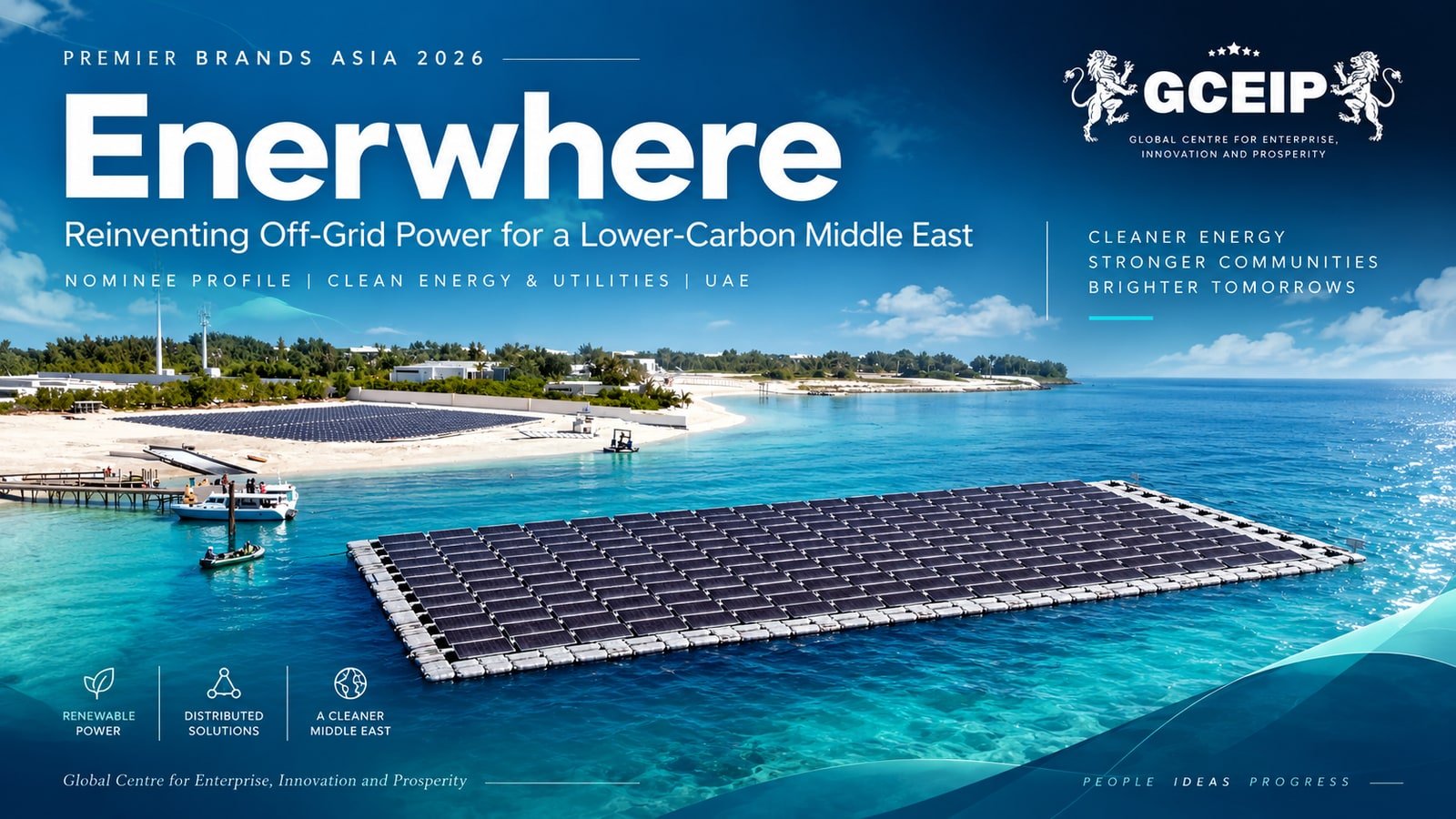
Enerwhere: Reinventing Off-Grid Power for a Lower-Carbon Middle East
From desert construction sites and quarries to islands, industrial facilities and oilfield operations, Enerwhere has built its reputation by taking renewable energy where conventional grids often cannot go — combining solar, storage, intelligent controls and flexible power systems to reduce diesel dependence without sacrificing reliability.
EnerwhereClean energy and utilities · United Arab Emirates · B2B
GCEIP Editorial Desk ·
Editorial. Published by the GCEIP editorial desk under our editorial policy. An editorial story does not make its subject an award recipient.
The energy transition is often discussed through giant solar parks, national grids and utility-scale infrastructure.
Enerwhere was not selling sustainability in place of reliability. It was selling sustainability through better reliability, efficiency and control.
Enerwhere operates in a more difficult part of the problem.
Its customers are often located where the grid is weak, temporary, unstable or completely absent. Construction sites. Mines. Islands. Oil and gas installations. Remote industrial facilities. Resorts. Camps.
These are environments where power is not optional. It has to be reliable.
Historically, diesel generators solved that problem. They were familiar, transportable and easy to deploy. But diesel carries a large operating burden: fuel cost, transport, storage, maintenance, emissions, exposure to price volatility and the operational complexity of keeping generators running around the clock.
Enerwhere was built around a different idea.
What if renewable energy could be delivered with the same flexibility as temporary power? What if solar could move with the customer? What if batteries, software and generators could work together intelligently rather than independently? And what if industrial customers could reduce fuel consumption and emissions without taking on the full capital burden of building a power plant themselves?
That is the space Enerwhere has spent more than a decade developing.
Founded in Dubai in 2012, the company describes its mission as the decarbonisation and digitalisation of the off-grid power sector.
That may sound specialised. In reality, it addresses one of the most practical challenges in the energy transition: how to make cleaner power work in places where reliability cannot be compromised.
From Diesel Dependence to Distributed Energy
Enerwhere was founded by Daniel Zywietz, now the company’s Founder and Chairman.
The original opportunity was clear. Across the Middle East and Africa, large numbers of commercial and industrial operations relied on diesel-powered mini-grids because grid infrastructure was unavailable or unsuitable.
The environmental case for replacing diesel was obvious. The commercial case was more complicated.
Solar energy is cheap once installed, but temporary and remote sites require systems that can be moved, resized, financed and managed under difficult operating conditions. A conventional rooftop solar installation was not enough.
Enerwhere therefore developed around solar-hybrid microgrids.
Rather than attempting to remove generators completely, its systems combine solar generation with diesel, battery storage where appropriate, and proprietary energy-management technology.
The solar system supplies renewable power when available. Generators provide backup and firm capacity. Software continuously monitors demand, generation and reserve requirements, adjusting the system in real time.
This hybrid approach allowed Enerwhere to attack diesel consumption without forcing customers to accept additional operational risk.
That distinction was fundamental to the brand.
Enerwhere was not selling sustainability in place of reliability. It was selling sustainability through better reliability, efficiency and control.
Building the Proposition
Enerwhere’s proposition is based on flexibility.
Its systems can be deployed from approximately 25 kW to 10 MW, allowing the company to support relatively small operations as well as much larger industrial loads.
They are also designed to be modular and transportable. That matters in markets such as construction, mining and oil and gas, where demand can change over time and operations may move geographically.
Enerwhere also offers systems under long-term power-purchase-agreement structures, with financing periods ranging from roughly two to twenty years.
That changes the buying decision.
Instead of asking an industrial customer to become a renewable-energy investor, Enerwhere can effectively sell energy as a service. The customer pays for power. Enerwhere finances, operates and maintains the energy infrastructure.
That model removes one of the biggest barriers to clean-energy adoption in industrial markets: upfront capital.
The company’s own operating logic can be reduced to three outcomes: reduce emissions, lower cost and maintain or improve reliability.
Those are practical outcomes. And that practicality may be one of the biggest reasons Enerwhere has been able to build credibility across difficult industrial environments.
Market Leadership and Growth
Enerwhere occupies a distinctive niche in the regional energy market.
It is not competing directly with large national utilities. Nor is it simply a solar installer. Its position is closer to that of a distributed utility serving customers that sit outside the traditional grid model.
The company is headquartered in Dubai and also operates from Abu Dhabi, serving commercial and industrial customers across the Middle East and Africa. Its portfolio includes applications in construction, mining, islands, industrial sites and the oil-and-gas sector.
One of the company’s most visible projects has been its solar-hybrid work in quarrying.
Under a long-term agreement with Al Barrak Crushers, Enerwhere finances, operates and maintains a solar-hybrid microgrid of approximately 4.1 MVA at a quarry in Fujairah, powering crushing machinery along with the workshop and offices, and cutting the operation’s carbon footprint by more than 30 per cent.
The company has also deployed systems on island resorts and large construction sites, demonstrating that its technology can support everything from hospitality loads to cranes, pumps and industrial machinery.
Introducing solar into a conventional diesel microgrid typically saves between 20 and 50 per cent of fuel consumption, and Enerwhere has said that with battery storage added, that figure can rise considerably further.
The exact percentage is less important than the strategic signal.
The company is solving a problem that remains widespread. Across the Gulf, Africa and other emerging markets, remote and temporary commercial operations still depend heavily on diesel.
That creates a large addressable market for companies capable of delivering cleaner power without disrupting operations. Enerwhere has spent years building exactly that capability.
Brand Strength and Trust
The Enerwhere brand is built less on consumer familiarity and more on operational trust. That is appropriate for its market.
Its customers are not buying a lifestyle product. They are handing over responsibility for an essential utility.
If a power system fails, construction can stop. Industrial production can fall. Mining operations can be disrupted. Oilfield activity can be interrupted.
Trust is therefore tied directly to uptime, engineering competence and the ability to operate in difficult environments.
Enerwhere has deliberately positioned its systems as rugged, modular, scalable and transportable, designed for conditions ranging from desert heat and dust to coastal humidity and salt exposure.
That physical robustness matters. But so does the company’s business model.
Because Enerwhere can finance and operate the system itself, its interests are aligned with the customer’s. A badly performing plant does not simply damage the customer. It damages Enerwhere’s own economics.
That alignment can strengthen trust in a way that a one-time equipment sale cannot.
The brand also benefits from longevity. More than a decade of operating in a difficult technical niche provides a degree of credibility that is hard to manufacture quickly.
Innovation: Making Renewable Energy Mobile
Enerwhere’s most important innovation is not solar power itself.
It is the adaptation of renewable energy to markets that were traditionally considered too temporary, mobile or operationally complex for solar.
Conventional solar development assumes permanence. Enerwhere built around mobility.
Its systems can be modularised and redeployed as demand changes. The company has also developed ultra-mobile solar formats that can be energised rapidly in remote environments without requiring the same level of heavy installation infrastructure as conventional projects.
That matters in sectors where operational geography is constantly changing.
The company’s second major area of innovation is software.
Enerwhere’s proprietary monitoring and control system provides real-time monitoring of site power requirements and optimises solar penetration by controlling the solar system, the generators and the loads together.
This allows the company to maximise renewable-energy penetration without compromising stability.
In energy systems, intelligence increasingly matters as much as generation. Solar panels are becoming commoditised. The differentiator is often how effectively the system manages energy.
Enerwhere’s strategy reflects that shift. Its brand sits at the intersection of renewable generation, energy storage, control software and industrial operations.
The company has also been adding battery storage to increase the solar share, storing daytime generation for use at night. That matters because as batteries become cheaper and more capable, the amount of diesel required in off-grid systems can fall further.
Governance and Responsibility
Enerwhere’s business model is closely aligned with environmental impact.
Its commercial proposition is built around reducing diesel use. That makes carbon reduction part of the revenue model rather than a separate corporate-responsibility initiative.
The company also operates in a sector where safety, reliability and technical governance are fundamental. Microgrids serving mines, industrial facilities and oil-and-gas operations must meet demanding operational standards, and remaining active in those markets depends on disciplined engineering and operating processes.
Leadership has also evolved.
In July 2023, Alice Cowman became Chief Executive Officer, separating the roles of chairman and chief executive, which Daniel Zywietz had held together since founding the company. Cowman had served as the company’s Chief Financial Officer and had been in senior roles there since 2017, bringing close to two decades in distributed energy and renewable-energy finance.
Her appointment also marked an important leadership milestone in a sector traditionally dominated by men.
Enerwhere’s team reflects the international nature of the Gulf economy, with employees from a wide range of nationalities and technical backgrounds. That matters in a business where solving difficult engineering problems requires multidisciplinary teams rather than a single technology.
Influence and Impact
Enerwhere’s broader influence lies in helping prove that the energy transition does not have to begin at the national grid. It can begin at individual industrial sites.
That is important.
Energy-transition discussions often focus on what governments and utilities need to do. Enerwhere shows how companies can decarbonise operationally, one site at a time.
A quarry can use less diesel. A construction project can run on a hybrid microgrid. A resort island can reduce fossil-fuel dependence. A remote industrial facility can introduce storage and renewable power.
Each individual project may be smaller than a utility-scale solar park. Collectively, however, distributed systems can have substantial impact.
Enerwhere is also relevant because its model addresses emerging-market realities. Many regions in Asia, Africa and the Middle East are still dealing with unreliable grids, rapid industrial growth and high demand for temporary power.
Waiting for grid infrastructure to catch up can take years. Distributed energy provides another route, allowing businesses to improve resilience and reduce emissions directly.
That makes Enerwhere not only a clean-energy company. It makes it part of a broader shift toward decentralised infrastructure.
The future energy system may not be defined by one central grid alone. It may be a network of grids, microgrids, batteries, generators, solar assets and intelligent software. Enerwhere has been building toward that world for years.
Why Enerwhere Is Nominated for Premier Brands Asia 2026
Enerwhere’s nomination reflects a business model that combines commercial relevance with environmental transformation.
Market leadership and growth. Enerwhere has built a specialised regional position in distributed solar-hybrid power for commercial and industrial customers operating beyond conventional grids. Its ability to deploy across construction, mining, hospitality and oil and gas demonstrates both technical versatility and addressable-market depth.
Brand strength and trust. In a market where reliability is non-negotiable, the company has built credibility through operating experience, long-term customer relationships and an energy-as-a-service model that aligns its performance directly with the customer’s outcome. Its brand promise is grounded in execution rather than advertising.
Innovation. Enerwhere has been an early mover in adapting renewable energy to mobile, temporary and industrial environments. Its transportable solar systems, hybrid microgrids, proprietary controls, real-time optimisation and growing use of battery technology represent practical innovation aimed at solving difficult operating problems.
Governance and responsibility. Decarbonisation is embedded directly into the commercial model. Every reduction in diesel use can translate into lower emissions and lower operational cost.
Influence and impact. Enerwhere is helping demonstrate that energy transition does not depend solely on large-scale grid projects. Distributed microgrids can reduce emissions immediately in industries that are difficult to electrify conventionally — an idea with relevance well beyond the UAE.
The nomination recognises the relevance of the brand’s journey and impact within its category. It does not represent a ranking, shortlist position or final award outcome.
Premier Brands View
Enerwhere’s most interesting achievement is not that it brought solar energy to remote industrial sites.
It is that it made renewable energy operationally credible in places where reliability matters more than ideology.
That distinction is important. Industrial customers will not adopt clean energy simply because it is cleaner. They adopt it when it is also cheaper, more reliable, easier to manage or strategically advantageous.
Enerwhere has built its business around making those conditions possible.
The next phase could be even more significant. Battery storage is improving. Energy-management software is becoming more intelligent. Industrial companies are under increasing pressure to reduce emissions. And distributed power is becoming a more important part of resilience planning.
Enerwhere sits directly at the intersection of those trends.
If it continues to scale while maintaining engineering discipline, the company could become one of the region’s most important examples of how commercial innovation can accelerate practical decarbonisation.
That is what makes Enerwhere more than a renewable-energy provider. It is helping redefine what reliable power can look like in the places the grid does not reach.
If this story is about you or your company, you are welcome to link to it. Copy either snippet below into your website, press page, email signature or post.
Where this story fits
Featured within GCEIP’s Transformational Leaders & Enterprises™ ecosystem.
Know a leader or enterprise like this? Nominate them for Transformational Leaders & Enterprises™, in Barcelona or London. Nominations for Dubai are closed.
Yalla Group · Digital social networking and gaming
From voice-led social networking and culturally resonant gaming to a growing ecosystem of digital entertainment, Yalla Group has built one of the Middle East’s most distinctive technology brands by proving that global-scale digital products can succeed when they begin with local behaviour, language and identity.
From continuous glucose monitoring and smart rings to blood biomarkers, women’s health and real-time biointelligence, Bengaluru-based Ultrahuman is attempting something far more ambitious than building another wearable. It wants to create a computing platform that understands the human body continuously.
Founded in Singapore in 2014, ShopBack spent a decade turning a browser cashback habit into Asia-Pacific’s largest rewards network, reaching unicorn status in 2026 on the back of quiet profitability. Its next move is harder: standing at the actual point of sale, not just after it.
Cred built its business on a contrarian idea — reward India’s most creditworthy consumers, not the underbanked majority. In 2026, that bet drew a $900 million investment from Meta, a $4.5 billion valuation, and sent its founder to run WhatsApp worldwide.


 Yalla Group · Digital social networking and gaming