Yalla Group: Building a Digital Social World Around MENA Culture
From voice-led social networking and culturally resonant gaming to a growing ecosystem of digital entertainment, Yalla Group has built one of the Middle East’s most distinctive technology brands by proving that global-scale digital products can succeed when they begin with local behaviour, language and identity.
Yalla GroupDigital social networking and gaming · United Arab Emirates · B2C
GCEIP Editorial Desk ·
Editorial. Published by the GCEIP editorial desk under our editorial policy. An editorial story does not make its subject an award recipient.
For much of the internet era, the Middle East has been an enthusiastic consumer of digital platforms created somewhere else.
The internet does not have to make every market look the same. Digital scale and cultural specificity can coexist.
Social networks, messaging applications, streaming services and games typically arrived after being designed around audiences in North America, Europe or East Asia.
Yalla Group approached the market differently.
Rather than asking how a global product could be adapted for MENA, the Dubai-headquartered technology company began by asking how people across the region already communicated, socialised and entertained themselves.
That distinction became the foundation of the brand.
Yalla’s flagship social platform was built around voice conversation — a format particularly well suited to the informal, community-oriented style of interaction familiar across Arab culture. Its digital rooms offered something closer to the atmosphere of a majlis or gathering place than a conventional broadcast-led social network.
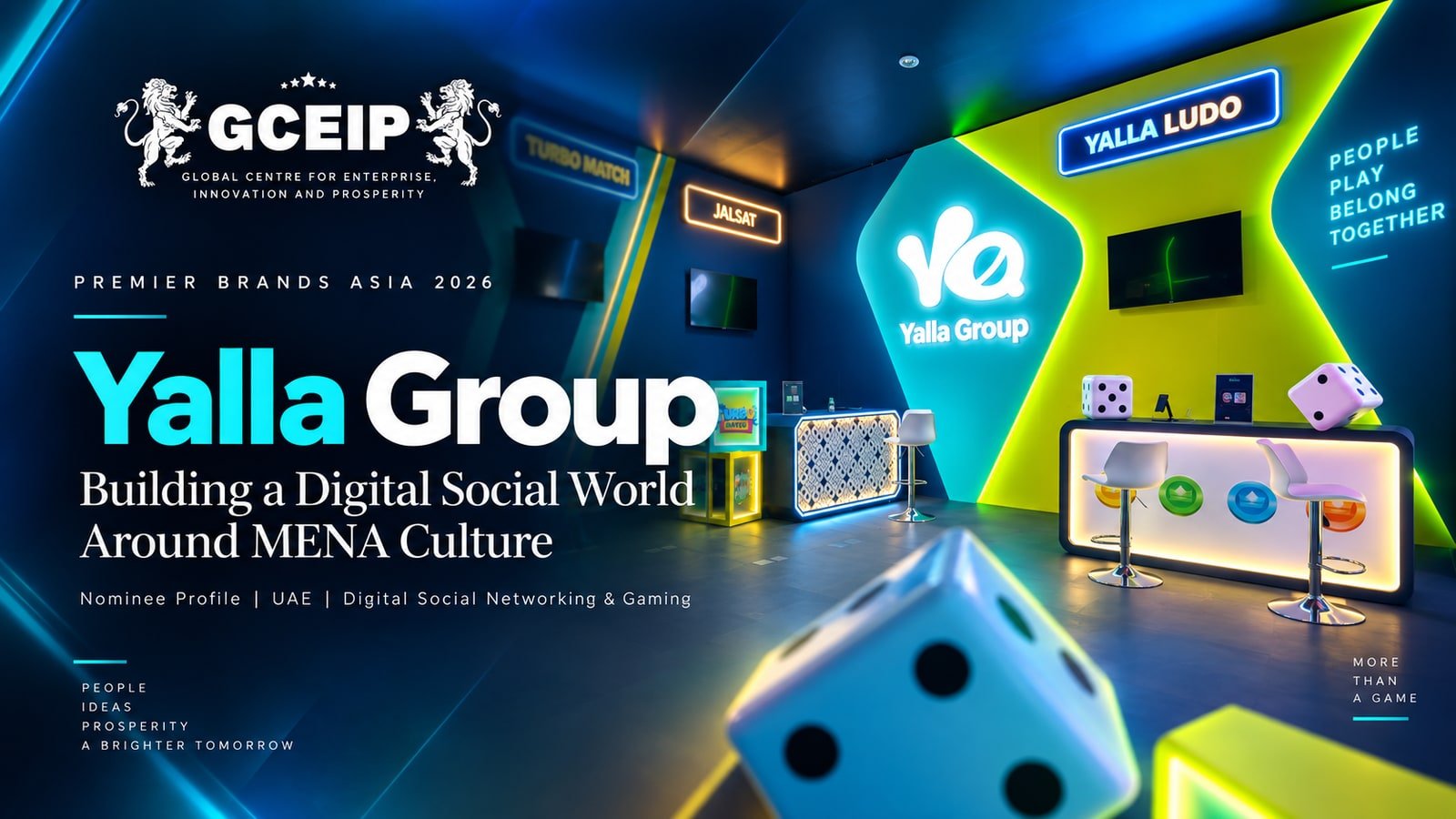
Yalla Ludo extended the same philosophy into gaming. The game itself was familiar, but voice interaction and a localised majlis function transformed it into something more social.
Over time, that formula — technology shaped around culture rather than culture forced around technology — helped Yalla build substantial regional scale.
Today, Yalla Group is listed on the New York Stock Exchange and describes itself as the largest MENA-based online social networking and gaming company. Its core applications reached approximately 47.6 million average monthly active users in the second quarter of 2026.
The larger significance lies in what Yalla represents.
It is evidence that the Middle East does not have to remain simply a destination for global technology. It can create digital products of its own.
The Insight Behind the Brand
Yalla’s early opportunity was not based on inventing social interaction. The opportunity was to understand it more deeply.
Voice was central to that thinking.
Many social platforms are structured around images, video, public profiles and follower counts. Yalla created a more conversational environment in which users could move between rooms, listen, speak and form relationships through audio.
That had several advantages. Voice feels immediate but does not require the constant visual performance associated with video. It allows people to participate more casually. It can also create a greater sense of presence than text alone.
Most importantly, the format felt culturally intuitive.
Yalla then carried that thinking into gaming.
Rather than seeing games solely as isolated entertainment products, it treated them as social environments. Yalla Ludo combined a widely recognised board game with voice-chat functionality. Users were not merely competing. They were gathering.
That concept became increasingly important as the Group expanded.
Products such as Yalla Baloot, built around a card game deeply familiar in Saudi Arabia and the Gulf, and 101 Okey Yalla, reflecting a game popular in Turkey and surrounding markets, reinforced the company’s localisation-first strategy.
This was not localisation as translation. It was localisation at the product level.
Community Before Content
The strongest technology brands often have a simple behavioural reason for users to return. For Yalla, that reason is community.
The company has built its proposition around environments in which people interact rather than merely consume.
That difference matters because digital communities can create their own network effects.
A new user may arrive because of the game. They stay because of the people. A social-room participant may initially be attracted by conversation. They return because the room becomes familiar.
This gives Yalla a brand characteristic that is difficult to reproduce with marketing spend alone. Habit becomes connected to belonging.
The company has also expanded beyond its two flagship products into a wider portfolio that includes social applications and casual games aimed at specific audiences. Some products remain primarily MENA-focused, while others have allowed Yalla to experiment with markets outside the region.
The strategy suggests that Yalla increasingly sees itself not as the owner of two successful applications, but as a digital entertainment company capable of building multiple communities.
That is an important evolution. A single hit product creates revenue. A repeatable product-development system creates long-term enterprise value.
Market Leadership and Growth
Yalla’s latest operating numbers illustrate both the scale of its established business and the changing shape of its revenue base.
For the second quarter of 2026, the company reported US$82.6 million in revenue. Chatting services generated approximately US$47.4 million, while games contributed roughly US$34.2 million.
Gaming revenue increased by 11.6 per cent compared with the same period a year earlier, lifting gaming to more than 41 per cent of quarterly revenue.
This growing contribution matters strategically. Yalla originally became known primarily through social networking. Gaming is giving the company a second major growth engine — and it grew in a quarter when the group’s overall revenue and net income softened year on year, as regional geopolitical disruption weighed on paying users.
Average monthly active users across the company’s principal applications increased approximately 12.3 per cent year-on-year to 47.6 million during the quarter.
The company also remained substantially profitable, reporting approximately US$29.3 million in quarterly net income, a net margin of 35.5 per cent.
This combination — large audience, meaningful monetisation and profitability — is important in consumer technology. Digital scale can often be expensive. Yalla has demonstrated that culturally focused platforms can also build strong economics.
Its balance sheet provides another advantage. The company has maintained substantial cash resources, giving management the flexibility to invest in product development, new gaming titles, user acquisition, artificial intelligence and international opportunities without depending entirely on external funding.
The strategic question has therefore changed. Yalla has already demonstrated that its flagship platforms can succeed. The next question is whether it can repeatedly create new products with the same cultural insight.
Brand Strength and Trust
Trust in a digital platform is built differently from trust in a physical consumer brand. Users rarely see factories or supply chains. They experience the brand through interfaces, conversations, moderation, communities and the quality of interaction.
Yalla’s strength comes partly from familiarity. Its products often feel culturally recognisable before a new user has fully learned the application.
That familiarity lowers psychological friction. A card game that has existed in a community for generations does not need its relevance explained. A conversational environment resembling a digital gathering place does not require users to adopt entirely foreign behaviour.
At the same time, its longevity provides another layer of confidence. Digital entertainment is highly competitive, and consumer tastes move quickly. Yalla has maintained meaningful user communities over multiple years while broadening its platform portfolio.
Its listing on the New York Stock Exchange since 2020 has also pushed the business into a more visible institutional framework, requiring regular financial reporting and exposing it to international investors.
For a brand originating in MENA’s consumer internet economy, that visibility has significance. It demonstrates that a regionally built digital company can move from startup growth into the governance and disclosure environment of global capital markets.
Innovation: When Localisation Becomes Product Architecture
Yalla’s most significant innovation may be difficult to represent in a patent or technical specification. It is cultural product design.
Many technology companies treat localisation as a late-stage process. First build the product. Then translate it. Then market it locally.
Yalla’s model is closer to the reverse. Start with the audience. Understand the behaviour. Then build the digital experience around it.
Yalla’s voice-room concept is one example. Yalla Baloot is another. Rather than asking Gulf consumers to adopt an internationally fashionable game, the company created a digital environment around a game already embedded in regional culture.
That approach can produce stronger engagement because users do not have to learn why the activity matters. They already know.
Increasingly, however, Yalla’s innovation agenda is becoming more technically ambitious.
Management has been expanding internally developed gaming projects across casual, hyper-casual and more sophisticated game categories. Its self-developed match-three title, Turbo Match, was featured by Apple’s App Store across MENA markets including Saudi Arabia in mid-2026 and is being prepared for wider commercialisation in the United States and Europe, while a desert-themed strategy game is being readied for a major content update.
This represents a significant strategic transition. Yalla is moving from localising familiar digital experiences toward developing more proprietary entertainment intellectual property.
Artificial intelligence is also entering the roadmap. The company has indicated that its development pipeline includes AI applications designed to strengthen the relationship between its gaming and social ecosystems, and has been deepening AI use across daily operations.
Gaming: The Next Strategic Frontier
Gaming may ultimately become one of the most consequential parts of Yalla’s future.
The Middle East is rapidly becoming a global gaming market. Saudi Arabia has placed gaming and esports within its broader economic-diversification strategy. The UAE continues investing in digital entertainment, technology and creative industries. Across the wider region, young populations and high smartphone adoption have created a substantial audience.
Yalla is positioned directly inside that expansion, and its gaming portfolio already benefits from existing user communities.
That creates an important strategic advantage. Customer acquisition is one of the largest costs in consumer gaming. A company with an established social audience has opportunities to introduce users to additional entertainment products within its own ecosystem.
Yalla has also increased its involvement in regional esports, serving as official event partner of Saudi eLeague 2026 and presenting partner of Yalla Saudi eLeague Women 2026.
The significance goes beyond tournament visibility. Gaming is increasingly becoming a convergence point for entertainment, social interaction, creators, commerce, intellectual property and media.
Yalla’s history in both social networking and games gives it a potentially valuable position at that intersection.
The strongest version of the future Yalla may therefore not be defined as a social-networking company or a gaming company. It may become a MENA-originated social entertainment platform.
Governance and Responsibility
Scale creates responsibility. For digital platforms, that responsibility covers information security, privacy, community moderation, governance, employee development and environmental impact.
Yalla has progressively expanded its public ESG framework.
Its 2025 Environmental, Social and Governance Report, released in April 2026, organised the company’s sustainability agenda around five principal pillars: responsible governance, environmental stewardship, trust, people and community engagement.
The company reported expanded use of renewable energy and energy-efficient technologies, advancing toward a carbon-neutrality goal, while strengthening its cybersecurity infrastructure and integrating AI into internal operations.
Yalla has also published annual ESG reporting for several consecutive years, creating a more consistent framework through which stakeholders can assess its development.
Trust is especially important. Social platforms operate inside users’ personal interactions. Gaming platforms can involve payments, community behaviour and large volumes of engagement data.
Long-term brand strength therefore depends not only on designing enjoyable products but on managing those products responsibly. As Yalla scales, governance will increasingly become part of the consumer proposition whether users consciously see it or not.
Influence and Impact
Yalla’s influence is larger than its user numbers. The company represents an important change in the direction of the Middle East’s digital economy.
Historically, much of the region’s technology story revolved around adoption. Consumers adopted global applications. Businesses adopted international software. Advertisers adopted foreign platforms.
Yalla demonstrates another model: create locally, understand the region deeply and build outward from that position.
This matters for entrepreneurship. Successful regional technology companies expand what future founders believe is possible. They provide talent with local technology organisations in which to build careers. They demonstrate to global investors that MENA can produce consumer internet companies rather than merely provide customers for them.
And they make regional culture part of the digital product rather than treating it as an afterthought.
Yalla’s public-market journey adds another dimension. A Dubai-headquartered digital company serving primarily MENA consumers has built enough scale to participate in international capital markets while remaining rooted in regional behaviour.
That sends a powerful message. The internet does not have to make every market look the same. Digital scale and cultural specificity can coexist.
Why Yalla Group Is Nominated for Premier Brands Asia 2026
Yalla Group’s nomination reflects the strength of its position across the five principal Premier Brands assessment dimensions.
Market leadership and growth (25%). Yalla has built one of MENA’s largest home-grown consumer digital platforms, reaching approximately 47.6 million average monthly active users in Q2 2026. Its significant revenue base, strong profitability and expanding contribution from gaming demonstrate both commercial resilience and the potential for additional growth engines.
Brand strength and trust (25%). The company’s products have built recurring communities around familiar regional behaviours. Rather than depending solely on transactional usage, Yalla benefits from the social relationships and habits that form inside its platforms. Its public-market presence and increasingly developed governance systems add institutional credibility to its consumer reach.
Innovation (20%). Yalla’s localisation-first product architecture distinguishes the brand. Its voice-centric communities, culturally specific gaming products, internally developed titles and increasing exploration of artificial intelligence show an organisation continuing to evolve beyond its original proposition.
Governance and responsibility (15%). Yalla has established annual ESG reporting and a framework covering governance, environmental stewardship, trust, employees and community engagement. As a digital platform serving millions of users, continued progress in these areas will be central to sustainable brand leadership.
Influence and impact (15%). Yalla has significance beyond its own financial performance. It demonstrates the potential for MENA-originated consumer technology to build regional scale, develop proprietary products and compete within international markets. Its journey contributes to a stronger innovation narrative for the UAE and the wider Middle East.
The nomination recognises the brand’s development, relevance and potential within its category. It does not represent a ranking, shortlist position, award win or guarantee of advancement to later stages of the Premier Brands Asia 2026 evaluation process.
Premier Brands View
Yalla Group’s competitive advantage begins with something technology companies sometimes underestimate: knowing exactly who they are building for.
Features can be copied. Games can be replicated. Marketing budgets can be matched. But cultural understanding is far more difficult to manufacture.
Yalla built its first major products by recognising that digital communities become more powerful when users do not feel as though they are entering someone else’s world. They feel at home.
The company’s next chapter will be harder. It must convert that cultural advantage into a repeatable pipeline of successful social, gaming and AI-enabled products while protecting the trust and profitability it has already established — and it must do so while regional volatility is visibly affecting the paying users its economics depend on.
If Yalla succeeds, its importance could extend well beyond one company. It could help demonstrate a larger principle for Asia’s digital economy: the next generation of global technology brands does not necessarily need to become less local as it grows.
Sometimes, understanding a region more deeply is exactly what gives a brand the confidence to travel further.
If this story is about you or your company, you are welcome to link to it. Copy either snippet below into your website, press page, email signature or post.
Where this story fits
Featured within GCEIP’s Transformational Leaders & Enterprises™ ecosystem.
From desert construction sites and quarries to islands, industrial facilities and oilfield operations, Enerwhere has built its reputation by taking renewable energy where conventional grids often cannot go — combining solar, storage, intelligent controls and flexible power systems to reduce diesel dependence without sacrificing reliability.
From continuous glucose monitoring and smart rings to blood biomarkers, women’s health and real-time biointelligence, Bengaluru-based Ultrahuman is attempting something far more ambitious than building another wearable. It wants to create a computing platform that understands the human body continuously.
Founded in Singapore in 2014, ShopBack spent a decade turning a browser cashback habit into Asia-Pacific’s largest rewards network, reaching unicorn status in 2026 on the back of quiet profitability. Its next move is harder: standing at the actual point of sale, not just after it.
Cred built its business on a contrarian idea — reward India’s most creditworthy consumers, not the underbanked majority. In 2026, that bet drew a $900 million investment from Meta, a $4.5 billion valuation, and sent its founder to run WhatsApp worldwide.



 Enerwhere · Clean energy and utilities