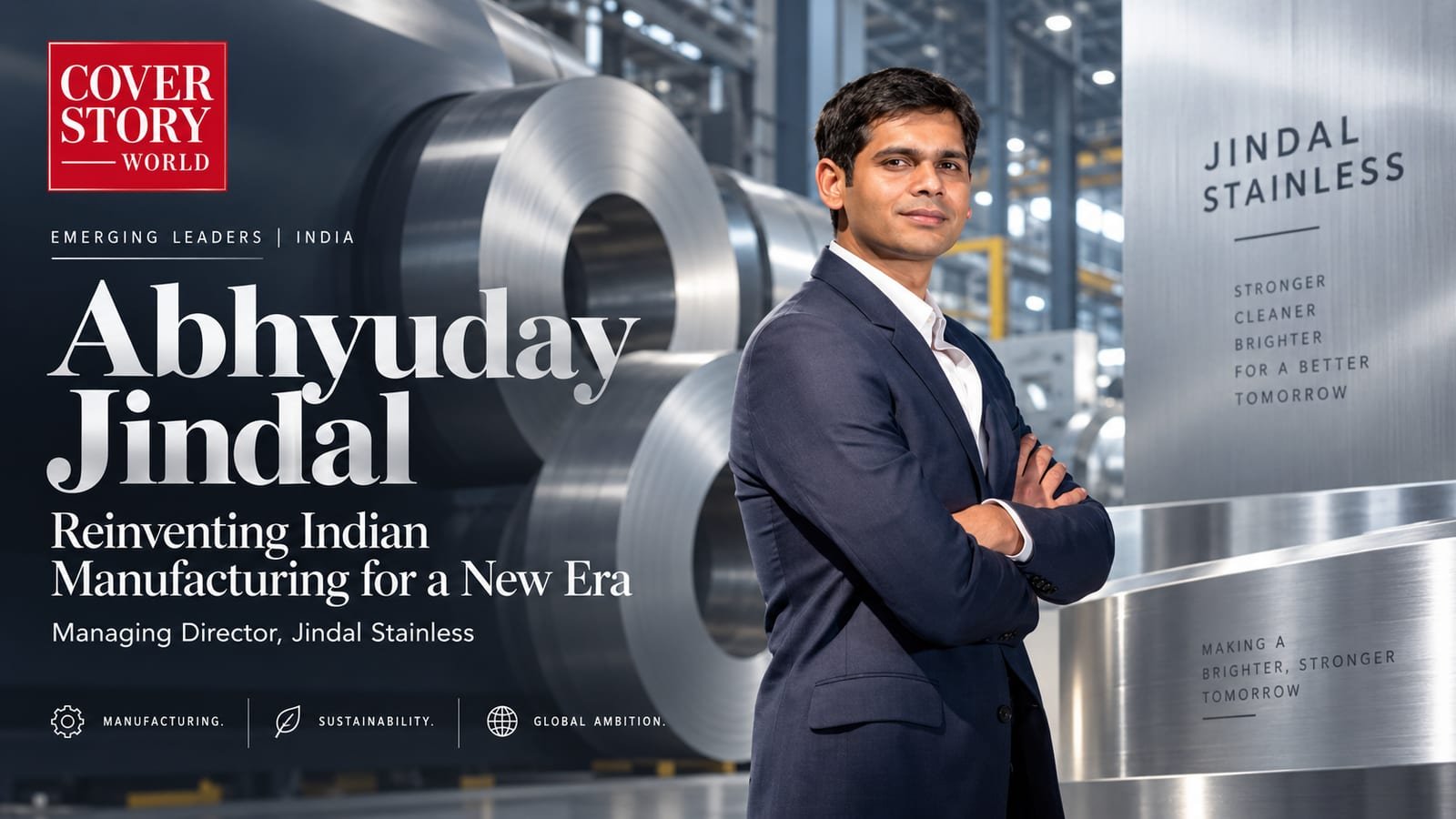
Abhyuday Jindal: Reinventing Indian Manufacturing for a New Era
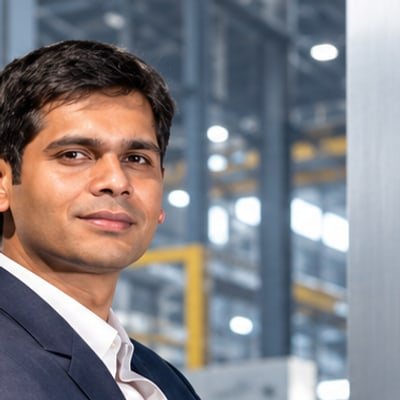
From expanding global stainless-steel capacity to advancing green hydrogen, renewable energy and high-value manufacturing, Abhyuday Jindal is helping position Jindal Stainless for the next phase of India’s industrial growth.
Abhyuday JindalManaging Director · Jindal Stainless · India
GCEIP Editorial Desk ·
Editorial. Published by the GCEIP editorial desk under our editorial policy. An editorial story does not make its subject an award recipient.
India’s next manufacturing story will not be built on scale alone.
Factories can be built with capital. Industrial capability has to be built through people.
It will be built on capability, technology, sustainability and execution.
That is the transition Abhyuday Jindal is helping lead at Jindal Stainless.
As Managing Director of India’s largest stainless-steel producer, Jindal is steering a company with deep industrial roots into a very different future — one shaped by global competition, low-carbon manufacturing, advanced applications and rising domestic demand.
His leadership challenge is not simply to grow an established industrial business.
It is to make that business more relevant to the India that is now emerging.
From Legacy to Leadership
Jindal comes from one of India’s best-known industrial families, but his professional path was not confined to the family enterprise.
A graduate of Boston University in economics and business management, he began his career with the JSW Group, where he was involved in the acquisition and integration of Ispat Industries. He later worked with Boston Consulting Group across industries including steel, cement, wind turbines and auto components.
That experience gave him a perspective beyond inherited business.
Today, as Managing Director of Jindal Stainless, he combines that external exposure with a company whose history stretches back more than five decades.
For a next-generation leader, the opportunity is significant: preserve the strength of the institution while changing how it competes.
Building at Global Scale
Jindal Stainless has become one of the world’s largest stainless-steel manufacturers.
Its manufacturing footprint now extends beyond India, with operations and investments spanning India, Spain and Indonesia, while serving industries from railways and automobiles to infrastructure, architecture, consumer goods and energy.
The company’s FY2025-26 performance reflected that scale.
Consolidated net revenue reached approximately ₹42,955 crore, EBITDA rose to ₹5,560 crore and profit after tax increased to ₹3,185 crore. Finished-goods sales volume reached about 2.57 million tonnes, the highest level in the company’s history.
But scale by itself is not Jindal’s most interesting strategic priority.
The focus is increasingly shifting toward value-added products, downstream capabilities and global market diversification.
That is where the next layer of competitive advantage may come from.
Manufacturing Meets Sustainability
Steel and sustainability are often discussed as competing ideas.
Jindal Stainless is trying to make them part of the same strategy.
The company has committed to achieving net-zero emissions by 2050 and is investing in renewable energy, green hydrogen, energy efficiency and lower-carbon manufacturing.
Its decarbonisation roadmap includes a major hybrid renewable-energy project and investments across operations designed to reduce carbon intensity.
The importance of this transition extends beyond ESG reporting.
Global buyers are becoming more conscious of embedded carbon. Governments are tightening climate regulations. And manufacturers increasingly need cleaner supply chains to remain globally competitive.
For Jindal, sustainability therefore becomes not simply an environmental responsibility.
It becomes a business capability.
Stainless Steel for the India Being Built
The larger opportunity lies in India itself.
Infrastructure spending, railways, metros, renewable energy, transportation, consumer goods and advanced manufacturing are all expanding the domestic use cases for stainless steel.
Jindal Stainless has been actively pushing the material into new applications.
In 2026, the company supplied stainless steel for India’s first hydrogen-powered train, while continuing to work with Indian Railways and other industries on corrosion-resistant, long-life applications.
It has also expanded into retail-focused products such as stainless-steel rebars, broadening the material’s use in construction.
The underlying thesis is straightforward: India will need more infrastructure. But it will increasingly need infrastructure that lasts longer, performs better and carries a lower lifecycle cost.
That creates a strong strategic position for stainless steel.
Beyond Capacity: Building Capability
Jindal’s own recent commentary offers perhaps the clearest insight into his leadership agenda.
He has argued that India’s next manufacturing challenge is no longer simply adding capacity.
It is building capability.
That includes advanced skills, stronger supply chains, automation, better technical expertise and the ability to produce higher-value products consistently.
Jindal Stainless is investing behind that philosophy.
Its training initiatives now reach tens of thousands of fabricators, while internal academies and partnerships with engineering institutions are being used to deepen technical capability across metallurgy, automation, operations and maintenance.
This may be one of the less visible parts of the strategy.
But it is also one of the most important.
Factories can be built with capital. Industrial capability has to be built through people.
A Broader Leadership Role
Jindal’s influence is also expanding beyond the company.
He currently serves as President of the Indian Chamber of Commerce and holds industry leadership responsibilities through the Confederation of Indian Industry.
That broader engagement matters because manufacturing leaders increasingly operate at the intersection of business and policy.
Trade protections. Infrastructure investment. Skills. Decarbonisation. Global supply chains.
All of these require collaboration between industry and government.
For Jindal, that creates an opportunity to contribute not only to the future of Jindal Stainless, but to the wider conversation around Indian manufacturing.
The Cover Story View
Abhyuday Jindal represents an important category of next-generation Indian leader.
He is inheriting industrial scale at exactly the moment when industrial leadership itself is changing.
The previous era was about building factories and expanding capacity.
The next era will require something more sophisticated: cleaner production, stronger technology, global competitiveness, skilled people and higher-value manufacturing.
Jindal Stainless already has scale.
Abhyuday Jindal’s defining task is to convert that scale into long-term industrial leadership.
If he succeeds, his contribution will not simply be growing a family enterprise.
It will be helping prove that the next generation of Indian manufacturing can be bigger, greener and globally more competitive at the same time.
If this story is about you or your company, you are welcome to link to it. Copy either snippet below into your website, press page, email signature or post.
Where this story fits
Featured within GCEIP’s Transformational Leaders & Enterprises™ ecosystem.
Know a leader or enterprise like this? Nominate them for Transformational Leaders & Enterprises™, in Barcelona or London. Nominations for Dubai are closed.
The founder who challenged India's fragmented hotel industry is now leading PRISM through a much larger transformation. With Motel 6 reshaping its international business and a proposed IPO approaching, Ritesh Agarwal faces a different test of leadership: building a financially resilient global hospitality company.
From solving daily delivery challenges for restaurant chains to building an on-demand refrigerated logistics platform, the founder of JustDeliveries is helping reshape how India's food businesses grow.
From strengthening India’s chronic-therapy leadership to integrating major acquisitions and shaping a broader growth agenda, Aman Mehta is emerging as one of the key next-generation leaders in Indian pharmaceuticals.
From solving online-payment friction for startups to helping businesses manage money through payments, banking and AI, Shashank Kumar has spent more than a decade building the rails beneath India’s digital economy.