
Steven Bartlett: Can The Diary of a CEO Become Bigger Than Its Founder?
The entrepreneur who built a global podcast audience is now attempting to create a business ecosystem spanning media, technology, investment and creator-led enterprises.
Marquee Stories · The Cover Story · Marquee Leaders
The founder who challenged India's fragmented hotel industry is now leading PRISM through a much larger transformation. With Motel 6 reshaping its international business and a proposed IPO approaching, Ritesh Agarwal faces a different test of leadership: building a financially resilient global hospitality company.
The Cover Story editorial team ·
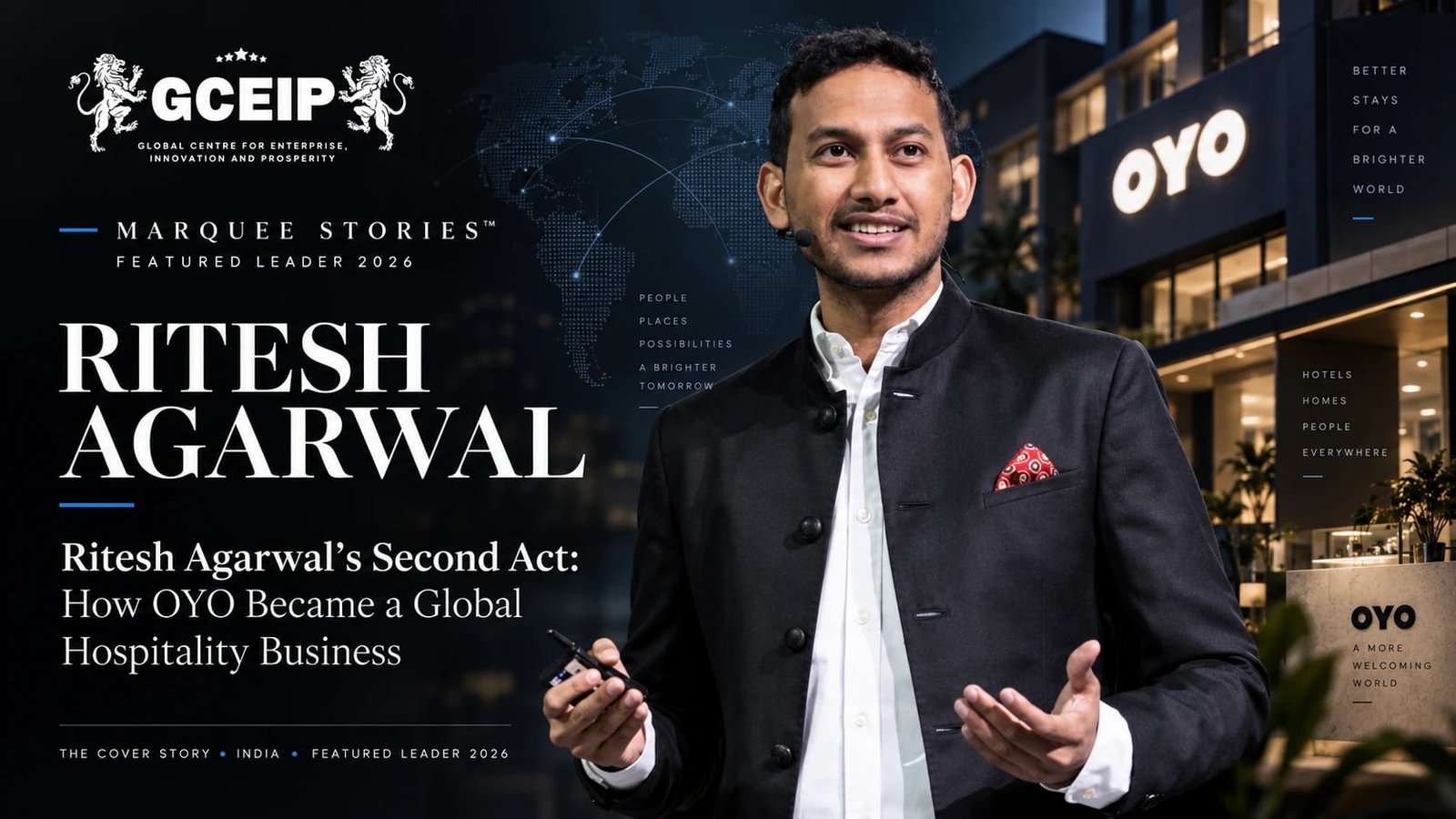
For years, Ritesh Agarwal's story was inseparable from OYO.
The strategy that helped build your business may not be the strategy required to lead its next chapter.
A young Indian entrepreneur had identified an opportunity in budget hospitality, built a technology-enabled hotel network and pursued international expansion at remarkable speed.
But the business associated with that early ambition looks considerably different today.
It is now operating under the wider identity of PRISM, a global hospitality technology group with a portfolio extending across India, Europe and North America.
And one of the most consequential businesses in its portfolio is not an Indian hotel brand.
It is America's Motel 6.
According to PRISM's 2026 annual reporting, its Motel 6 business represents approximately 46% of group gross booking value.
That single development says a great deal about how the organisation has changed.
The next chapter of Ritesh Agarwal's entrepreneurial journey is no longer simply about building OYO. It is about integrating and operating a global hospitality business.
When Agarwal founded OYO in 2013, India's budget accommodation market presented a fragmented customer experience.
Independent hotels often struggled with distribution, technology, standardisation and access to travellers.
Customers faced inconsistent booking experiences and uncertainty about service quality.
OYO developed a model intended to connect these needs.
By combining technology, online distribution, branding and operating processes, it offered independent accommodation providers access to a wider customer base while giving travellers a more recognisable booking proposition.
The model attracted investment and expanded internationally.
But the experience also exposed the difficulties of scaling a hospitality business across different owners, properties, markets and service standards.
Growth in hotel listings does not automatically translate into consistent guest experiences or sustainable economics.
Hotel operators have different commercial interests. Local regulations vary. Property standards require ongoing attention.
These are not problems that software can solve independently of operations.
For Agarwal, the challenge evolved from making fragmented hotel supply more accessible to building an organisation capable of delivering dependable commercial outcomes across that supply.
A defining shift came with the acquisition of G6 Hospitality, the parent company of Motel 6 and Studio 6, in December 2024.
The transaction brought established American economy-lodging brands into the group's international portfolio.
It also changed the economic balance of the business.
PRISM's 2026 disclosures indicate that the Motel 6 business now accounts for nearly half of its gross booking value.
In other words, an Indian-founded hospitality technology business has become significantly dependent on the performance of its American accommodation operations.
That creates an interesting strategic relationship.
India provides substantial technology, engineering and centralised operating capabilities.
North America contributes an increasingly important part of the group's commercial activity.
The opportunity is to connect these strengths—to improve revenue management, distribution, operating efficiency and customer experience across a much larger portfolio.
But the integration also creates new demands.
Different brands require different commercial strategies. Franchise relationships must be managed carefully. Technology investments need to deliver measurable benefits to property owners.
The business must demonstrate that its international scale creates genuine operational advantage.
The transition to PRISM in 2025 reflected the expanding scope of the organisation.
OYO remains an important brand, but the wider group now encompasses multiple hospitality offerings, business models and international markets.
The distinction matters.
A technology platform serving independent accommodation owners is different from a diversified hospitality organisation managing established brands and influencing more of the guest experience.
PRISM's strategy increasingly involves combining distribution technology with greater operating involvement.
The group has also expanded its attention towards premium hospitality alongside its established economy and budget segments.
This creates a more complicated enterprise—but potentially a more diversified one.
The challenge is balancing the advantages of an asset-light model with the additional responsibility that comes from taking greater control of hotel operations.
For Agarwal, this means leading a company whose future depends as much on integration, capital allocation and execution as it does on expansion.
PRISM's 2026 annual reporting describes a business with considerable changes in its financial profile.
According to figures examined by hospitality publication Skift, consolidated revenue rose approximately 50% to ₹9,400 crore.
Gross booking value increased to approximately ₹30,700 crore, while the group reported positive consolidated EBITDA for a fourth consecutive year.
These developments offer evidence of operating progress.
But the financial story also needs to be understood alongside the company's capital structure.
In June 2026, PRISM filed updated papers proposing an IPO of ₹6,650 crore.
The proposed issue is structured as a fresh share issuance, with a substantial proportion of proceeds earmarked for repaying or prepaying debt.
That creates an important distinction between business growth and balance-sheet improvement.
A company may have growing revenue and improving operating performance while still needing to strengthen its financial position.
The proposed IPO is therefore more than a fundraising milestone.
It is part of the next financial test of PRISM's transformation.
Ritesh Agarwal's evolution represents a broader challenge for founders who build rapidly expanding businesses.
In the early stages, the central questions involve customer acquisition, market opportunity and the ability to scale.
As an organisation matures, the questions change.
Can the company integrate acquisitions successfully?
Can it maintain service quality across different markets?
Can technology produce measurable operating efficiencies?
Can growth generate sustainable financial returns?
PRISM's transformation provides a useful case study because its present business differs significantly from the platform that originally attracted international attention.
Three strategic shifts stand out.
First, diversification. The group has moved beyond its original Indian budget-hotel proposition into a wider portfolio of hospitality brands and markets.
Second, operating control. Its business model increasingly seeks to connect technology and distribution with greater influence over hotel performance.
Third, financial discipline. The proposed IPO and debt-reduction plans put the sustainability of the group's capital structure firmly in focus.
These are meaningful developments.
They also raise questions about integration complexity, international exposure, competition and the commercial performance of acquired businesses.
The ultimate measure will not simply be the number of hotels or countries in the portfolio.
It will be whether the group's capabilities make its brands and operating partners stronger businesses.
A business that succeeds at one stage may require a different leadership approach at the next.
Building a startup demands experimentation, conviction and speed.
Operating a global enterprise requires those qualities alongside capital discipline, governance, organisational depth and consistent execution.
The founder's role must evolve accordingly.
For Agarwal, the journey from OYO to PRISM illustrates the importance of understanding when a business has changed enough to require a different operating philosophy.
The lesson extends far beyond hospitality.
The strategy that helped build your business may not be the strategy required to lead its next chapter.
Successful founders must recognise that transition—and develop the organisation around it.
PRISM's future will depend on the performance of its international portfolio, the integration of its technology and hospitality operations, and the management of its financial obligations.
The proposed IPO represents one potential milestone.
But public-market readiness is not the final measure of an enterprise's strength.
That judgment will depend on consistent operating results, customer experience, franchise relationships and the ability to generate durable financial value.
For Ritesh Agarwal, the most consequential part of the journey may therefore lie ahead.
OYO demonstrated his ability to identify an industry opportunity and build at scale. PRISM will test his ability to lead a larger, more complex international institution.
Ritesh Agarwal's story illustrates an important stage in entrepreneurial leadership: the transition from startup expansion to managing a diversified global business.
PRISM's international portfolio, the growing significance of Motel 6 and its changing operating model demonstrate how fundamentally a company can evolve beyond its original proposition.
Its next stage will depend on disciplined execution, effective integration and sustainable commercial performance.
For GCEIP Marquee Stories™, Agarwal presents a compelling example of a founder facing the challenge of transforming not only his business—but also the way he leads it.
GCEIP MARQUEE STORIES™
Featured Leader 2026 | The Cover Story | India
Recognising Transformation. Celebrating Achievement.
Ritesh Agarwal is the Indian entrepreneur who founded OYO in 2013 and now leads PRISM, the global hospitality technology group whose portfolio includes OYO and Motel 6.
PRISM is the global hospitality technology group with a portfolio across India, Europe and North America. The group moved from the OYO name to PRISM in 2025, and OYO remains an important brand within it.
According to PRISM's 2026 annual reporting, its Motel 6 business represents approximately 46% of group gross booking value.
In June 2026 PRISM filed updated papers proposing an IPO of ₹6,650 crore, structured as a fresh share issuance with a substantial proportion of proceeds earmarked for repaying or prepaying debt. It is a proposed offering.
No. Marquee Stories is an editorial classification. A Marquee feature does not make its subject an award recipient.
GCEIP Marquee Stories™. This story is part of Marquee Stories, published under The Cover Story. A Marquee feature is an editorial classification and does not make its subject an award recipient.
Featured within GCEIP’s Transformational Leaders & Enterprises™ ecosystem. Explore the leadership story behind the recognition: Transformational Leaders and The Cover Story.
Know a leader or enterprise like this? Nominate them for Transformational Leaders & Enterprises™, in Dubai, Barcelona or London.
The entrepreneur who built a global podcast audience is now attempting to create a business ecosystem spanning media, technology, investment and creator-led enterprises.
From solving daily delivery challenges for restaurant chains to building an on-demand refrigerated logistics platform, the founder of JustDeliveries is helping reshape how India's food businesses grow.
From Aachen to a wider European market, the German AI company is pursuing a fundamental business question: what if the real challenge of artificial intelligence is not the model, but the knowledge it needs to work?
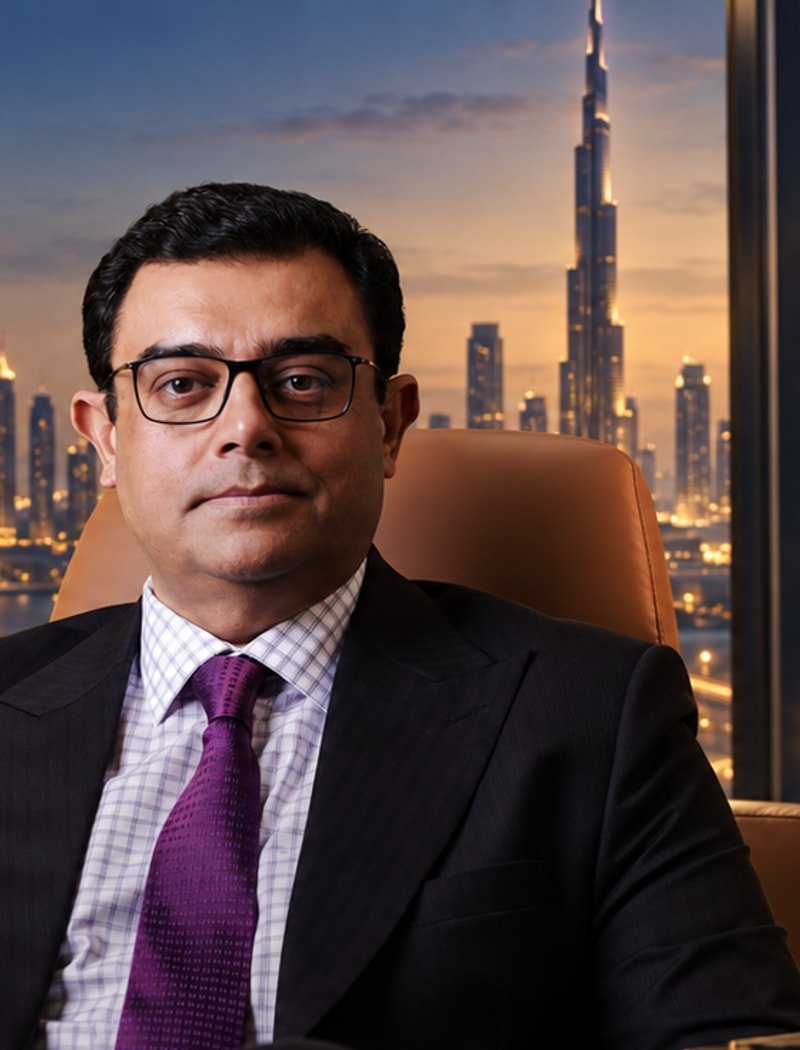 Imran Farooq · SAMANA Developers
 From resort-style apartments and private pools to international expansion, branded residences and vertical integration, Imran Farooq has turned SAMANA Developers into one of Dubai’s fastest-rising property businesses — and is now building for a much larger stage.