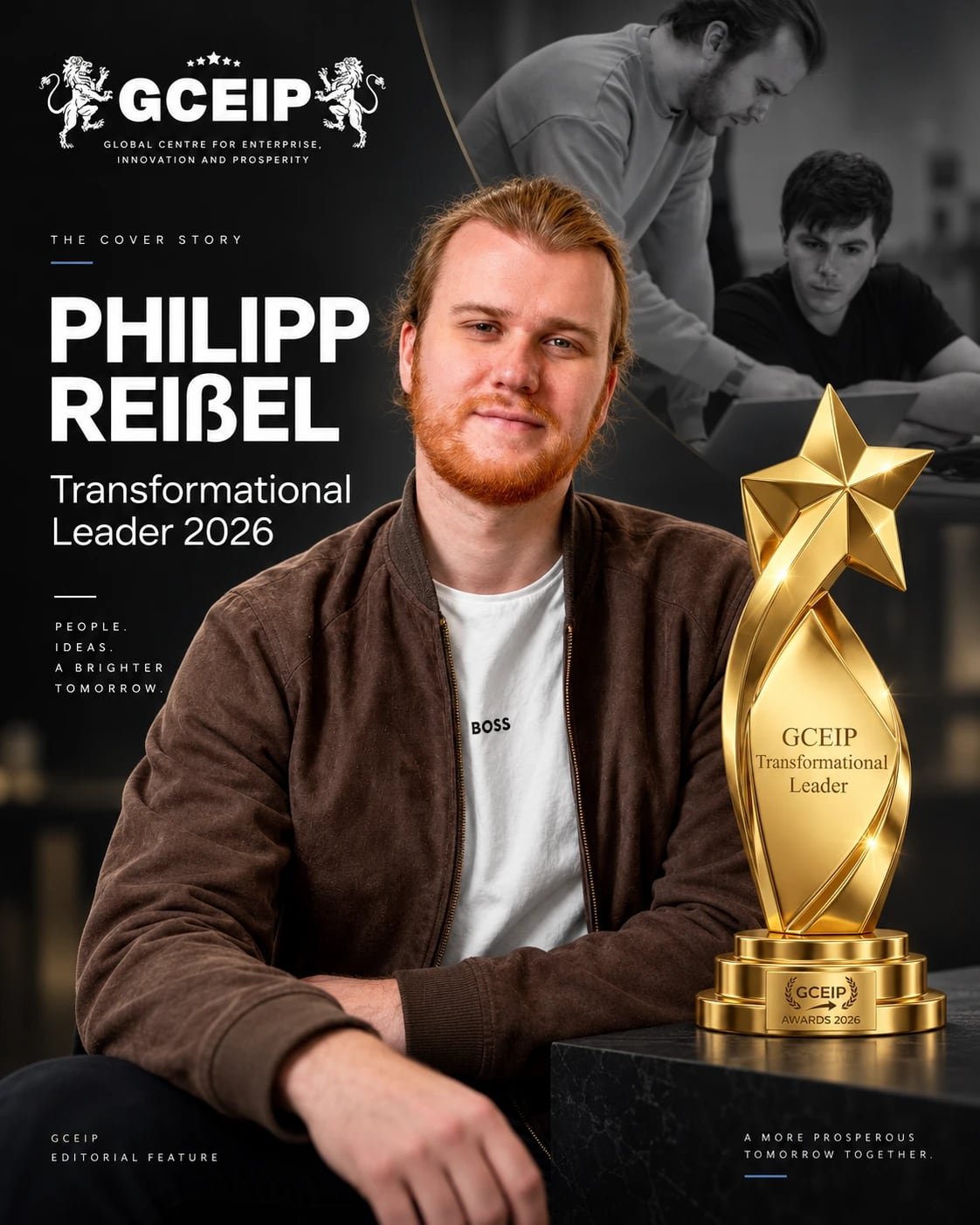
Philipp Reißel: How amber Is Building Business AI for Germany's Mittelstand
From Aachen to a wider European market, the German AI company is pursuing a fundamental business question: what if the real challenge of artificial intelligence is not the model, but the knowledge it needs to work?
PR
Philipp ReißelCo-founder and CEO · amber · Germany
The Cover Story editorial team ·
An AI assistant can produce an impressive answer in seconds. But what happens when the information it needs is scattered across years of internal documents, emails, project records and systems that do not communicate with one another?
What if the real challenge of artificial intelligence is not the model, but the knowledge it needs to work?
For many established businesses, this is where the promise of artificial intelligence meets the complexity of everyday operations.
It is also the problem that Philipp Reißel, co-founder and CEO of Aachen-based amber, has made central to his company's strategy.
In August 2026, amber announced a €7 million Series A funding round co-led by Ventech and NRW.Venture, the venture capital arm of NRW.BANK. The investment will support the development of its enterprise AI platform and expansion into additional European markets.
The financing is a significant milestone. But the more interesting story is the sequence of decisions behind it.
While much of the AI industry competes to develop ever more powerful models, amber has concentrated on something less visible: helping those models understand the information that already exists inside a business.
A business problem that existed before the AI boom
Germany's Mittelstand—its substantial base of small and medium-sized enterprises, including specialised industrial businesses—offers a particularly demanding environment for enterprise technology.
These organisations often possess years of technical expertise, customer experience and operational knowledge.
The difficulty is making that expertise accessible.
An engineering team may have documentation in one system, customer correspondence in another and crucial project history in a third. Employees must locate information, judge which version is current and understand whether it applies to the task at hand.
When experienced colleagues leave, some of that organisational understanding can become harder to recover.
For Reißel and his co-founders, this problem presented an opportunity before generative AI became a mainstream business priority.
The founding team—Reißel, Bastian Maiworm and Igli Manaj—met at RWTH Aachen University and established amber in 2021. Their approach combined experience of business information problems with technical work in artificial intelligence.
Instead of beginning with a conversational interface, the team focused on how company information could be connected, retrieved and interpreted.
That decision now sits at the centre of amber's commercial proposition.
Building the context before the intelligence
At the heart of amber's platform is what the company calls its AI Data Layer.
The system connects information distributed across company applications and data sources. It is designed to preserve existing access permissions while giving AI tools a relevant understanding of organisational information.
The distinction matters.
A language model may be capable of explaining an engineering process, but that does not mean it has access to the specific requirements, changes and decisions governing an individual company's project.
Making those materials available in the correct context is a separate technological problem.
amber's platform combines search, AI-assisted answers and agent capabilities. The company describes integrations with familiar enterprise environments such as SharePoint, Teams, Confluence and Jira.
Its architecture is also intended to work with different AI models rather than depend entirely on one provider.
In commercial terms, amber is trying to make the business's own knowledge the durable foundation of its AI investment, even as the underlying models change.
That is a meaningful strategic choice. The next generation of language models may become considerably more capable, but organisations will still need to decide what information those models can access, whether that information is reliable and what actions an AI system is permitted to perform.
From finding answers to completing work
amber began with a knowledge-access problem. Its next ambition is broader.
The company wants to move from systems that respond to employee requests towards AI that can increasingly carry out appropriate business workflows.
That progression changes the stakes.
Finding a document is one kind of task. Using the information in that document to update a business process, prepare an output or initiate an action requires more context, more integration and stronger controls.
It also creates a different test of usefulness.
An AI tool should not be judged only by the quality of its language or the sophistication of its demonstration. A business must understand whether it reduces unnecessary work, improves information retrieval and delivers dependable outcomes under real operating conditions.
For enterprise customers, security and permissions become especially important when software moves from answering questions to taking actions.
amber's technology is designed around existing access rights and traceable answers. But the move towards greater autonomy will require continuing evidence of reliability across different customer environments.
That is both the opportunity and the challenge facing the business.
The commercial evidence behind the ambition
At the time of its August 2026 financing announcement, amber reported serving more than 400 business customers.
The company identified customers across manufacturing, engineering, IT consulting and consumer goods, including Ritter Sport, Zentis, Scheidt & Bachmann, Schüßler-Plan, Dalli and Hailo.
Those relationships give amber a stronger commercial foundation than an AI concept supported only by investor enthusiasm.
The €7 million funding round also provides resources for expansion beyond Germany, initially into the Benelux region, alongside continued investment in the platform and its integrations.
Yet funding is not the same as proof of durable competitive advantage.
amber faces a market in which major software providers already have established customer relationships, extensive distribution and the ability to embed AI directly into applications that employees use every day.
Its challenge is to show why a dedicated business-context layer creates enough additional value to justify adoption.
For SMEs, that case will likely depend on practical considerations: deployment effort, integration quality, cost, user adoption, trustworthy answers and demonstrable improvements in work.
GCEIP Analysis: Europe's enterprise AI opportunity may be in the infrastructure
The most interesting element of amber's strategy is its position between business information and AI models.
As increasingly capable models become available from multiple providers, the ability to connect proprietary company knowledge to those models could become an important source of enterprise value.
This is particularly relevant in Europe, where buyers may place considerable weight on data control, regulatory obligations and the location of their technology infrastructure.
But European origin alone does not establish security, technical superiority or commercial success. Those claims must be demonstrated through architecture, controls and customer results.
For amber, the immediate opportunity is to make AI adoption more practical for companies that cannot devote large internal teams to building and maintaining complex data infrastructure.
The longer-term question is whether that position can support a defensible European software business as competition intensifies.
The company's financing and reported customer adoption suggest real commercial traction. They do not yet settle that larger question.
The business lesson: solve the information problem first
There is a lesson here for companies far beyond the AI sector.
Before investing in another AI assistant, a business should ask whether its people can reliably find and interpret the information needed to do their work.
Where does the organisation's most important operational knowledge live? Who can access it? How frequently is it updated? What happens when an experienced employee leaves?
These questions may appear less exciting than choosing the newest AI model.
They may also determine whether the investment produces real value.
For founders, Reißel's experience points to another consideration: identifying an enduring customer problem can provide a more durable strategic foundation than building exclusively around a rapidly changing technology trend.
The next chapter
amber now has to turn its architectural proposition into a larger European business.
The task is not simply to sign more customers. It is to demonstrate that its approach remains useful as AI models become more capable, enterprise software becomes more integrated and businesses demand measurable returns.
For Reißel and the founding team, the August financing marks an opportunity to test that proposition at greater scale.
The question worth watching is whether amber can move from helping businesses find what they know to helping them act on that knowledge—reliably, securely and economically.
That would represent a considerably more important achievement than building another AI chatbot.
The Cover Story World View
Philipp Reißel and amber illustrate an important direction in European enterprise technology: AI's business value may depend as much on the quality, context and accessibility of organisational knowledge as on the power of the underlying model.
Their progress provides an interesting case of a growing European business attempting to solve a practical enterprise problem. Its next stage will depend on execution, customer evidence and the ability to compete in an increasingly crowded market.
GCEIP — Global Centre for Enterprise, Innovation and Prosperity
Editorial profile based on publicly available information. This article does not imply GCEIP nomination, ranking or award recognition.
Key facts
Who is Philipp Reißel?
Philipp Reißel is co-founder and CEO of amber, an Aachen-based enterprise AI company he established in 2021 with Bastian Maiworm and Igli Manaj.
What does amber do?
amber's AI Data Layer connects information across company applications and data sources, preserving existing access permissions, so that AI tools can work with an organisation's own knowledge.
How much funding did amber announce?
In August 2026 amber announced a €7 million Series A funding round co-led by Ventech and NRW.Venture.
Featured within GCEIP’s Transformational Leaders & Enterprises™ ecosystem. Explore the leadership story behind the recognition: Transformational Leaders and The Cover Story.
Know a leader or enterprise like this? Nominate them for Transformational Leaders & Enterprises™, in Dubai, Barcelona or London.
From continuous glucose monitoring and smart rings to blood biomarkers, women’s health and real-time biointelligence, Bengaluru-based Ultrahuman is attempting something far more ambitious than building another wearable. It wants to create a computing platform that understands the human body continuously.
From resort-style apartments and private pools to international expansion, branded residences and vertical integration, Imran Farooq has turned SAMANA Developers into one of Dubai’s fastest-rising property businesses — and is now building for a much larger stage.
From strengthening India’s chronic-therapy leadership to integrating major acquisitions and shaping a broader growth agenda, Aman Mehta is emerging as one of the key next-generation leaders in Indian pharmaceuticals.

 Ultrahuman · Health-tech and wearables