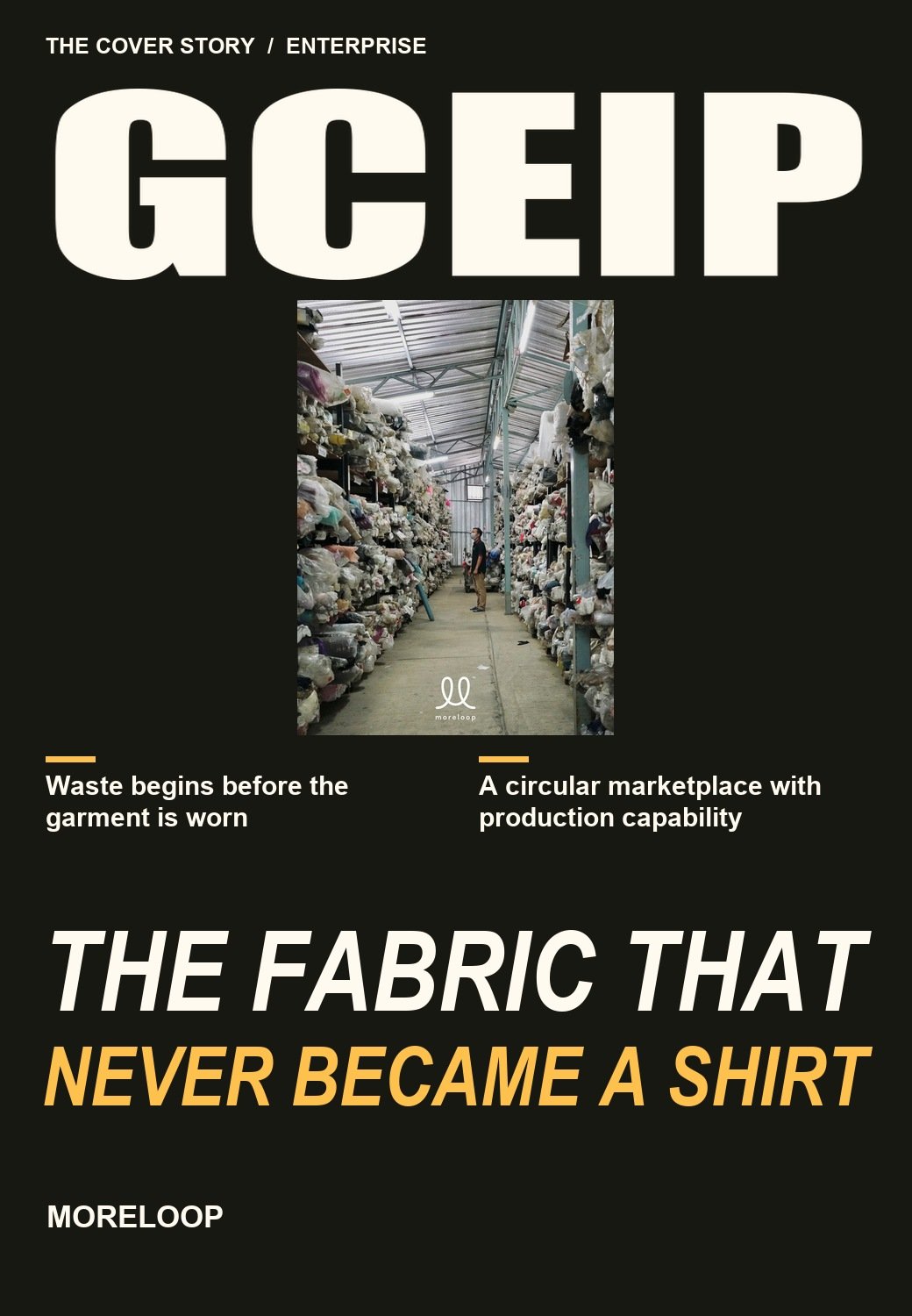
A textile factory can produce fabric that never reaches a customer: surplus rolls, unwanted colours or material left after production plans change. Often the fabric itself is perfectly usable. The waste arises from mismatch—between what was made and what someone can use. Thailand’s moreloop approaches that problem as a business opportunity. Instead of treating all surplus textiles as rubbish to be processed later, it connects available material with designers, businesses and buyers willing to put it to work.
A circular marketplace with production capability
moreloop developed an online marketplace for unused fabric, then extended its offering into upcycled products for corporate and other clients. This is an important difference. A pure marketplace needs enough buyers and sellers to find one another; a design and production service can help create demand for hard-to-place material. The company’s model therefore connects sourcing, creative design and garment partners rather than pretending fabric recovery is only a logistics task. Each stage introduces operational costs and quality requirements that ordinary sustainability slogans rarely describe.
Proof that the network exists
A European Union-supported SWITCH-Asia case study reported that by early 2024 moreloop’s platform involved about 70 Thai textile companies and approximately 150 customers. It also documented reuse of surplus fabric and an enterprise model leaning heavily on corporate orders. These are historical figures from the case study, rather than a current network count. More recently, Thai developer Ananda announced a partnership with moreloop to create staff uniforms from surplus fabric. The partnership demonstrates a concrete B2B use case: a customer choosing surplus material for an actual business requirement.
What circular commerce must overcome
Surplus material is not a standardised commodity. A buyer may require a particular shade, weight or quality that cannot be reproduced when the original stock is exhausted. Sales teams must work within the inventory that exists rather than promise unlimited availability. Production partners also need to handle smaller, varied orders economically. Environmental impact claims should be tied to a documented methodology rather than assuming that every reused metre of cloth creates the same savings. The Ananda collaboration provides a useful example, but lasting scale requires repeat procurement and measured economics.
The hidden work of material matching
A manufacturer buying surplus cloth needs a reliable answer to basic questions: how much is available, is the colour consistent, and can a factory produce a finished item at the required quality? moreloop sits between those practical uncertainties and a buyer who wants a predictable delivery. Its ability to classify stock, source appropriate production partners and manage small orders therefore matters as much as its sustainability message. The company's previous business-case evidence suggests that creating finished products is important to its revenue mix. Repeated B2B contracts will show whether that model continues to be commercially resilient.
GCEIP Analysis
moreloop creates a buyer for excess stock by helping turn it into usable products. Corporate purchasing teams can then assess those products against ordinary requirements for price, quality and delivery. The test is whether it can preserve reliability and margin while working with an inherently inconsistent supply stream. Evidence of new corporate programmes is encouraging; current revenue, repeat-customer rates and independently assessed material savings still need confirmation.
GCEIP View
moreloop shows how overlooked inventory can acquire value through design, coordination and commercial credibility. Textile circularity will become more common only when reusing materials is practical for purchasing teams, manufacturers and end users. The company’s progress suggests a route through that problem. Its future depends less on dramatic recycling imagery than on making surplus fabric an ordinary input in good products.
Key facts
What does moreloop do?
moreloop is a Thai circular-textiles business that sells and upcycles surplus fabric.
What is an example of moreloop’s work?
Ananda Development partnered with moreloop on staff uniforms made using surplus textiles.
If this story is about you or your company, you are welcome to link to it. Copy either snippet below into your website, press page, email signature or post.
About this feature
This is a GCEIP editorial feature. Publication does not confer nomination, finalist, winner or honouree status.
What began as a struggle to supply fresh ingredients to a handful of restaurants has evolved into one of Thailand's notable FoodTech businesses. Freshket's journey reveals how solving an everyday operational problem can build an enterprise that attracts the attention of an industry giant.
From performance-focused electric motorbikes to affordable family transportation, Dat Bike is taking on one of Southeast Asia's most established consumer habits. Its next challenge is not simply building a better electric motorcycle, but building a manufacturing and service business capable of competing at national and eventually regional scale.
Construction projects can run into trouble long before building work starts. Stockholm-based Brickanta is developing an AI-powered platform to help construction companies analyse contracts, identify risks, prepare bids and make better decisions before committing resources.
From flexible warehouse capacity to connected transportation networks, Riyadh-based Sirdab is attempting to transform one of the most important—and least visible—parts of Saudi Arabia's growing business economy.