
The Fabric That Never Became a Shirt: moreloop’s Circular Business
Thailand’s moreloop is turning surplus fabric into products and business supply, testing whether textile waste can become a reliable commercial input.
Nomination Stories · Southeast Asia · Featured Enterprise
What began as a struggle to supply fresh ingredients to a handful of restaurants has evolved into one of Thailand's notable FoodTech businesses. Freshket's journey reveals how solving an everyday operational problem can build an enterprise that attracts the attention of an industry giant.
GCEIP Editorial Desk · · Updated
Editorial. Published by the GCEIP editorial desk under our editorial policy. An editorial story does not make its subject an award recipient.
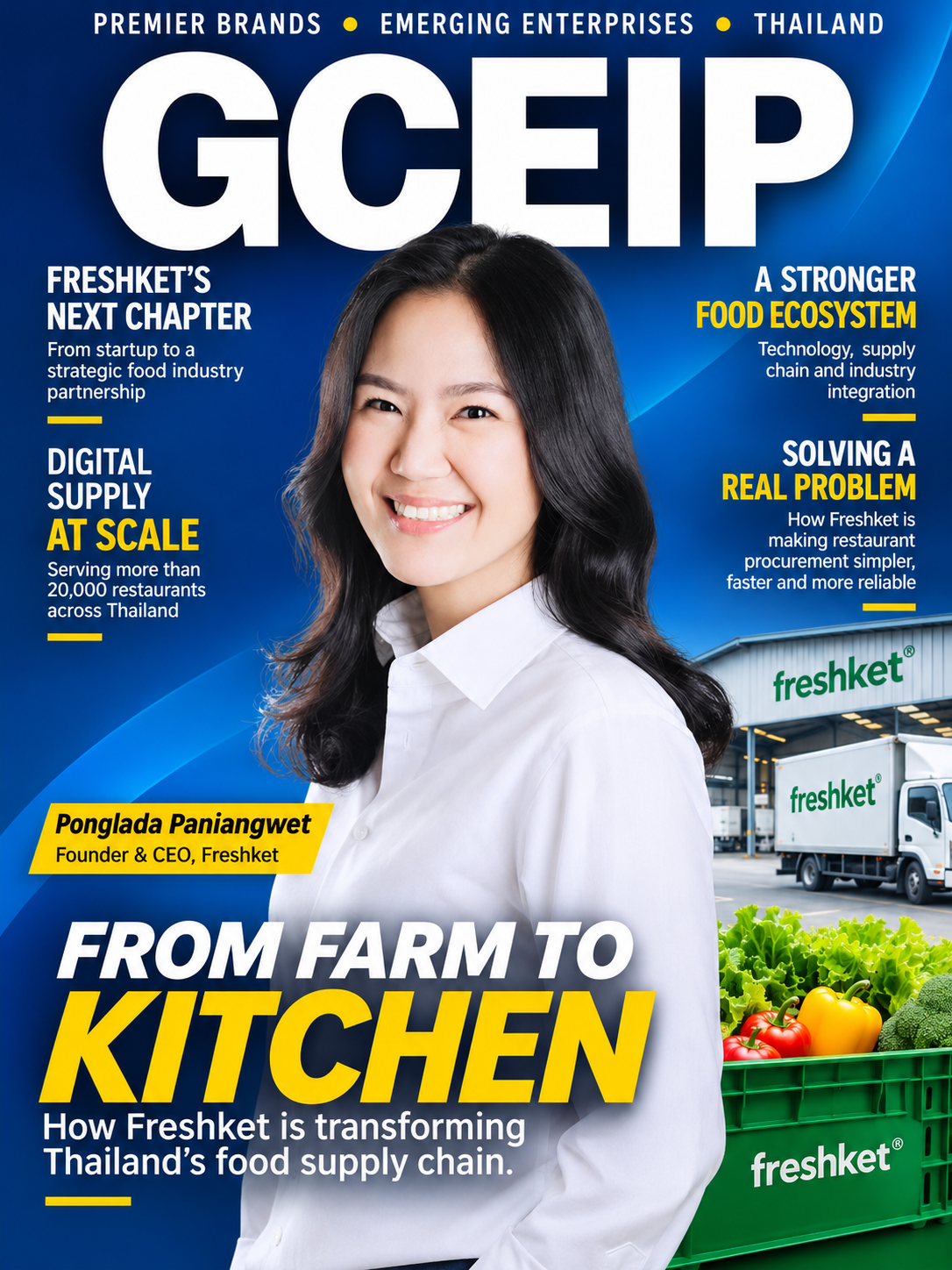
Every morning, thousands of restaurants across Thailand face the same challenge: securing fresh ingredients at the right price, in the right quantity, and at the right time.
For customers, it is an invisible process. For restaurant operators, it can determine whether an entire day's business runs smoothly.
Ponglada “Bell” Paniangwet experienced this frustration firsthand.
Before establishing Freshket, she operated a fresh-food supply business that required hours of overnight coordination to fulfil orders for a small group of restaurants.
Prices fluctuated. Orders changed unexpectedly. Suppliers operated independently. Deliveries were difficult to coordinate.
Rather than accepting these inefficiencies as unavoidable, Ponglada recognised a business opportunity.
What if restaurants could source their ingredients through one coordinated technology-enabled supply chain instead of dealing with numerous fragmented suppliers?
That question became the foundation of Freshket.
Founded in 2017, Freshket initially connected restaurants with ingredient suppliers through a digital marketplace.
But its early experience revealed something important.
Restaurants did not simply want access to more sellers. They wanted reliable quality, predictable delivery and fewer operational complications.
Freshket adapted its business model.
Instead of functioning only as a marketplace, it began developing greater control over sourcing, product handling, warehousing and distribution.
Technology connected the processes, but physical execution determined whether customers would return.
This decision changed the company's proposition.
Freshket was no longer simply digitising ingredient orders.
It was building the operating infrastructure behind Thailand's foodservice businesses.
As restaurant operators increasingly sought efficient procurement and reliable supply, Freshket expanded its technology and logistics capabilities.
The company attracted investments from regional venture capital firms and strategic industry partners.
In 2022, it secured a $23.5 million Series B funding round. Additional financing followed as the business continued expanding.
By October 2026, Freshket was serving more than 20,000 foodservice operators, according to figures announced by Betagro.
Its platform offered more than 10,000 products across categories including fresh produce, meat, seafood, dry goods and frozen ingredients.
The company also reported delivery accuracy exceeding 98.5%.
These milestones demonstrate how a business built around a specific customer frustration developed into a substantial distribution platform.
But the most consequential transformation was still ahead.
On October 20, 2026, Betagro, one of Thailand's major integrated food companies, announced its acquisition of a majority stake in Freshket.
The transaction marked an important turning point.
Freshket had built digital procurement relationships with thousands of restaurants and foodservice businesses.
Betagro brought manufacturing capabilities, established food production operations, logistics infrastructure and supply-chain expertise.
Together, they identified an opportunity to connect food production more directly with digital distribution.
The transaction also introduced a new strategic challenge for Freshket.
The company now had access to the resources of a major industry group, but its future performance would depend on successfully integrating complementary capabilities while preserving the flexibility and customer focus that helped it grow.
The acquisition was not the end of Freshket's entrepreneurial story.
It was the beginning of a different kind of enterprise transformation.
Freshket's next phase includes expanding its product range, strengthening cold-chain logistics and expanding service to more areas in Thailand.
For restaurants, a well-integrated platform can simplify purchasing, consolidate suppliers and improve inventory planning.
For producers, stronger distribution connections may create access to a broader customer network.
But achieving these outcomes consistently requires more than technology.
It demands dependable product quality, efficient logistics, competitive pricing and the ability to respond to changing customer requirements.
Freshket must also navigate a different organisational environment following its acquisition.
Maintaining the advantages of an entrepreneurial business while integrating into a larger corporate ecosystem will become an important test of its leadership and operating model.
Freshket's journey offers an important lesson for emerging entrepreneurs.
Its initial opportunity appeared to be a digital marketplace connecting suppliers and buyers.
But the underlying customer problem was larger.
Restaurants needed an easier and more dependable way to manage ingredient procurement.
By recognising that distinction, Freshket moved beyond facilitating transactions towards developing a more comprehensive operational service.
The strongest business opportunities sometimes emerge when entrepreneurs stop asking how to digitise a transaction and start asking how to improve the entire customer experience.
Freshket represents a compelling example of enterprise transformation emerging from Southeast Asia.
Its development illustrates how practical industry knowledge, technology adoption and operating discipline can create significant business opportunities in traditional sectors.
The company's expansion and acquisition by Betagro demonstrate the commercial importance of solving structural supply-chain challenges.
Its next phase will test whether that innovation can deliver greater value as part of a larger food industry ecosystem.
For GCEIP's Transformational Enterprises & Leaders 2027 programme in Malaysia, Freshket presents a strong case for research-led nomination consideration.
Freshket's achievement is not simply that it connected restaurants with suppliers. It helped demonstrate how an overlooked operational problem could become the foundation of an enterprise with national significance.
If this story is about you or your company, you are welcome to link to it. Copy either snippet below into your website, press page, email signature or post.

Featured within GCEIP’s Transformational Leaders & Enterprises™ ecosystem.
Know a leader or enterprise like this? Nominate them for Transformational Leaders & Enterprises™, in Barcelona or London. Nominations for Dubai are closed.
Thailand’s moreloop is turning surplus fabric into products and business supply, testing whether textile waste can become a reliable commercial input.
For a hardware company, getting from a prototype to reliable production can mean coordinating many suppliers and processes. Karkhana.io is building a managed manufacturing network around that gap.
M Village began with flexible urban accommodation in Vietnam and has expanded into a multi-brand hospitality group. Its latest transition tests whether a local operating model can travel across more segments.
Bateriku began with an urgent automotive need—getting a dead battery replaced—and grew into a network of technicians, local entrepreneurs and roadside services. Its next challenge is to connect growth with responsible battery recovery.
Choose an assistant to explore this page further.
Opens in a new tab. You can also copy the prompt into your assistant.