Sirdab: The Saudi Startup Rethinking How Businesses Store, Move and Manage Goods
From flexible warehouse capacity to connected transportation networks, Riyadh-based Sirdab is attempting to transform one of the most important—and least visible—parts of Saudi Arabia's growing business economy.
S
SirdabLogistics technology · Saudi Arabia · B2B
The Cover Story editorial team ·
Imagine launching a successful consumer brand in Riyadh.
A company should not necessarily need to build or lease its own logistics infrastructure before it can enter a new market.
Orders are growing. New distributors want your products. Retailers in Jeddah and Dammam are interested. The opportunity to expand looks increasingly attractive.
Then comes a less exciting question.
Where will you store everything?
Finding warehouse space is rarely as simple as finding an available building.
The location must work. The facility must meet the product's handling requirements. The commercial terms must make sense. Inventory must be tracked. Deliveries must be coordinated. And the business needs enough flexibility to respond when demand changes.
For a growing company, these decisions can consume substantial management time and capital.
That is the opportunity Sirdab, the Riyadh-based logistics technology enterprise founded in 2022, has set out to address.
Co-founded by Naif Alzahri and Abdulrahman Alnamlah, Sirdab is building a technology-enabled network that gives businesses access to warehousing, transportation, inventory management and fulfilment services through one platform.
Its proposition challenges a longstanding assumption about business expansion.
A company should not necessarily need to build or lease its own logistics infrastructure before it can enter a new market.
With a recently announced $10 million funding round, Sirdab is now attempting to take that proposition to a larger scale.
The Hidden Cost of Business Expansion
Saudi Arabia's ambitions in commerce, manufacturing, tourism and logistics are creating new opportunities for businesses across the Kingdom.
But physical expansion brings its own challenges.
An e-commerce company may need inventory positioned near several customer markets. A food supplier may require temperature-controlled storage. A cosmetics distributor may need properly licensed facilities. An industrial company may require space for spare parts or equipment.
Each requirement can involve a different operator, contractual arrangement and management process.
A business expanding into a new city may face decisions about whether to lease space, recruit warehouse employees, invest in inventory systems and establish transportation relationships.
The result can be a substantial fixed-cost commitment before demand in the new market has been established.
At the same time, warehouse operators face a different challenge.
Available capacity does not automatically translate into customers. Space can be underutilised in one location while businesses struggle to find suitable facilities elsewhere.
The problem is not simply a shortage of buildings.
It is also the fragmentation of information, capacity, operating standards and customer relationships.
Sirdab's business model sits directly within that gap.
A Different Way to Access Warehouse Capacity
Instead of asking every customer to establish an independent network of warehouses and transport providers, Sirdab brings available capacity and related services together through its technology platform.
Businesses can seek storage suited to their requirements without necessarily committing to an entire facility.
The company's services include dry, ambient, chilled and frozen storage, alongside transport coordination, inventory management and order fulfilment.
Its warehouse offering supports flexible requirements, including storage priced by pallet or square metre.
The commercial idea is straightforward.
A growing enterprise should be able to access the infrastructure it needs according to its operational requirements, rather than making every logistics decision a long-term property commitment.
For a business dealing with seasonal demand, this flexibility can be particularly valuable.
Inventory may increase significantly during a peak sales period and decline afterwards.
A conventional fixed warehouse arrangement may leave the company paying for capacity it does not always use.
Sirdab's approach seeks to make access to warehousing more adaptable.
But the real challenge goes beyond aggregating available space.
The company must make the network function as a dependable operational system.
Turning Fragmented Providers Into One Connected Network
A digital marketplace can help a business discover a warehouse.
That does not automatically solve what happens after the goods arrive.
Products still have to be received, recorded, stored, located, picked, packed and dispatched.
Inventory records need to remain accurate. Service providers need clear responsibilities. Transportation schedules must connect with warehouse activity.
For Sirdab, this is where technology becomes central to its proposition.
The company has developed software intended to connect warehousing and transportation providers with customers through a shared operational platform.
Businesses can monitor inventory and orders across locations, while providers can use the system to standardise processes, report capacity, manage billing and coordinate services.
The ambition is to make a distributed logistics network operate more like one integrated infrastructure system.
That distinction is important.
Sirdab is not merely trying to become another directory of available warehouses.
It is attempting to reduce the complexity of operating across multiple logistics providers.
A customer dealing with several facilities should not have to rebuild the same management processes every time it adds a new location.
The value lies in making access to logistics capacity easier—and the operation of that capacity more consistent.
Building Scale Without Owning Every Facility
Sirdab's operating model is another important part of its story.
The company has built an asset-light provider network, complemented by strategically located facilities that it operates in selected logistics hubs.
This hybrid approach allows it to combine access to third-party infrastructure with more direct operational control where appropriate.
The advantages are significant.
A network-based model can extend geographic coverage without requiring the company to purchase or develop every warehouse in its system.
It can also help warehouse operators gain access to new customer demand while benefiting from shared technology and operating procedures.
But this approach creates its own demands.
Service levels must remain dependable across different providers. Product handling requirements vary. Customer expectations do not necessarily become more forgiving because several companies are involved in delivering the service.
Sirdab therefore needs to manage both technology and physical execution.
In logistics, the software experience may create the customer relationship.
The physical delivery of the service determines whether that relationship lasts.
From Startup to an Expanding Logistics Platform
Sirdab's early development included participation in Y Combinator's Winter 2023 programme.
Its original proposition concentrated on flexible warehousing and transportation access for businesses in Saudi Arabia.
The company has since broadened its platform, provider network and range of operational services.
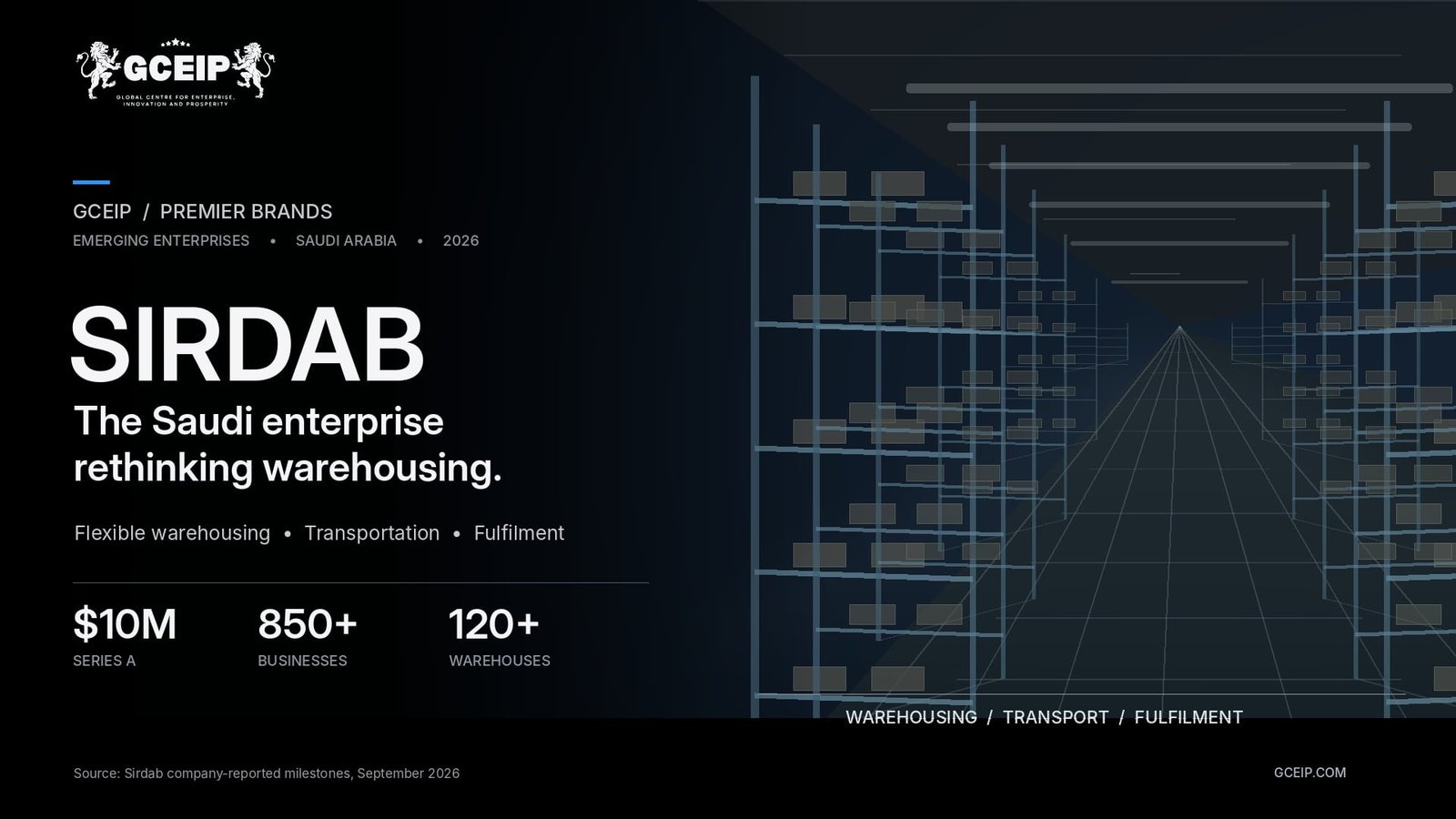
In its September 2026 funding announcement, Sirdab reported several significant milestones.
More than 850 businesses were using its platform.
Its network extended across more than 120 warehouses and over 60 transportation providers.
It reported revenue growth of approximately 20 times since participating in Y Combinator's Winter 2023 batch and stated that it had reached profitability.
These are company-reported operating and financial milestones. They demonstrate the scale of Sirdab's commercial ambitions, although the underlying revenue and profitability figures were not publicly detailed in the announcement.
The customer base reportedly includes major enterprises, publicly listed businesses and government entities.
That breadth is commercially relevant.
A logistics provider serving several industries must support different operating requirements while maintaining consistent standards.
For Sirdab, the next stage will test whether its systems and management processes can support continued expansion without sacrificing that consistency.
The $10 Million Investment and the Next Chapter
On September 3, 2026, Sirdab announced a $10 million Series A funding round, equivalent to SAR 37.5 million.
The round was co-led by Elm, the Saudi digital solutions company backed by the Public Investment Fund, and BECO Capital.
Other investors associated with the company include Y Combinator, COTU Ventures and D Global Ventures.
The investment is intended to accelerate expansion across Saudi Arabia and the wider Gulf region, develop the provider network and strengthen the company's technology infrastructure.
One area of planned development involves artificial intelligence.
Sirdab wants to use AI to improve the matching of customer requirements with suitable logistics capacity and automate parts of the coordination between shippers, warehouse operators and transportation providers.
That is a practical application of the technology.
Rather than treating AI as an independent product, the company is exploring how it can reduce friction within an existing operating system.
Matching the right customer with the right facility involves multiple variables: location, capacity, handling requirements, availability and service capabilities.
Improvements in that process could make a large provider network easier to use and manage.
The opportunity is compelling, but successful execution will require measurable improvements in service quality, operating efficiency and customer outcomes.
The funding round provides resources to pursue the ambition.
The operating performance of the expanded network will determine its value.
Why Saudi Arabia Is an Important Market for This Model
Sirdab's development comes at a time when logistics infrastructure is receiving considerable strategic attention in Saudi Arabia.
The Kingdom's economic diversification agenda includes increasing logistics capabilities, improving connectivity and supporting the development of integrated supply-chain services.
Saudi Logistics Services Company's 2025 annual report cited industry estimates indicating warehouse occupancy of approximately 97% across key logistics markets.
The same report projected warehouse demand rising from around 87 million square metres in 2023 to approximately 115 million square metres by 2030.
These estimates reflect significant structural demand for logistics infrastructure.
But greater physical capacity alone does not resolve every problem faced by growing enterprises.
Businesses also need usable space in suitable locations, dependable services and systems that connect inventory movements across facilities.
This is the opportunity Sirdab is pursuing.
Its proposition is not to replace the physical logistics industry.
It is to organise access to that industry more effectively.
GCEIP Analysis: The Opportunity Is Bigger Than Warehousing
Sirdab illustrates an increasingly important category of enterprise innovation: businesses that make existing infrastructure easier to access, coordinate and use.
The company is not attempting to reinvent the warehouse building itself.
It is changing the commercial and operational relationship between businesses that need warehouse capacity and providers that can supply it.
Three strategic choices stand out.
First, flexibility over fixed infrastructure. The platform offers an alternative to some of the long-term capacity commitments that traditionally accompany business expansion.
Second, integration over fragmentation. By connecting storage, transportation and inventory information, Sirdab is attempting to reduce the complexity of working with multiple logistics providers.
Third, technology combined with physical operations. Its proposition recognises that software alone is not enough to deliver dependable logistics.
These choices could become increasingly valuable as Saudi businesses expand across more cities, channels and product categories.
But the company also faces important competitive and operational questions.
Can service quality remain consistent across a larger partner network?
Can the technology create measurable efficiencies for customers and providers?
Can the business maintain attractive economics while entering new markets?
And how effectively can its model adapt to different regulatory and commercial environments across the Gulf?
The answers will determine whether Sirdab becomes a successful Saudi logistics platform or develops into a broader regional infrastructure business.
The Business Lesson: Build Access Before Building Assets
There is a useful lesson in Sirdab's strategy for entrepreneurs across industries.
Businesses frequently assume growth requires ownership of more infrastructure.
More warehouses. More equipment. More facilities. More permanent operating capacity.
Sometimes, that is necessary.
But not every business needs to own every resource on which it depends.
A well-designed network can create access to specialised capabilities while allowing organisations to allocate capital more selectively.
The challenge is ensuring that flexibility does not compromise quality or accountability.
For business leaders, the central question is:
Which infrastructure does your company genuinely need to own—and which could it access more effectively through a trusted operating network?
That question can influence how a company approaches expansion, investment and long-term operating efficiency.
Sirdab is building a business around helping other enterprises answer it.
What Comes Next for Sirdab?
Sirdab's next phase will involve expanding its network, introducing more technology-enabled coordination and pursuing opportunities beyond its existing Saudi market.
Its continued development will depend on the quality of the relationships it builds with warehouse operators, transportation providers and enterprise customers.
The company will also need to demonstrate that its approach creates sustainable economic value as it grows.
For the broader logistics industry, the opportunity is clear.
Warehouses, transportation networks and inventory systems will remain essential physical infrastructure.
But the way businesses access and manage those resources is changing.
Sirdab wants to play a central role in that transformation.
Its biggest opportunity may not be filling more warehouses. It may be helping more businesses grow without the burden of building an entire logistics network themselves.
Premier Brands View
Sirdab represents an emerging generation of Saudi enterprises using technology to address structural challenges in business infrastructure.
Its development demonstrates how an industry-specific operating problem can become the foundation for a scalable platform business.
The company's expanding network, reported customer adoption and recent financing provide evidence of meaningful commercial progress.
Its next stage will depend on execution, partner reliability, operational performance and the ability to deliver consistent value across a larger regional market.
As Saudi Arabia develops its position as an international logistics hub, enterprises capable of connecting physical capacity with better information and operating systems may become increasingly important.
Sirdab is attempting to become one of those enterprises.
GCEIP — Global Centre for Enterprise, Innovation and Prosperity
Transformational Leaders and Enterprise Emerging | 2026
Sirdab is a Riyadh-based logistics technology enterprise, founded in 2022 by Naif Alzahri and Abdulrahman Alnamlah, that gives businesses access to warehousing, transportation, inventory management and fulfilment services through one platform.
How much funding has Sirdab raised?
On 3 September 2026 Sirdab announced a $10 million Series A round, equivalent to SAR 37.5 million, co-led by Elm and BECO Capital.
What has Sirdab reported about its scale?
In its September 2026 announcement Sirdab reported more than 850 businesses on its platform, more than 120 warehouses and over 60 transportation providers, and revenue growth of approximately 20 times since Y Combinator's Winter 2023 batch. These are company-reported figures.
Which storage does Sirdab offer?
Sirdab's services include dry, ambient, chilled and frozen storage, alongside transport coordination, inventory management and order fulfilment, with flexible options such as storage priced by pallet or square metre.
Featured within GCEIP’s Transformational Leaders & Enterprises™ ecosystem. Explore the enterprise story behind the recognition: Transformational Enterprises and Premier Brands.
Know a leader or enterprise like this? Nominate them for Transformational Leaders & Enterprises™, in Dubai, Barcelona or London.
From continuous glucose monitoring and smart rings to blood biomarkers, women’s health and real-time biointelligence, Bengaluru-based Ultrahuman is attempting something far more ambitious than building another wearable. It wants to create a computing platform that understands the human body continuously.
From resort-style apartments and private pools to international expansion, branded residences and vertical integration, Imran Farooq has turned SAMANA Developers into one of Dubai’s fastest-rising property businesses — and is now building for a much larger stage.
From strengthening India’s chronic-therapy leadership to integrating major acquisitions and shaping a broader growth agenda, Aman Mehta is emerging as one of the key next-generation leaders in Indian pharmaceuticals.


 Ultrahuman · Health-tech and wearables