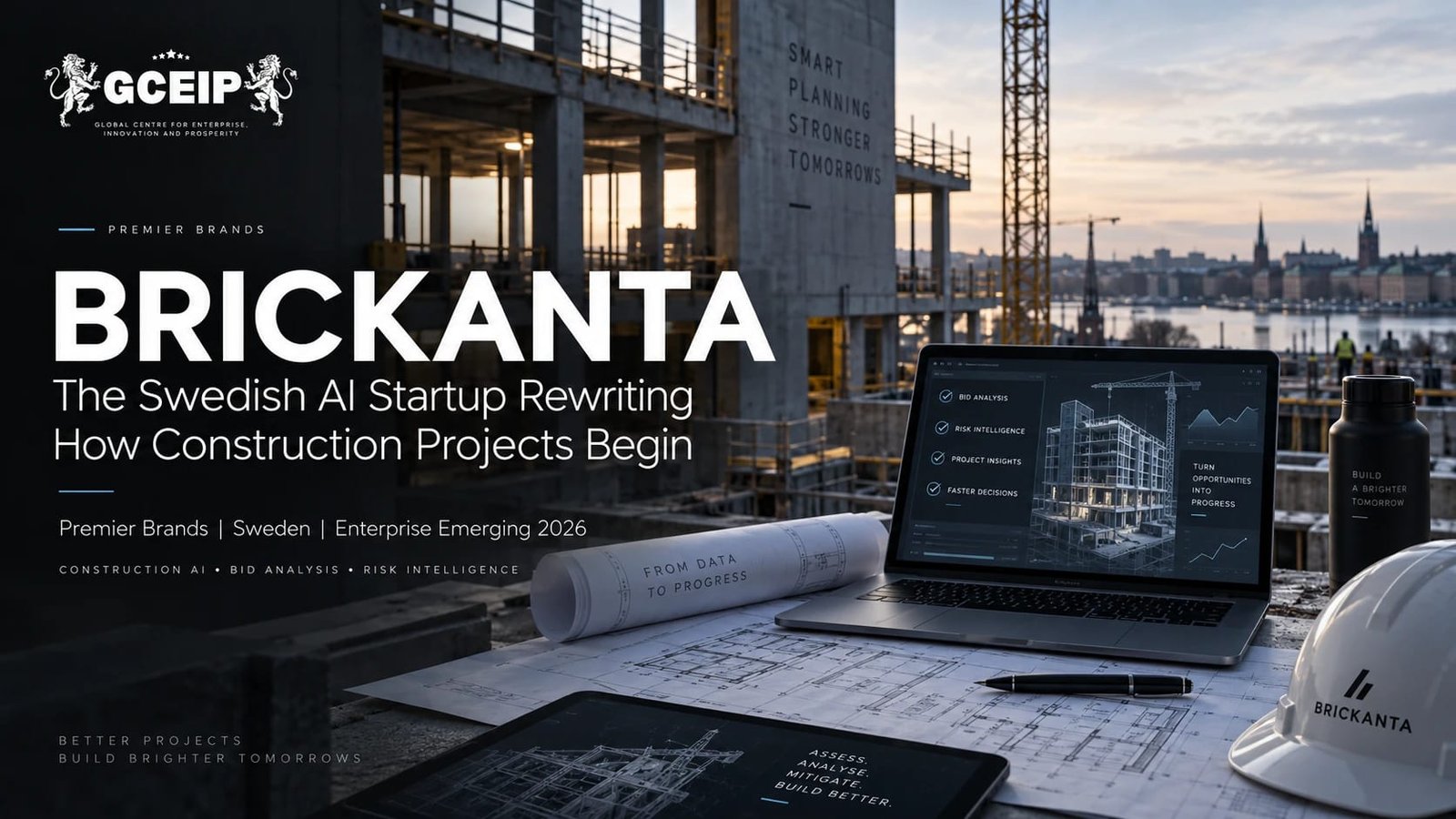
Brickanta: The Swedish AI Startup Rewriting How Construction Projects Begin
Construction projects can run into trouble long before building work starts. Stockholm-based Brickanta is developing an AI-powered platform to help construction companies analyse contracts, identify risks, prepare bids and make better decisions before committing resources.
B
BrickantaConstruction technology · Sweden · B2B
The Cover Story editorial team ·
A construction project can begin losing money before a single brick is laid.
A system that links the finding to the underlying contractual language makes professional review more practical.
The problem might be buried in a tender document. A pricing assumption may overlook an important requirement. A contract could allocate unexpected responsibility to the contractor. A late revision might change the cost of materials or the scope of work.
These are decisions made long before a construction site becomes active.
Yet the consequences can continue throughout the project.
For construction companies, carefully reviewing thousands of pages of technical specifications, contracts, calculations and procurement documents can be an enormous responsibility.
Brickanta, a Swedish artificial intelligence startup founded in 2025, is building its business around making those early decisions faster, more informed and easier to verify.
Based in Stockholm, the company is developing what it describes as an AI-native operating system for construction.
Its approach combines industry-specific artificial intelligence with real construction documentation, historical project information, technical requirements and professional workflows.
The company's ambition extends beyond producing faster estimates.
It wants to change how construction enterprises prepare, evaluate and manage projects.
And after raising $8 million in January 2026, Brickanta has been expanding its technology, customer relationships and specialist capabilities.
The Billion-Dollar Decisions Hidden in Construction Documents
Construction is a physical industry, but much of its commercial outcome is determined through information.
Before a project receives final approval, contractors must interpret specifications, understand contractual obligations, calculate costs, assess risks and prepare procurement decisions.
Different teams may work on separate parts of the process.
Estimators examine material and labour requirements.
Project managers consider scheduling and operational constraints.
Commercial teams evaluate contractual risks.
Procurement specialists assess suppliers and purchasing requirements.
The quality of these decisions depends on having accurate, relevant and current information.
But important details are often distributed across extensive documentation.
A requirement appearing in one technical appendix may affect a calculation contained elsewhere.
A contract amendment can change the commercial significance of an earlier assumption.
A missed discrepancy may not become visible until work has already begun.
Brickanta's founders saw an opportunity to address this complexity through AI designed specifically for the construction industry.
Rather than develop a general-purpose chatbot, the business began with the workflows that determine whether a project is commercially viable.
That focus became the foundation of its product.
Building AI for the People Who Actually Build
Brickanta was co-founded by Lucas Otterling, its CEO, and Linus Bein Fahlander, its CTO.
The founding team brought experience working with AI in industrial and enterprise settings, and the company became part of Y Combinator's 2025 cohort.
Its strategy concentrated on three closely connected activities: bid analysis, cost estimation and procurement.
Each involves decisions that can significantly influence a construction company's profitability.
A contractor preparing a bid needs to understand not simply what a customer wants built, but also the obligations, exclusions, uncertainties and potential changes associated with the project.
Brickanta's system is designed to analyse tender documentation and identify issues requiring professional attention.
It can examine technical specifications alongside contractual conditions, draw on previous project information and prepare structured findings.
For procurement teams, the platform can also help generate documentation that would otherwise require extensive manual preparation.
This creates an opportunity to reduce repetitive administrative work while improving the consistency of project analysis.
But there is an important distinction between automating document processing and automating business judgment.
An AI system may identify a contractual clause or unexpected specification.
The decision about whether to accept the risk, modify the bid or seek clarification still belongs to the responsible professionals.
Brickanta's approach increasingly reflects that division of responsibility.
The $8 Million Investment That Accelerated the Business
In January 2026, Brickanta announced an $8 million seed funding round led by Northzone.
The investor group included Y Combinator, SSE Business Lab, technology entrepreneurs and individuals with experience in construction and related industries.
The financing attracted attention because Brickanta was targeting a large industry where many administrative and pre-construction workflows remain labour-intensive.
According to reporting by Tech.eu at the time of the financing, the platform had been introduced to construction teams across 11 countries on four continents.
The company was also reporting interest from enterprise customers seeking ways to improve the speed and quality of early project decisions.
The funding was intended to support product development, recruitment and expansion across Europe.
But the investment itself is only one part of the enterprise story.
The more significant question is how quickly Brickanta can translate technical capability into measurable operating improvements for construction companies.
For an emerging enterprise software company, commercial credibility comes from customers incorporating the technology into actual workflows.
That is where Brickanta's recent development becomes especially interesting.
From Technology Demonstrations to Construction Workflows
One of Brickanta's reported customers is H2, a Swedish construction company operating across residential development projects.
In June 2026, Swedish construction publications reported that H2 was introducing Brickanta's platform into its early project processes.
The objective was to examine project material, compare documents with previous project experience and identify risks or opportunities that could otherwise require substantial manual review.
For a growing construction company, this is more than an exercise in technology adoption.
Every new project increases the amount of information that must be reviewed, coordinated and acted upon.
If administrative tasks grow at the same rate as construction activity, organisations may eventually find their expansion limited by the capacity of their existing teams.
AI-assisted analysis offers the possibility of increasing that capacity.
However, H2's publicly stated ambition to improve productivity should be distinguished from independently measured productivity gains.
An intention to double capacity per employee, for example, is not evidence that the outcome has already been achieved.
Brickanta also describes work with SPV Group, a Swedish road and traffic safety business.
According to Brickanta's published customer case study, the platform helped SPV organise tender preparation, project documentation, estimating and change-order management.
The company reports that administrative work was reduced by several hours each week, with risks identified earlier in the project process.
These customer-reported outcomes provide evidence of practical usage, although they should not be treated as independently audited performance results.
The important development is that Brickanta's technology is moving into real operational environments.
That is a necessary step towards building a sustainable enterprise.
Why Construction Expertise Matters as Much as AI
Brickanta's 2026 expansion has not been limited to adding software features.
The company has also brought specialist expertise into its organisation.
In May, it announced the acquisition of Praxiom AI, a construction-law AI tool developed by lawyer Anne Wijkman.
The move added expertise in interpreting contractual questions and relevant legal decisions.
In August, Brickanta announced another specialist addition involving Alysa, an AI tendering startup co-founded by Nayar Grinberg.
In September, the company brought in further expertise connected to sustainable housing, AI development and enterprise technology implementation.
These decisions point towards a broader strategy.
Brickanta is attempting to combine artificial intelligence with professional knowledge that is difficult to reproduce through generic software alone.
Construction contracts, building practices and procurement requirements differ across jurisdictions and project types.
An AI system that understands the language of a document but not its professional context may produce answers that are superficially convincing yet commercially unreliable.
Domain expertise therefore becomes part of the product's value.
For Brickanta, the challenge is to translate that expertise into software that can be used consistently by different customers without requiring a specialist to manually review every routine action.
The October 2026 Product Update
On October 8, 2026, Brickanta announced a significant expansion of its platform.
The update introduced new workflows designed to begin analysing project information as soon as users connect the relevant files.
The company described integrations that allow documentation to be imported from systems such as SharePoint and Dropbox.
Once the information is available, Brickanta can begin reviewing project materials and organising the steps required for further analysis.
Another important development concerns traceability.
The platform is designed to connect findings to the particular documents and passages from which they were derived.
That matters because a construction professional must be able to verify why an issue has been flagged.
A system that identifies a potential risk without showing the supporting evidence creates another layer of uncertainty.
A system that links the finding to the underlying contractual language makes professional review more practical.
The October update also introduced stronger project-memory capabilities, allowing changes in documentation, decisions and requirements to be tracked over time.
This is an important development because construction projects are not static.
Contracts change. Specifications are revised. Procurement decisions evolve.
An operating platform must be able to follow those changes rather than analyse only the original version of a project.
Brickanta also emphasised human control over consequential actions, with users able to review, modify or reverse relevant steps.
The direction is clear: the company wants AI to become part of the construction workflow, not simply another application that employees consult occasionally.
Partnerships as the Next Growth Strategy
On October 1, Brickanta announced a partnership with Norteam, bringing together its construction-focused AI technology with expertise in Microsoft Cloud and cybersecurity.
The partnership addresses a problem faced by many enterprise software businesses.
A strong application is not automatically easy to deploy inside an established organisation.
Customers need to understand security, access permissions, integration, governance and responsibility for the information being processed.
Construction enterprises frequently rely on existing document-management systems and internal technology environments.
New AI tools must work alongside those systems.
For Brickanta, partnering with implementation specialists could reduce some of the barriers to adoption.
The opportunity is not merely to sell software to more companies.
It is to make the software easier to introduce, govern and use in everyday business operations.
That could become an important element of its European expansion strategy.
GCEIP Analysis: Europe's Construction AI Opportunity
Brickanta represents an emerging category of European technology enterprise: companies developing AI around the operating requirements of traditional industries.
The business is not competing to create the largest general-purpose language model.
It is attempting to create value through industry knowledge, customer workflows and the ability to interpret complex business information.
Three decisions are particularly significant.
First, Brickanta chose a narrowly defined starting point. Bid analysis, cost estimation and procurement provide specific use cases where improvements can be evaluated against existing workflows.
Second, the company is combining AI with professional expertise. Its specialist additions in construction law, tendering and sustainability suggest that domain knowledge is central to the product's development.
Third, it is building towards deeper enterprise integration. The October product release and Norteam partnership show an emphasis on traceability, existing IT environments and practical adoption.
These choices could help Brickanta differentiate itself from generic AI applications.
But they also create demanding responsibilities.
Construction companies need accurate, auditable outputs. Contractual mistakes can have substantial financial consequences. Information security and customer trust will influence adoption.
Competition is also likely to intensify as established construction software providers introduce more AI capabilities.
Brickanta must demonstrate why its specialised approach provides additional value.
Its long-term advantage will depend not just on what the platform can analyse, but on how dependably it improves decisions for customers.
The Business Lesson: Solve the Costly Decision Before Automating the Routine Task
Brickanta's development provides a useful lesson for entrepreneurs building AI businesses.
The opportunity is not always to automate the most visible part of an industry.
Sometimes the greatest value lies in improving an earlier decision that influences everything that follows.
For construction companies, a missed issue during tender analysis can create problems throughout the project.
Identifying that issue before a contract is signed may be more valuable than accelerating an administrative task after work has begun.
The same principle applies across other industries.
A manufacturer benefits from identifying supplier risks before production starts.
A financial services business benefits from recognising compliance problems before a transaction is completed.
A healthcare provider benefits from accurate information before a clinical or operational decision is made.
The most valuable AI application may not be the one that completes the most tasks. It may be the one that helps an organisation avoid its most expensive mistakes.
That is the business opportunity Brickanta is pursuing.
What Comes Next for Brickanta?
Brickanta's next phase will test whether its construction-specific approach can scale across different customers, markets and regulatory environments.
The company has raised capital, attracted industry attention and demonstrated customer adoption.
It has also expanded its product and brought additional specialist knowledge into the business.
The challenge now is execution.
Can Brickanta consistently deliver reliable analysis across different construction documents and practices?
Can it demonstrate measurable savings and improved outcomes for customers?
Can it maintain product quality as the platform becomes more autonomous?
And can its technology become a normal part of construction companies' operating systems?
These questions will determine whether Brickanta becomes a successful specialist application or develops into a more substantial international enterprise software business.
For an industry built around physical structures, an important part of the next transformation may begin with information.
Brickanta's opportunity is to help construction businesses make better decisions before those decisions become expensive buildings, projects and commitments.
Premier Brands View
Brickanta represents a new generation of Swedish enterprises applying artificial intelligence to established industrial challenges.
Its focus on pre-construction decisions, professional expertise and practical workflows offers an approach to technology development grounded in the operating needs of customers.
The company's early funding, international customer activity and continued product expansion demonstrate commercial momentum.
Its long-term success will depend on reliable execution, clear customer outcomes and the ability to build a sustainable competitive position in the construction technology market.
The larger lesson is relevant well beyond Sweden.
Innovation becomes most meaningful when it changes how important work is actually done.
Key facts
What is Brickanta?
Brickanta is a Stockholm-based artificial intelligence company building what it describes as an AI-native operating system for construction, focused on bid analysis, cost estimation and procurement.
Who founded Brickanta?
Brickanta was co-founded by Lucas Otterling, its CEO, and Linus Bein Fahlander, its CTO. The company became part of Y Combinator's 2025 cohort.
How much funding has Brickanta raised?
In January 2026 Brickanta announced an $8 million seed round led by Northzone, with participation from Y Combinator, SSE Business Lab and other investors.
What does Brickanta's platform do?
It analyses tender documentation, technical specifications and contractual conditions, draws on previous project information and prepares structured findings so that construction professionals can review risks before committing resources. The company says findings are linked to the documents and passages they come from.
Which construction companies use Brickanta?
Brickanta's reported customers include the Swedish construction company H2, which was introducing the platform into its early project processes in June 2026, and the road and traffic safety business SPV Group, according to the company's customer case study. Customer outcomes are company-reported and not independently audited.
Is a GCEIP Premier Brands story an award?
No. A Premier Brands story is an editorial feature. It does not make its subject an award recipient, and recognition is subject to GCEIP's eligibility, review and selection standards.
Featured within GCEIP’s Transformational Leaders & Enterprises™ ecosystem. Explore the enterprise story behind the recognition: Transformational Enterprises and Premier Brands.
Know a leader or enterprise like this? Nominate them for Transformational Leaders & Enterprises™, in Dubai, Barcelona or London.
From continuous glucose monitoring and smart rings to blood biomarkers, women’s health and real-time biointelligence, Bengaluru-based Ultrahuman is attempting something far more ambitious than building another wearable. It wants to create a computing platform that understands the human body continuously.
From resort-style apartments and private pools to international expansion, branded residences and vertical integration, Imran Farooq has turned SAMANA Developers into one of Dubai’s fastest-rising property businesses — and is now building for a much larger stage.
From strengthening India’s chronic-therapy leadership to integrating major acquisitions and shaping a broader growth agenda, Aman Mehta is emerging as one of the key next-generation leaders in Indian pharmaceuticals.


 Ultrahuman · Health-tech and wearables