A Factory for the Difficult Battery: Bryan Oh’s Lithium Recovery Bet
Bryan Oh is moving a Singapore battery-recycling technology from laboratory promise into the demanding economics of industrial production.
BO
Bryan OhCo-founder and CEO · NEU Battery Materials · Singapore
GCEIP Editorial Desk ·
Editorial. Published by the GCEIP editorial desk under our editorial policy. An editorial story does not make its subject an award recipient.
Quick ReadHighlights from this page⌃
Bryan Oh is moving a Singapore battery-recycling technology from laboratory promise into the demanding economics of industrial production.
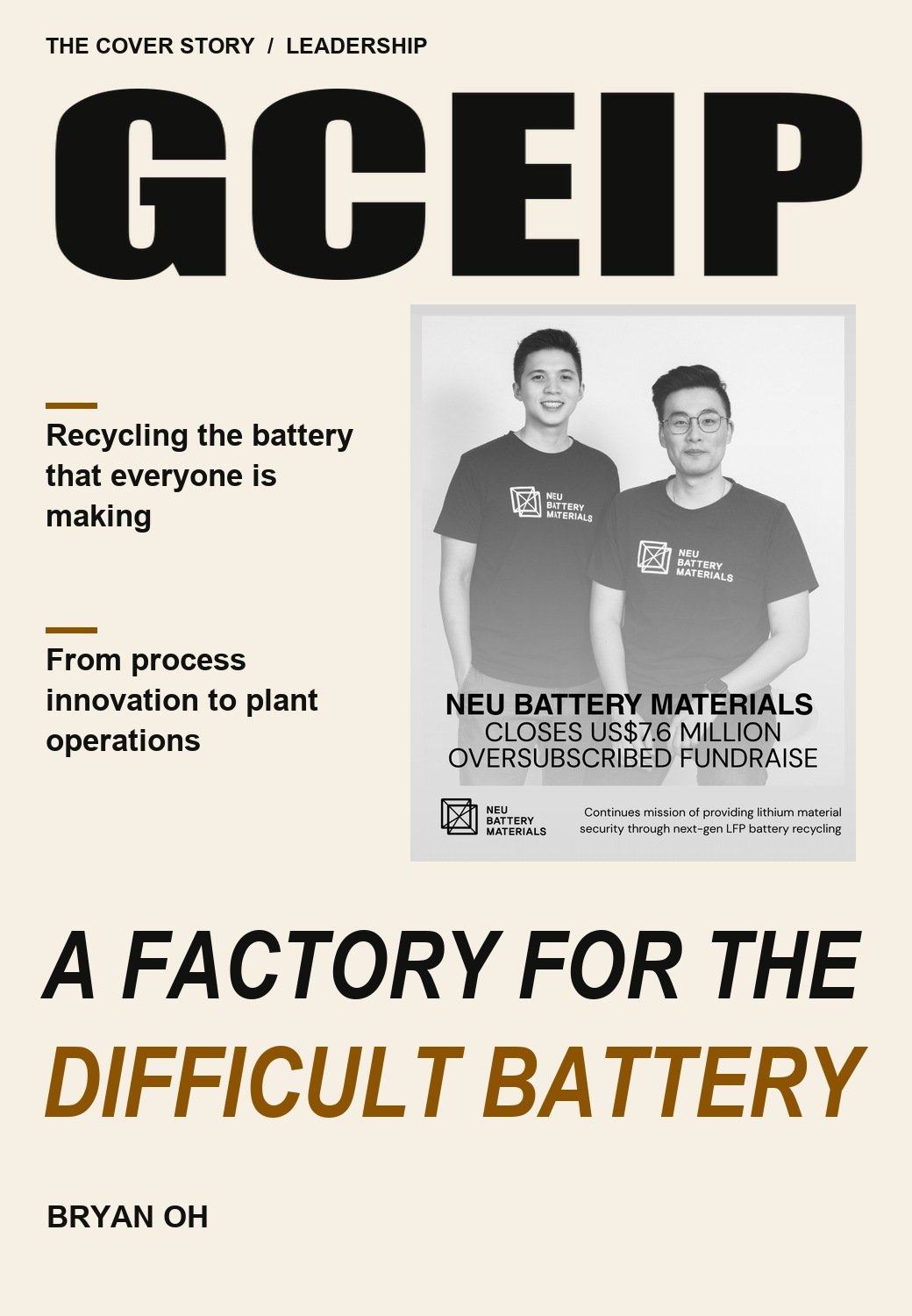
NEU Battery Materials co-founders Bryan Oh and Kenneth Palmer. Photograph: NEU Battery Materials. Source
Recycling the battery that everyone is making
Lithium iron phosphate batteries have become increasingly important in electric vehicles and stationary storage. Their appeal rests partly on cost and durability. But when they reach end of life, recovering valuable materials is not straightforward. NEU Battery Materials, led by co-founder and CEO Bryan Oh, is developing an electrochemical process intended to recover battery-grade lithium from lithium iron phosphate material. That sounds like a chemical-engineering problem. For Bryan, it has become a manufacturing and supply-chain problem: can a cleaner process deliver material that industrial buyers actually need at a viable cost?
From process innovation to plant operations
NEU’s reported method uses water, electricity and regenerative chemistry rather than relying exclusively on conventional high-heat or chemical-intensive processing routes. Different recycling methods have different environmental and economic trade-offs, so broad claims of superiority require like-for-like assessment. The company’s central proposition is that lithium recovery could be more efficient for LFP battery streams that are increasingly common. The question for management is whether promising results at pilot scale survive the transition to commercial feedstock variability, plant uptime, purity testing and customer specifications.
October 2026 changed the conversation
On October 13, 2026, NEU announced a US$7.6 million funding round co-led by Shift4Good and SGInnovate. The announcement followed commissioning of a Singapore factory described as having 1,300 tonnes of annual input-processing capacity. An independent report in The Straits Times confirmed the financing and the company's plans to reduce production cost while pursuing overseas growth. Factory capacity is not the same as measured annual throughput or sales. Nevertheless, commissioning a physical facility is a meaningful change for a technology business: assumptions must now be tested through continuous operations, maintenance and actual customers.
Building the lithium supply chain
The value of recovered lithium depends on more than collection volumes. Industrial buyers need dependable specifications, price, delivery schedules and traceable material. NEU must therefore earn trust on both ends of the chain: secure consistent battery scrap and end-of-life inputs, then deliver a predictable output. Expansion into international markets would introduce varied waste-management rules and operational partnerships. Additional investment creates room to refine the process, but does not remove the technical and commercial risk of reaching sustained industrial scale.
How industrial proof differs from laboratory proof
A recycling facility must handle materials that arrive in inconsistent form and condition. Even a high-performing process can struggle if incoming batteries are contaminated, if feedstock costs rise or if recovered material fails a buyer’s quality test. NEU will need to publish process results in ways that distinguish nameplate capacity, actual throughput, lithium recovery yield and saleable output. Those figures tell different stories. For Bryan, building a dependable operating culture around safety, procurement and analytical chemistry may become as important as the innovation that first attracted investors.
GCEIP Analysis
What distinguishes this leadership case is the move from technical differentiation towards industrial accountability. Battery recycling is attracting capital because the installed base of batteries is growing. Yet an expanding market is not a business model in itself. NEU needs independently supported recovery rates, documented safety controls, evidence of battery-grade output quality and long-term buyer relationships. The 2026 plant and fundraising round support the claim of progress; commercially mature operations remain the test.
GCEIP View
Bryan Oh’s opportunity is to make a difficult battery material economically recoverable rather than merely technically recyclable. The new plant puts NEU closer to proving that proposition. Its operating record will depend on how much material the plant processes and sells at the required quality, and whether buyers keep returning. That would make Singapore’s recycling innovation part of a more resilient battery supply chain.
Key facts
Who is Bryan Oh?
Bryan Oh is the co-founder and CEO of NEU Battery Materials in Singapore.
What does NEU Battery Materials recycle?
It develops electrochemical recovery of lithium from lithium iron phosphate battery materials.
If this story is about you or your company, you are welcome to link to it. Copy either snippet below into your website, press page, email signature or post.
About this feature
This is a GCEIP editorial feature. Publication does not confer nomination, finalist, winner or honouree status.
At Singapore's Augmentus, Daryl Lim is addressing a problem that has kept industrial automation out of many workshops: the time and specialist knowledge needed to program robots for changing tasks.
Ailytics uses computer vision to flag hazards in existing CCTV footage. Co-founder and CEO Lenard Tan is selling an operational tool into industries that have good reasons to be cautious about new technology.
The founder who challenged India's fragmented hotel industry is now leading PRISM through a much larger transformation. With Motel 6 reshaping its international business and a proposed IPO approaching, Ritesh Agarwal faces a different test of leadership: building a financially resilient global hospitality company.
The entrepreneur who built a global podcast audience is now attempting to create a business ecosystem spanning media, technology, investment and creator-led enterprises.