
A Factory for the Difficult Battery: Bryan Oh’s Lithium Recovery Bet
Bryan Oh is moving a Singapore battery-recycling technology from laboratory promise into the demanding economics of industrial production.
Nomination Stories · Southeast Asia · Featured Leader
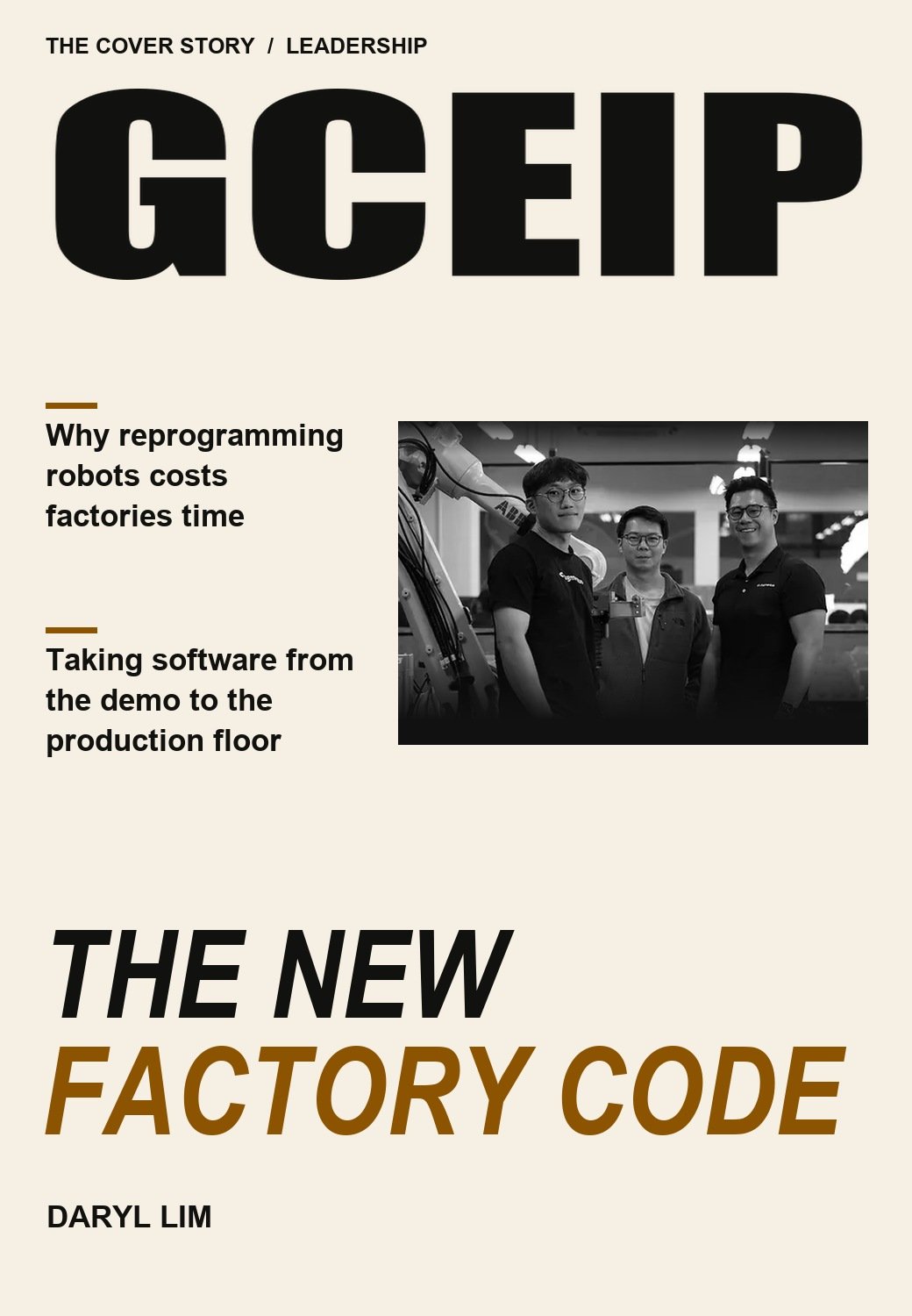
At Singapore's Augmentus, Daryl Lim is addressing a problem that has kept industrial automation out of many workshops: the time and specialist knowledge needed to program robots for changing tasks.
GCEIP Editorial Desk ·
Editorial. Published by the GCEIP editorial desk under our editorial policy. An editorial story does not make its subject an award recipient.
Industrial robots are often associated with high-volume factories, where the same process repeats thousands of times. That arrangement can justify the expense of programming and engineering a robot cell. But what happens in a workshop where components change weekly, parts vary and production runs are small?
Daryl Lim, co-founder and chief executive of Singapore-based Augmentus, has built a company around that question. Augmentus develops software intended to make industrial robot programming less dependent on specialist coding and manual teaching. Its AutoPath platform uses digital part information, scanning and automated path planning to prepare robotic work for processes including finishing, spraying and welding.
The proposition is not that any robot can do any task without human oversight. It is that a substantial programming bottleneck might be reduced for manufacturers whose work is too varied for conventional automation to be economical.
Augmentus was founded in 2019 by Lim, Chong Voon Foo and Leong Yong Shin. The founding team's central challenge was to make the transition from an engineering concept to software capable of supporting real industrial processes.
In July 2025, Augmentus announced an US$11 million Series A+ funding round led by Woori VP, with EDBI and other investors participating. Three months later, it announced a strategic investment from Applied Ventures, the venture-capital arm of Applied Materials.
Such financing does not establish product effectiveness by itself. It does, however, show the business attracting industrial and financial partners interested in the prospect of more flexible robotic automation. The company's website now positions AutoPath as an agentic robot-programming system for high-mix manufacturing.
Lim's job is to ensure the technology works reliably across different installations and production requirements. A factory buying automation needs more than an impressive demonstration. It needs safe integration, predictable cycle times, qualified operators and support when tasks change.
Manufacturing environments are rarely as tidy as software demonstrations. Material finishes vary. Parts may be positioned differently. Equipment from different vendors behaves differently. A robot path that looks valid digitally must be checked against physical reality and workplace safety requirements.
That complexity is why the company's approach combines software with process-specific knowledge. Users still need a clear understanding of the job being performed and appropriate engineering controls. Faster programming should never be confused with automatic permission to bypass validation.
Augmentus' business model also depends on convincing manufacturers that total automation costs can be justified for smaller production runs. Hardware, integration, training and ongoing support all affect the final decision. Lim therefore has to translate technical functionality into measurable operational outcomes.
The company advertises significant potential reductions in programming time. Those are vendor claims; performance will depend on the task, production environment and comparison method. Independent customer case evidence is important before treating any headline saving as representative.
The transformation Augmentus is pursuing is a shift in the economics of factory automation. Its technology addresses a constraint that sits between the hardware manufacturers already own and the range of work they wish those machines could perform.
Lim's leadership combines deep product development with the commercial demands of industrial software: standards, integrations, channel partnerships and customer trust. The 2025 investments are an enabling step, not the conclusion of the story.
A more revealing measure will be the number of customers that deploy the system repeatedly, extend it to new processes and renew their relationships because the operating economics work.
Daryl Lim represents an emerging industrial-technology leader focused on a precise problem rather than a broad promise that artificial intelligence will transform everything.
Augmentus' work suggests that the next advance in robotics may come from making machines easier to reconfigure, not merely making them more powerful. Whether the company can turn that idea into a durable global business will depend on dependable performance in demanding manufacturing environments. That combination of technological ambition and operational accountability makes Lim's story worth watching.
If this story is about you or your company, you are welcome to link to it. Copy either snippet below into your website, press page, email signature or post.

Featured within GCEIP’s Transformational Leaders & Enterprises™ ecosystem.
Know a leader or enterprise like this? Nominate them for Transformational Leaders & Enterprises™, in Barcelona or London. Nominations for Dubai are closed.
Bryan Oh is moving a Singapore battery-recycling technology from laboratory promise into the demanding economics of industrial production.
Ailytics uses computer vision to flag hazards in existing CCTV footage. Co-founder and CEO Lenard Tan is selling an operational tool into industries that have good reasons to be cautious about new technology.
 Alisha Moopen · Aster DM Healthcare GCC
From expanding hospital networks to digital health, AI-enabled care and a growing Saudi footprint, Alisha Moopen is helping transform Aster DM Healthcare from a traditional provider into a connected healthcare ecosystem for the GCC.
 Navneet Mandhani · Karma Developers
From technology and global business to real estate and venture investing, Navneet Mandhani has built his career around one recurring idea: spotting opportunity early and scaling it across markets.
Choose an assistant to explore this page further.
Opens in a new tab. You can also copy the prompt into your assistant.