A Solar Plant Without the Capital Bill: Suryanesia’s Rooftop Bet
Indonesia’s Suryanesia is building a commercial rooftop-solar business around long-term energy services rather than one-off equipment sales.
S
SuryanesiaDistributed solar / energy services · Indonesia
GCEIP Editorial Desk ·
Editorial. Published by the GCEIP editorial desk under our editorial policy. An editorial story does not make its subject an award recipient.
Quick ReadHighlights from this page⌃
Indonesia’s Suryanesia is building a commercial rooftop-solar business around long-term energy services rather than one-off equipment sales.
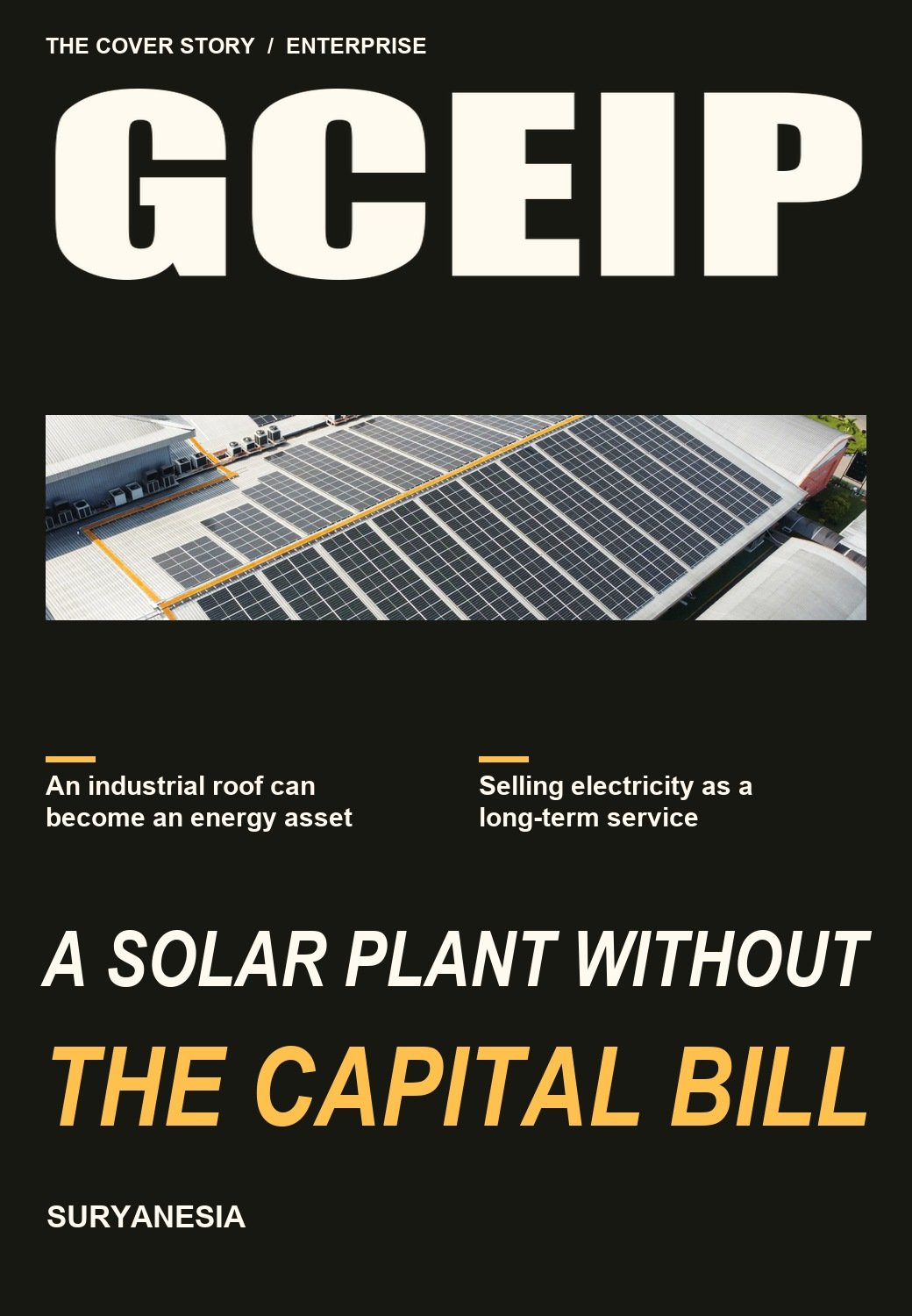
Rooftop solar installation. Photograph: Suryanesia. Source
An industrial roof can become an energy asset
A large factory roof is often an underused asset. It can house solar panels and reduce reliance on grid electricity, but its owners must decide whether deploying capital into power generation is more valuable than investing in their core business. Indonesia’s Suryanesia is trying to change that decision. Its model focuses on rooftop solar for commercial and industrial customers, with financing and ongoing system operation designed to reduce the need for large initial capital outlays. The commercial challenge is not simply placing panels on a roof: it is making clean power dependable, financially compelling and easy to procure.
Selling electricity as a long-term service
The company offers rooftop photovoltaic systems and associated development and maintenance services. Its approach can include long-term arrangements in which the customer pays for electricity generated rather than funding and owning the system outright. That changes the sales conversation. A manufacturer can evaluate power costs and operating impact without becoming a solar project developer. Suryanesia, meanwhile, takes on engineering, procurement, installation, maintenance and financing complexity. This model can unlock installations, but it also introduces risks around customer creditworthiness, long-duration contracts and changing power-sector rules.
A 2025 industrial partnership
In March 2025, lightweight-brick manufacturer Superior Prima Sukses, listed under the stock code BLES, announced an industrial rooftop-solar partnership with Suryanesia. Reporting on the arrangement described a plan to help BLES transition towards cleaner energy through a rooftop installation. This is a more concrete milestone than an aspirational corporate net-zero pledge: it links a specific industrial customer to a power project. However, a partnership announcement is not the same as independently verified lifetime generation or emissions savings. Those results require metered output, a consistent accounting method and a completed operating period.
Looking beyond the first installation
Suryanesia has discussed ambitious multi-year expansion, including a reported target of reaching 1,000 megawatt-peak of rooftop solar by 2029. That is a future target, not capacity already installed. To grow responsibly, a distributed-power company needs standardized design, reliable contractors and systems for monitoring equipment at many sites. It also requires capital providers willing to finance portfolios whose cash flows arrive over years rather than months. Growth in bookings alone will not answer whether projects generate attractive returns and maintain uptime.
The Indonesian market test
Indonesia has compelling industrial electricity demand, abundant sunlight and a complex regulatory environment. Rules governing on-site generation, power exports and procurement can shape the economics of every project. Customers also have varying roof conditions, operating schedules and load profiles. Suryanesia will need to choose projects carefully, avoiding assumptions that a panel performs equally well on every factory. The strongest evidence of enterprise transformation would be a repeatable portfolio of operating plants with published generation, safety, reliability and customer-retention results.
Financing cannot hide poor economics
A no-upfront-cost offer can be attractive, but it does not eliminate project costs; it reallocates them across contract terms and financing parties. An industrial customer needs to understand tariff assumptions, equipment warranties, termination conditions and the consequences of a factory moving or changing production. Suryanesia must manage those risks clearly. A mature energy-services company succeeds when its contracts stay sensible under changing electricity prices and operating circumstances. Transparent metered generation and customer case studies would make its transformation easier to assess beyond announcements.
GCEIP Analysis
The company's innovation is commercial as much as technical. Solar panels are established technology; helping an industrial company adopt them without redirecting essential capital is the service opportunity. The BLES agreement points to a real industrial application, while the 2029 expansion goal indicates ambition. The hard part lies between those two facts: financing, delivery and operations across many customer sites. This is where an energy services business earns its differentiation.
GCEIP View
Suryanesia sells an energy service to customers whose main business is manufacturing. If the company can consistently deliver competitively priced, well-maintained solar electricity, the rooftop becomes productive infrastructure rather than unused space. Metered output and contract performance will show how well the model works.
Key facts
What is Suryanesia?
Suryanesia is an Indonesia-based developer of commercial and industrial rooftop solar systems and energy services.
What is Suryanesia’s expansion target?
Reporting described a target of 1,000 MWp of rooftop solar by 2029. This is a future target.
If this story is about you or your company, you are welcome to link to it. Copy either snippet below into your website, press page, email signature or post.
About this feature
This is a GCEIP editorial feature. Publication does not confer nomination, finalist, winner or honouree status.
The Swiss-Indonesian agritech company is extending farm-level traceability into AI-assisted reporting. Its work shows why sustainability claims increasingly depend on the quality of underlying supply-chain records.
Waste4Change combines collection, sorting, education and consulting in Indonesia. The business built by founder Mohamad Bijaksana Junerosano is trying to make responsible waste handling easier to procure and track.
From performance-focused electric motorbikes to affordable family transportation, Dat Bike is taking on one of Southeast Asia's most established consumer habits. Its next challenge is not simply building a better electric motorcycle, but building a manufacturing and service business capable of competing at national and eventually regional scale.
Construction projects can run into trouble long before building work starts. Stockholm-based Brickanta is developing an AI-powered platform to help construction companies analyse contracts, identify risks, prepare bids and make better decisions before committing resources.