
A Solar Plant Without the Capital Bill: Suryanesia’s Rooftop Bet
Indonesia’s Suryanesia is building a commercial rooftop-solar business around long-term energy services rather than one-off equipment sales.
Nomination Stories · Southeast Asia · Featured Enterprise
The Swiss-Indonesian agritech company is extending farm-level traceability into AI-assisted reporting. Its work shows why sustainability claims increasingly depend on the quality of underlying supply-chain records.
GCEIP Editorial Desk ·
Editorial. Published by the GCEIP editorial desk under our editorial policy. An editorial story does not make its subject an award recipient.
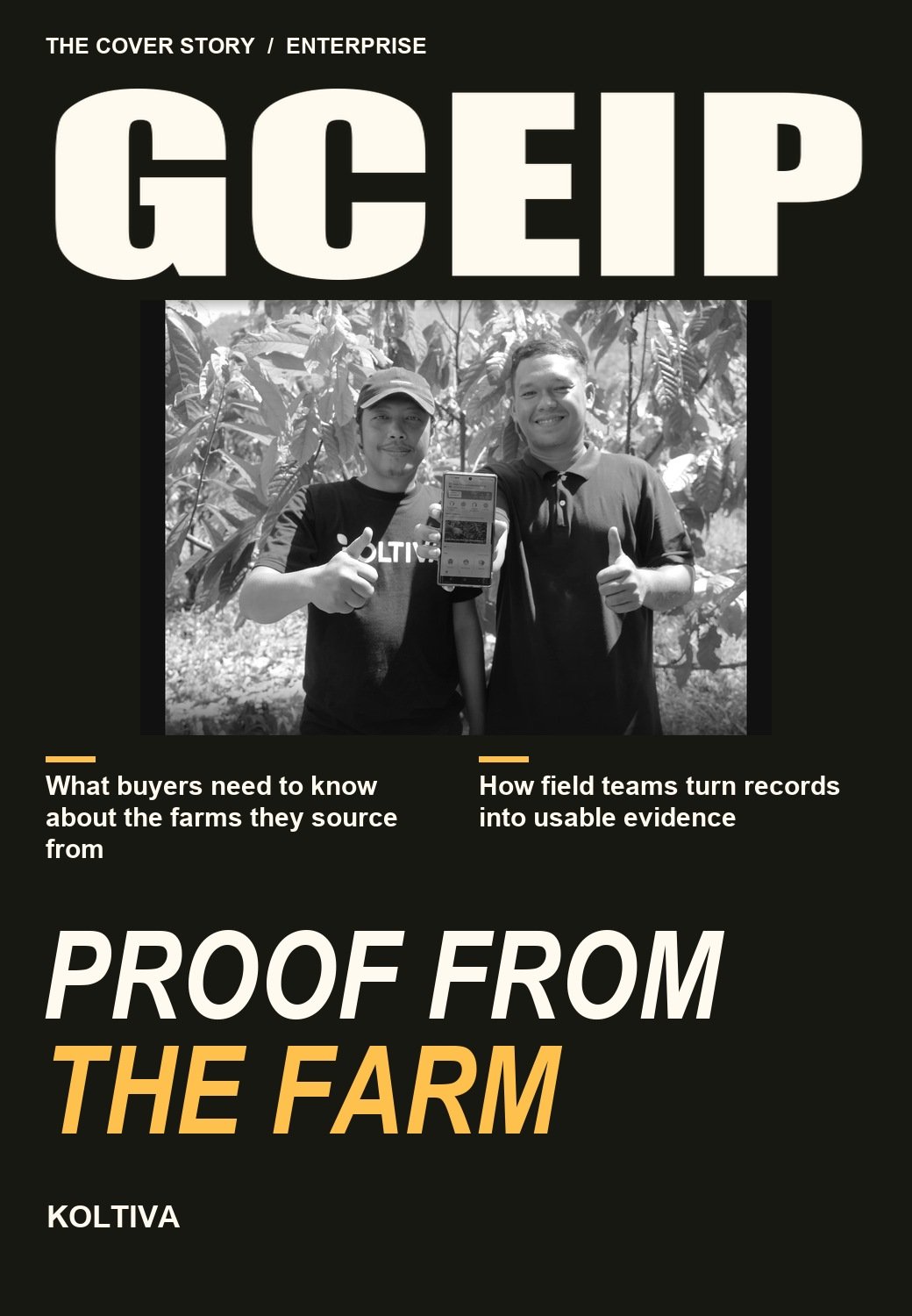
A coffee, cocoa or other agricultural product may travel through many hands before reaching a consumer. Buyers often know the immediate supplier but have less visibility into the farms, transactions and conditions behind the shipment.
Koltiva works on that information gap. The Swiss-Indonesian company combines digital traceability tools with field data collection and related services to support agricultural supply chains. Its model addresses a problem that becomes more urgent as companies face requirements to substantiate responsible sourcing and environmental claims.
Traceability is not merely a map with farm locations. Useful records require the ability to connect producers, sourcing activity, transactions and relevant documentation in a way that remains reliable as products move through the system.
In February 2026, Koltiva announced an AI-powered traceability pilot involving SUGATA, a coffee and cocoa supplier in Aceh, Indonesia. The project was described as part of an AI Singapore industry initiative and aimed to improve data quality monitoring and sustainability reporting.
The initiative was presented as a pilot, not a proven universal system capable of certifying every agricultural claim automatically. That distinction is fundamental. Artificial intelligence can help detect anomalies and prepare reports, but it cannot make unreliable source records truthful.
Koltiva's stated plan was to combine automated processes with its existing field and transaction data, allowing agribusiness customers to organise evidence for responsible sourcing more efficiently. It described operating across a large international footprint and serving many producer networks. Such scale figures are company-reported; the stronger editorial point is the complexity of the challenge being addressed.
The external environment is also shifting. Regulations and buyer standards can increase demand for traceability, but their exact requirements and implementation dates differ and may change. Koltiva's systems therefore need to be flexible rather than built around one headline rule.
Agricultural data is particularly difficult because many producers operate small farms, sometimes with limited connectivity and inconsistent documentation. A digital system has to account for ground conditions, local languages and the incentives of different participants.
Koltiva's model includes field engagement as well as software. That matters because a record is only as strong as the process through which it was collected and maintained. Digital tools can improve consistency, yet independent assurance and appropriate human review may still be required for significant claims.
The economics are complicated too. Buyers may want detailed evidence, while smallholders have limited time to provide it. A sustainable approach must avoid transferring all of the reporting burden to the least resourced participant.
The company also has to manage privacy and access. Supply-chain data may contain commercially sensitive transactions and personal information about producers. A trustworthy platform must restrict access appropriately and be transparent about its methodology and limitations.
Koltiva's transformation is from digitising agricultural traceability towards providing decision-support and reporting capabilities across international supply chains. The 2026 pilot represents a specific new application of AI within that existing infrastructure.
Its success should not be judged by the number of dashboards generated. More useful measures would include fewer data gaps, better source validation, reduced reporting effort and a clear record of how claims are reviewed.
This is a practical example of responsible technology adoption: automation should strengthen evidence, not replace it.
Koltiva's relevance lies in the transition from sustainability language to traceable operational information. The company is working in an environment where businesses increasingly need to show where products come from and how important claims were established.
The next challenge is to demonstrate that AI-assisted tools can improve the reliability of supply-chain records while respecting the realities of smallholder agriculture. If it can deliver that balance, Koltiva's contribution will be measured in stronger commercial trust and more credible evidence across the agricultural value chain.
If this story is about you or your company, you are welcome to link to it. Copy either snippet below into your website, press page, email signature or post.

Featured within GCEIP’s Transformational Leaders & Enterprises™ ecosystem.
Know a leader or enterprise like this? Nominate them for Transformational Leaders & Enterprises™, in Barcelona or London. Nominations for Dubai are closed.
Indonesia’s Suryanesia is building a commercial rooftop-solar business around long-term energy services rather than one-off equipment sales.
Waste4Change combines collection, sorting, education and consulting in Indonesia. The business built by founder Mohamad Bijaksana Junerosano is trying to make responsible waste handling easier to procure and track.
 Cred · Fintech
Cred built its business on a contrarian idea — reward India’s most creditworthy consumers, not the underbanked majority. In 2026, that bet drew a $900 million investment from Meta, a $4.5 billion valuation, and sent its founder to run WhatsApp worldwide.
From performance-focused electric motorbikes to affordable family transportation, Dat Bike is taking on one of Southeast Asia's most established consumer habits. Its next challenge is not simply building a better electric motorcycle, but building a manufacturing and service business capable of competing at national and eventually regional scale.
Choose an assistant to explore this page further.
Opens in a new tab. You can also copy the prompt into your assistant.