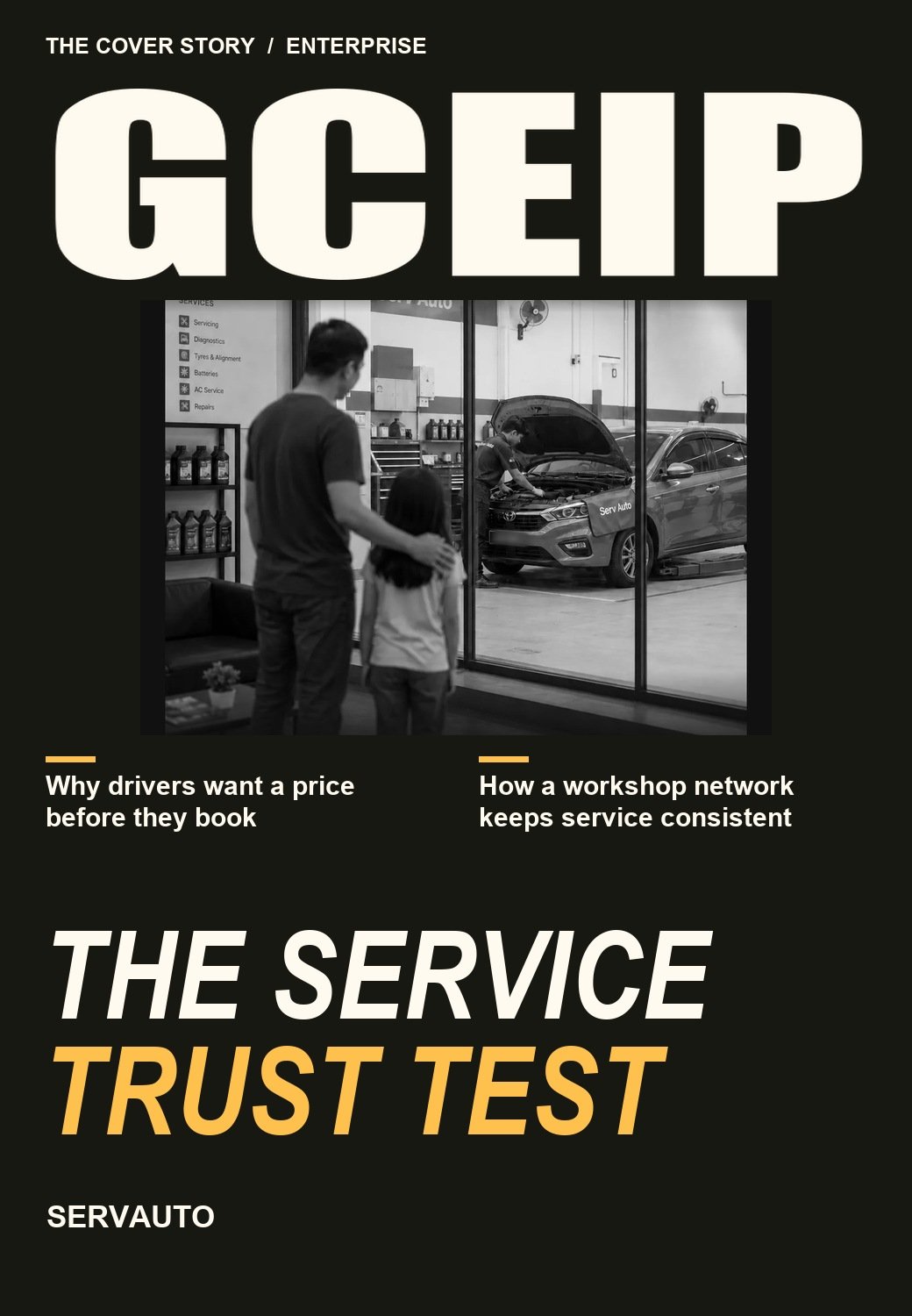
Rebuilding Trust in Car Servicing: Malaysia's ServAuto Playbook
ServAuto is combining online booking, workshop standards and parts sourcing to simplify a fragmented automotive aftersales market. Its 2026 financing round is a test of whether standardisation can scale.
S
ServAutoAutomotive aftersales / service marketplace · Malaysia
GCEIP Editorial Desk ·
Editorial. Published by the GCEIP editorial desk under our editorial policy. An editorial story does not make its subject an award recipient.
Quick ReadHighlights from this page⌃
Malaysian startup ServAuto is scaling a verified workshop network and transparent car-service booking model following new 2026 funding.
A Market Every Driver Knows
Buying a car is a major financial decision, but maintaining it can involve smaller frustrations that accumulate over years: uncertain prices, inconsistent workshop quality, unfamiliar replacement parts and unpredictable service experiences. Malaysia has a substantial vehicle-owning population, yet much of the aftersales market remains fragmented.
ServAuto is attempting to create a more organised layer between drivers, workshops and parts suppliers. Its platform allows customers to arrange selected car services while building a network of participating service locations operating under defined standards.
The business is not trying to replace every independent workshop with a company-owned garage. Instead, its model combines a technology platform, sourcing relationships and a network of workshops so that customers receive a more consistent experience.
That is a practical form of transformation: making an everyday service more transparent and repeatable.
Early Traction and a New Funding Round
ServAuto was founded by a team with experience in the automotive technology ecosystem. It built its proposition around frequent aftersales needs such as oil changes and selected car accessories, categories where customers often value convenience and clearly understood pricing.
On February 10, 2026, Digital News Asia reported that the company had secured a new financing round led by Vynn Capital, bringing its reported total funding close to US$6 million. Investors included Jelawang Capital, Openspace Capital and others.
The company reported serving more than 30,000 customers during its first twelve months. Its current corporate website describes a network of more than 150 verified workshops across 11 Malaysian states. These are company-provided operating figures and should not be mistaken for independently audited measures of customer satisfaction or workshop performance.
The funding was intended to extend service coverage and deepen the workshop network. For ServAuto, that expansion creates a new challenge: maintaining standards while adding locations and service categories.
What Makes the Model Difficult
A booking interface is relatively easy to copy. Consistency in automotive service is not. Participating workshops may have different equipment, training levels, operating habits and capacities. Parts availability can vary. A platform promising transparent prices has to make sure that what customers see before booking aligns with what happens at the workshop.
ServAuto's website describes workshop verification, audits and standardised service procedures as important elements of the model. Whether those controls work consistently is an operational question that matters more than the number of partner logos on a page.
The economics must also work for workshops. A platform can attract customers, but repair businesses still need enough margin to provide careful service, train personnel and invest in tools. ServAuto's long-term position depends on creating value for both drivers and service partners.
Funding can accelerate the network, but expanding faster than quality assurance would put the company's central promise at risk. The most informative future metrics would include repeat bookings, complaint resolution, service consistency and retention of workshop partners.
GCEIP Analysis
ServAuto is tackling an unglamorous but substantial opportunity: helping ordinary consumers navigate a sector where information and trust are often uneven.
The transformation goes beyond putting garages online. It requires systems for price clarity, parts sourcing, workshop assessment and a consistent customer experience. That combination is harder to build and could be more defensible than a standalone booking app.
Its 2026 fundraising offers the resources to test the model nationally, but it does not guarantee that service outcomes will remain uniform as the network grows.
GCEIP View
ServAuto demonstrates how a growing Malaysian company can create value by organising a familiar, fragmented service industry. The business is trying to establish a more dependable relationship between vehicle owners and workshops through standardisation supported by technology.
The next stage will reveal whether its operating methods are strong enough to scale across more locations without sacrificing trust. If ServAuto succeeds, it will have built more than a car-care marketplace: it will have helped turn a loosely coordinated aftersales industry into a clearer, more reliable customer service system.
If this story is about you or your company, you are welcome to link to it. Copy either snippet below into your website, press page, email signature or post.
Where this story fits
Featured within GCEIP’s Transformational Leaders & Enterprises™ ecosystem.
Know a leader or enterprise like this? Nominate them for Transformational Leaders & Enterprises™, in Barcelona or London. Nominations for Dubai are closed.
Bateriku began with an urgent automotive need—getting a dead battery replaced—and grew into a network of technicians, local entrepreneurs and roadside services. Its next challenge is to connect growth with responsible battery recovery.
From performance-focused electric motorbikes to affordable family transportation, Dat Bike is taking on one of Southeast Asia's most established consumer habits. Its next challenge is not simply building a better electric motorcycle, but building a manufacturing and service business capable of competing at national and eventually regional scale.
Construction projects can run into trouble long before building work starts. Stockholm-based Brickanta is developing an AI-powered platform to help construction companies analyse contracts, identify risks, prepare bids and make better decisions before committing resources.
From flexible warehouse capacity to connected transportation networks, Riyadh-based Sirdab is attempting to transform one of the most important—and least visible—parts of Saudi Arabia's growing business economy.