Past the AI Pilot: Stephanie Sy’s Regional Enterprise Challenge
Thinking Machines founder Stephanie Sy is moving from building AI projects to helping organisations run AI as part of everyday work.
SS
Stephanie SyFounder of Thinking Machines Data Science; Managing Director, Applied AI & Data at Temus · Philippines
GCEIP Editorial Desk ·
Editorial. Published by the GCEIP editorial desk under our editorial policy. An editorial story does not make its subject an award recipient.
Quick ReadHighlights from this page⌃
Thinking Machines founder Stephanie Sy is moving from building AI projects to helping organisations run AI as part of everyday work.
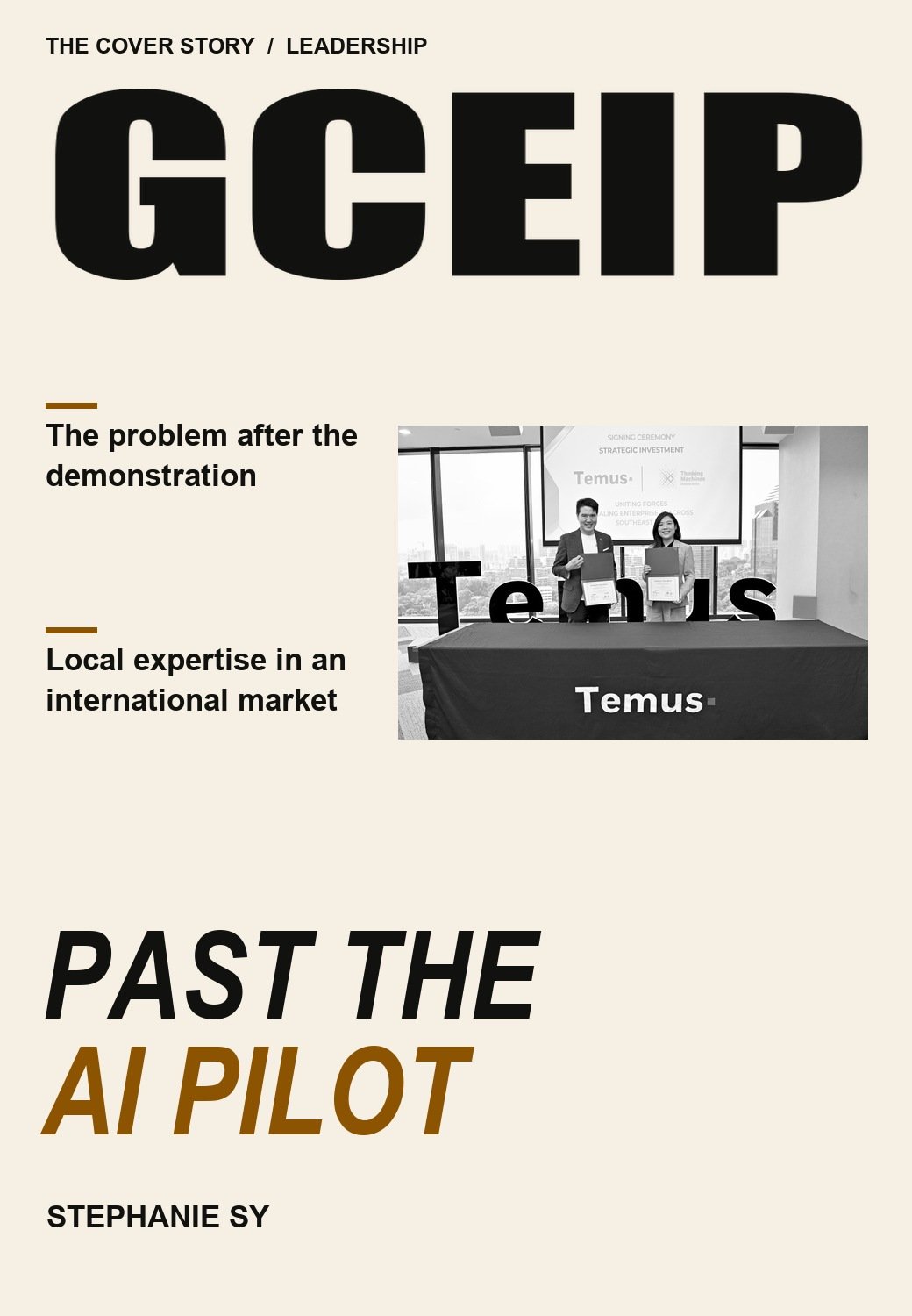
From left: Sng Ren Yeong and Stephanie Sy. Photograph: Temus. Source
The problem after the demonstration
Many organisations can show an impressive artificial-intelligence pilot. Far fewer can explain how the system will operate next year, who will be accountable for mistakes or whether employees will use it. Stephanie Sy founded Thinking Machines Data Science in Manila in 2015, positioning data engineering and applied AI around operational business needs. Her team works with companies whose legacy software and fragmented information can make AI difficult to use reliably.
Local expertise in an international market
Thinking Machines has built a regional presence spanning Manila, Singapore and Bangkok. Its work includes data platforms, machine-learning applications and training people to manage digital tools. The company has stated that it has worked with more than 110 organisations and trained over 10,000 professionals in AI-related capabilities. Those are company-provided totals, not independently assessed measures of sustained business improvement. But they help explain the business model: combine the engineering work of deploying data systems with the organisational work of enabling people to use them. In enterprise technology, one is usually inadequate without the other.
July 2026: a change in scale
On July 30, 2026, Temus, a Singapore digital-transformation company established by Temasek, announced a strategic investment and combination with Thinking Machines. The Filipino-founded company would continue under its own brand and leadership as a Temus entity. Sy joined Temus’s leadership, co-leading Applied AI & Data as a managing director. This was a significant structural shift, not simply a new customer announcement. It connected the company’s established engineering expertise with Temus’s larger regional delivery capabilities. The announcement did not disclose a transaction valuation or ownership percentage.
Preserving the operating culture
The hard part of combining technology organisations is rarely the announcement. Teams need common delivery standards, shared technical practices, consistent accountability and clear priorities for customers. For Sy, the challenge is to preserve the entrepreneurial strengths of the Manila-built business while using a larger organisation to deliver work that one company could not handle alone. The partnership also raises a practical question: can AI consulting move from bespoke engagements towards repeatable, measurable business outcomes without sacrificing safety or useful human oversight?
What continuity should mean for clients
A strategic transaction can broaden access to capital and commercial relationships, but it can also unsettle clients who chose a specialist for its independence and attention. Thinking Machines must show how existing service commitments, governance and technical quality survive its closer relationship with Temus. The ability to work across languages, regulatory contexts and uneven enterprise data quality is especially important in Southeast Asia. Stephanie’s leadership will be judged not by deal announcements alone but by whether customers experience more reliable projects, better staff support and measurable results without losing the responsiveness that drew them to a regional AI specialist.
GCEIP Analysis
Sy now has regional delivery responsibilities within a larger group. Thinking Machines was founded when enterprise AI was a far narrower market than it is today. The 2026 combination suggests the company’s capabilities have strategic value, and gives clients a reason to examine how the combined delivery team will work. Clients will need evidence that employees use the systems, information stays secure and service remains reliable.
GCEIP View
Stephanie Sy’s career illustrates a practical idea: AI becomes useful when clients can depend on it in everyday work. The Temus combination gives her team a larger platform to test that proposition. Its success will be measured by better daily decisions and workflows for clients, supported by human accountability. For Southeast Asia, the broader significance is that enterprise AI expertise can be developed in the Philippines and become part of a regional delivery institution.
Key facts
Who founded Thinking Machines Data Science?
Stephanie Sy founded Thinking Machines Data Science in Manila in 2015.
What happened to Thinking Machines in 2026?
Temus announced a strategic investment in July 2026; Thinking Machines continues operating under its own brand as a Temus entity.
If this story is about you or your company, you are welcome to link to it. Copy either snippet below into your website, press page, email signature or post.
About this feature
This is a GCEIP editorial feature. Publication does not confer nomination, finalist, winner or honouree status.
Mayani co-founder JT Solis is building a commercial connection between smallholders and institutional buyers. His next challenge is to make cold-chain infrastructure and market access work together at scale.
Lhoopa combines property data, a network of local agents and contractors, and financing relationships to bring lower-cost homes to market in the Philippines. Co-founder Sabrina Tan leads its people-centred side.
The founder who challenged India's fragmented hotel industry is now leading PRISM through a much larger transformation. With Motel 6 reshaping its international business and a proposed IPO approaching, Ritesh Agarwal faces a different test of leadership: building a financially resilient global hospitality company.
The entrepreneur who built a global podcast audience is now attempting to create a business ecosystem spanning media, technology, investment and creator-led enterprises.