The Carbon Contract Reaches the Farm: Varaha’s Next Scale Test
India-based Varaha is turning rural carbon-removal practices into long-term commercial agreements, including a 2026 deal with Microsoft.
V
VarahaCarbon removals / rural climate services · India
GCEIP Editorial Desk ·
Editorial. Published by the GCEIP editorial desk under our editorial policy. An editorial story does not make its subject an award recipient.
Quick ReadHighlights from this page⌃
India-based Varaha is turning rural carbon-removal practices into long-term commercial agreements, including a 2026 deal with Microsoft.
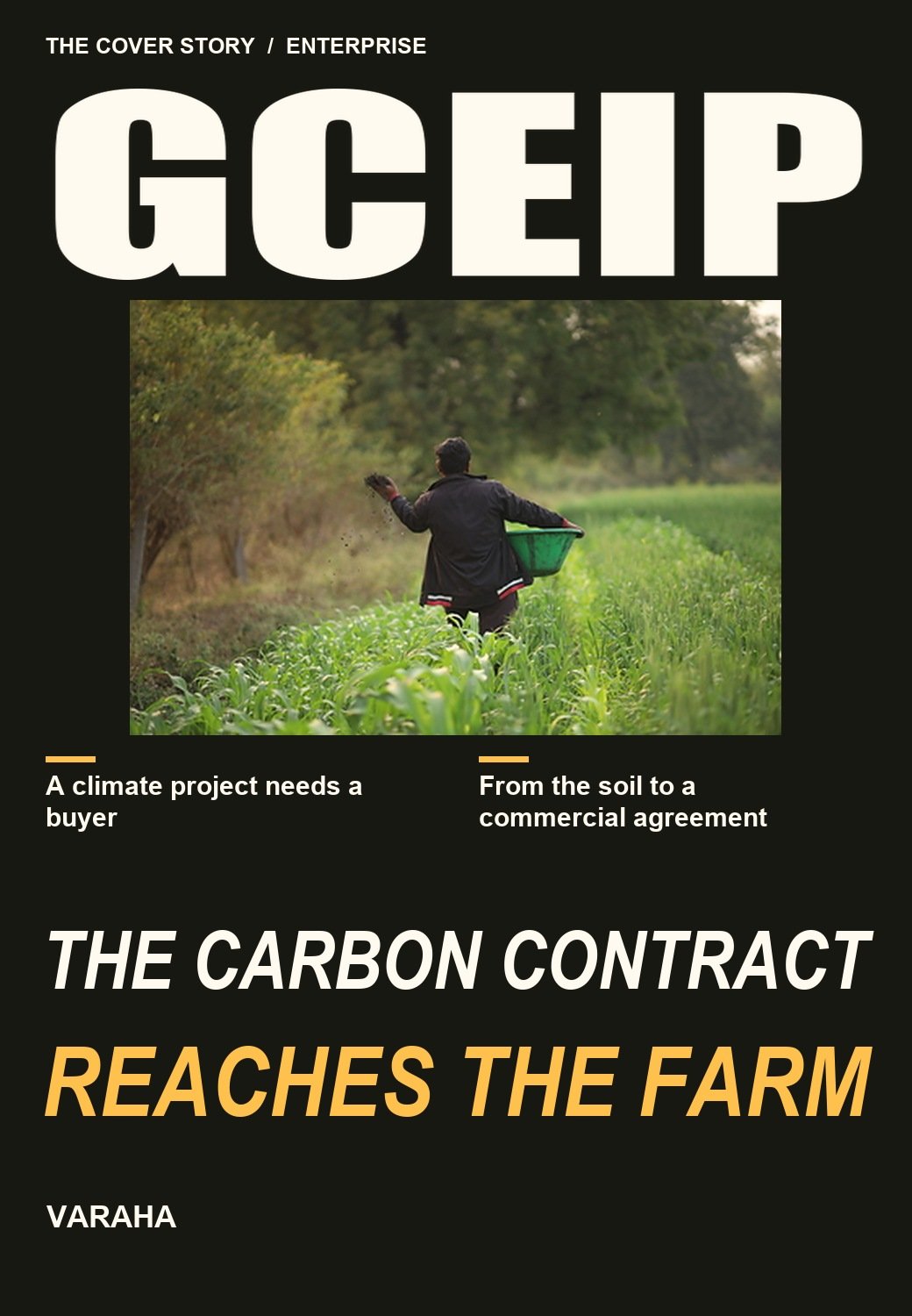
Farmers applying biochar. Photograph supplied by Varaha ClimateAg. Source
A climate project needs a buyer
For many farmers, adopting different land-management practices can create costs or uncertainty before a financial benefit appears. For companies buying carbon removal, the problem runs in reverse: they want credible, measurable environmental outcomes delivered across years. India-based Varaha is building an enterprise between those two needs. It works with rural partners and agricultural projects to develop carbon-removal credits that can be purchased by large corporate buyers. The business challenge is not merely calculating carbon. It is coordinating real activity on the ground with verification systems and buyer contracts.
From the soil to a commercial agreement
Varaha's model involves developing projects such as biochar and other forms of carbon removal, working with farmers, agricultural suppliers and technology partners. Biochar is a carbon-rich material produced from biomass under controlled conditions and can retain carbon for long periods when appropriately produced and used. But neither the word 'biochar' nor the existence of a farm project guarantees high-quality credits. Measurement, additionality, permanence, project boundaries and third-party standards determine credibility. A carbon developer must also demonstrate who receives the proceeds and whether local participants understand the arrangements.
Microsoft's 2026 commitment
On January 15, 2026, Varaha announced a carbon-removal purchase agreement with Microsoft covering more than 100,000 tonnes of removals over three years. This is an agreement for future delivery, not proof that the full amount has already been removed and independently verified. It is nevertheless a notable commercial milestone because a large technology buyer is committing to a defined purchasing programme. It also raises the operational bar. A developer needs project execution, measurement and delivery controls reliable enough to match contractual expectations, even when projects operate across scattered rural locations.
A financing milestone with an important distinction
In early February 2026, Varaha announced a planned US$45 million Series B round, including an initial US$20 million tranche reported as secured. News coverage described the first tranche as a tangible funding milestone. The larger amount should not be described as money already received unless subsequent closings are verified. The financing supports a company trying to expand beyond pilots into an infrastructure-like platform for climate outcomes. But investors will expect the operating systems, project economics and quality controls to grow alongside the headline size of the pipeline.
The integrity challenge
Carbon markets have experienced scrutiny over credit quality, permanence and the gap between marketing claims and verified outcomes. These questions matter directly to Varaha. Rural projects must generate real climate benefits, not paper estimates that disappear under rigorous examination. Contracts should be fair to landholders and transparent about monitoring obligations. Buyers need assurance that a credit has not been double counted, that the expected carbon duration is accurately described and that any reversal risks are managed. Growth measured only in announced credits or project acreage would be an incomplete picture.
GCEIP Analysis
Varaha's transformation is the emergence of a commercial platform between distributed rural climate activity and sophisticated international procurement. The 2026 Microsoft agreement and financing announcement support the view that buyer and investor interest is developing. However, purchase agreements, pledged funding and verified delivered removals are distinct categories. A strong enterprise evaluation should track those separately, while examining independent audits, local participant economics and real-world project delivery.
GCEIP View
Varaha shows how a climate enterprise can create a commercial connection between farms and global carbon buyers. The idea is promising because it gives rural activities a potential new revenue channel. The next test is whether that channel generates reliable, verified climate value and fair local outcomes over time. Each delivered credit will need records linking it to verified work on the ground.
Key facts
What does Varaha do?
Varaha is an India-based developer of carbon-removal projects connecting rural activities with carbon-credit buyers.
What does Varaha’s Microsoft agreement cover?
The January 2026 announcement described a purchase agreement for more than 100,000 tonnes of carbon removal over three years. It is a future-delivery commitment.
If this story is about you or your company, you are welcome to link to it. Copy either snippet below into your website, press page, email signature or post.
About this feature
This is a GCEIP editorial feature. Publication does not confer nomination, finalist, winner or honouree status.
AMAti Motors / Ati Robotics · Industrial robotics / automation
India-born Ati Motors is building autonomous material-handling robots for production environments. Its recent expansion shows why effective automation starts with practical tasks, not spectacle.
For a hardware company, getting from a prototype to reliable production can mean coordinating many suppliers and processes. Karkhana.io is building a managed manufacturing network around that gap.
From continuous glucose monitoring and smart rings to blood biomarkers, women’s health and real-time biointelligence, Bengaluru-based Ultrahuman is attempting something far more ambitious than building another wearable. It wants to create a computing platform that understands the human body continuously.
Cred built its business on a contrarian idea — reward India’s most creditworthy consumers, not the underbanked majority. In 2026, that bet drew a $900 million investment from Meta, a $4.5 billion valuation, and sent its founder to run WhatsApp worldwide.