The Water Behind the Data Centre: Hydroleap's Industrial Bet
Singapore's Hydroleap is expanding electrochemical water-treatment solutions into data centres and other water-intensive industries. Its business case connects sustainability with an everyday operating expense.
Editorial. Published by the GCEIP editorial desk under our editorial policy. An editorial story does not make its subject an award recipient.
Quick ReadHighlights from this page⌃
Singapore’s Hydroleap is expanding electrochemical water treatment for data centres and industrial clients after a 2025 funding round.
The Resource Behind Modern Industry
The growth of digital infrastructure has made electricity demand a major public conversation. Water deserves attention too. Data centres, industrial plants and many manufacturing processes depend on reliable cooling and treatment systems. Water quality affects equipment performance, operating costs and regulatory compliance.
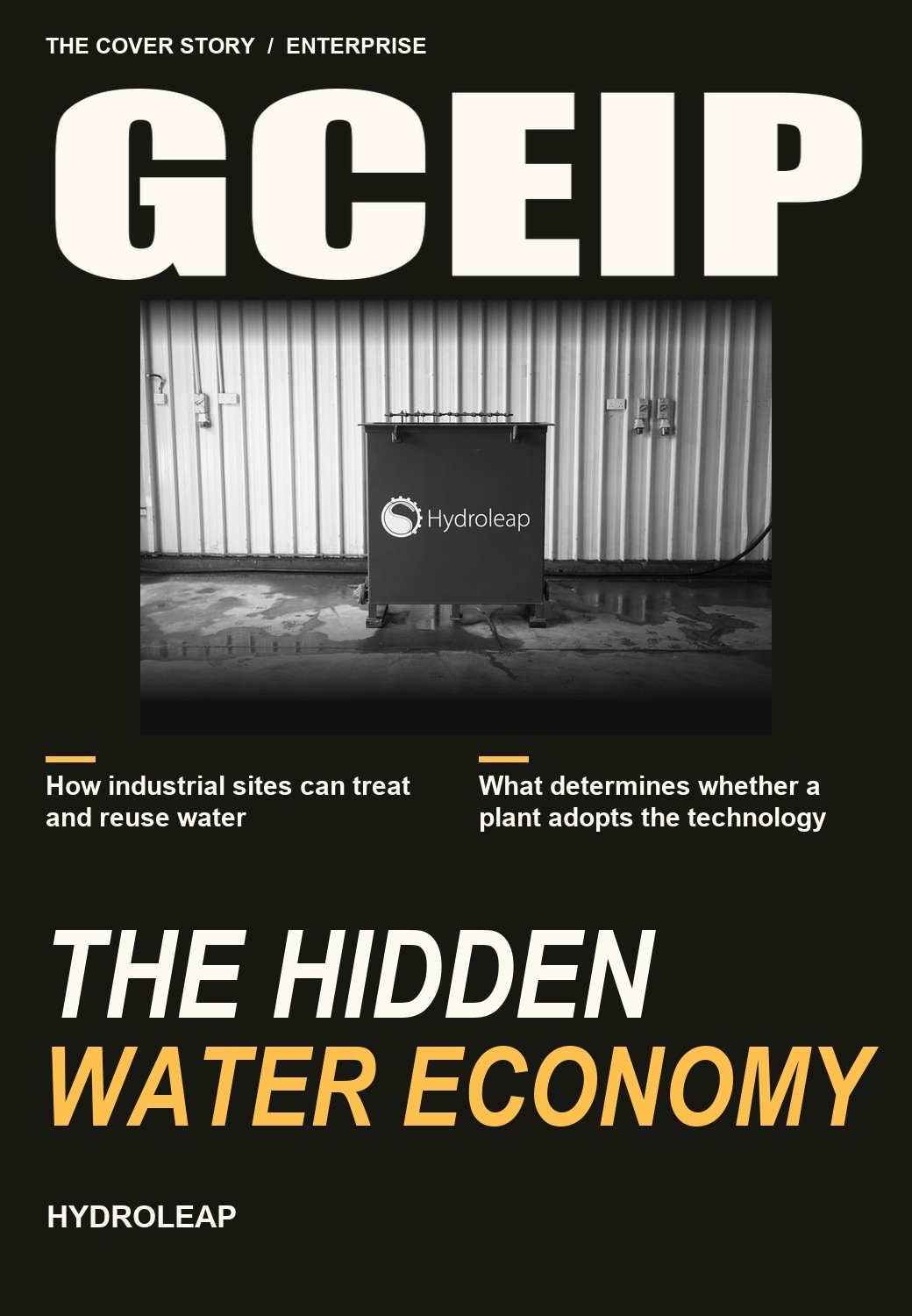
Hydroleap, a Singapore-based industrial water-treatment company, develops electrochemical and modular technologies intended to reduce dependence on conventional chemical-intensive treatment processes.
Its approach treats water as an operational business concern rather than simply a sustainability slogan. A customer may support environmental goals, but investment decisions still depend on reliability, installation costs, measurable performance and the service needed to keep a system running.
A New Stage of Commercial Expansion
Hydroleap has been developing its technology for several years. On July 30, 2025, the company announced an additional US$4.75 million financing round involving investors including EDBI, Antares Ventures and Woh Hup. The company said its total funding had reached nearly US$12 million.
The funds were intended to expand deployments in Asia-Pacific data centres and strengthen its position in sectors such as pharmaceuticals, semiconductors and agrifood processing. These are commercially demanding environments, where an intervention that disrupts operations can cost far more than any promised efficiency gain.
Hydroleap's website describes solutions designed for suspended solids, certain contaminants and water-reuse applications. Those are vendor descriptions of the technology's intended performance, not evidence that every wastewater stream can be treated to the same standard.
The business has also discussed international development and participated in industry discussions about water management in AI infrastructure. The opportunity is becoming more visible as governments and customers scrutinise how expanding data centres consume resources.
Where Water Technology Is Won or Lost
Water treatment cannot be evaluated through one demonstration. Industrial sites have different incoming water quality, contaminant profiles and operational requirements. Systems must be selected, designed and validated for the actual site.
Hydroleap's modular approach may allow certain deployments to be configured around local needs. The company still has to prove lifecycle economics: energy consumption, consumables, maintenance, replacement parts, downtime and the quality of treated water.
In a data centre, for example, equipment availability and cooling reliability are non-negotiable. A treatment system that reduces chemical use but adds unacceptable operational risk would not be a successful commercial solution.
For customers, the relevant question is not whether a technology is described as sustainable. It is whether verified testing shows that it achieves the required water outcomes with acceptable cost, safety and service requirements.
Hydroleap must also manage sales cycles and project execution. Industrial customers often need engineering reviews, procurement approval and pilot results before a full deployment. The company may have attractive technology, but turning that into consistent revenue requires a capable field and service organisation.
GCEIP Analysis
Hydroleap illustrates a transformation in the water-treatment industry, where efficiency and environmental outcomes increasingly need to be considered together with the operational constraints of industrial buyers.
Its 2025 financing and target-market expansion are noteworthy, but the lasting evidence will be customer deployments that demonstrate repeatable water quality, resource efficiency and positive economics under real conditions.
The business also reveals how the AI economy creates opportunities far beyond chips and software, reaching into the physical infrastructure needed to sustain computing and manufacturing.
GCEIP View
Hydroleap is addressing a resource problem that sits beneath the visible growth of Southeast Asia's industrial and digital economy. Its proposition is compelling because water management is both an environmental responsibility and an operating requirement.
The company now has to translate electrochemical innovation into reliable industrial infrastructure. If it can deliver verified outcomes across diverse applications, Hydroleap may become an important example of Singaporean climate technology succeeding through engineering discipline and practical customer value.
If this story is about you or your company, you are welcome to link to it. Copy either snippet below into your website, press page, email signature or post.
Where this story fits
Featured within GCEIP’s Transformational Leaders & Enterprises™ ecosystem.
Know a leader or enterprise like this? Nominate them for Transformational Leaders & Enterprises™, in Barcelona or London. Nominations for Dubai are closed.
Founded in Singapore in 2014, ShopBack spent a decade turning a browser cashback habit into Asia-Pacific’s largest rewards network, reaching unicorn status in 2026 on the back of quiet profitability. Its next move is harder: standing at the actual point of sale, not just after it.
Singapore-based Hivebotics is developing a robot to clean commercial restrooms, beginning with one of facilities management’s most repetitive and difficult jobs. The company’s challenge is to make specialised automation work in real buildings.
Cred built its business on a contrarian idea — reward India’s most creditworthy consumers, not the underbanked majority. In 2026, that bet drew a $900 million investment from Meta, a $4.5 billion valuation, and sent its founder to run WhatsApp worldwide.
From performance-focused electric motorbikes to affordable family transportation, Dat Bike is taking on one of Southeast Asia's most established consumer habits. Its next challenge is not simply building a better electric motorcycle, but building a manufacturing and service business capable of competing at national and eventually regional scale.


 ShopBack · E-commerce