Electric Freight Has an Economics Problem: Saurav Kumar's Euler Motors Response
Euler Motors is expanding its electric commercial-vehicle business in India. Founder Saurav Kumar's central challenge is to prove that cleaner delivery vehicles can also work financially for businesses that depend on uptime.
SK
Saurav KumarEuler Motors · India
GCEIP Editorial Desk ·
Editorial. Published by the GCEIP editorial desk under our editorial policy. An editorial story does not make its subject an award recipient.
Quick ReadHighlights from this page⌃
Euler Motors founder Saurav Kumar is scaling electric cargo-vehicle manufacturing and service networks while proving fleet economics for logistics customers.
The Vehicle Behind Every Delivery
A delivery company does not choose a commercial vehicle for appearance alone. It needs payload, reliability, predictable maintenance, affordable financing and a service network that can get a vehicle back to work quickly. Electrification changes the powertrain, but it does not remove those requirements.
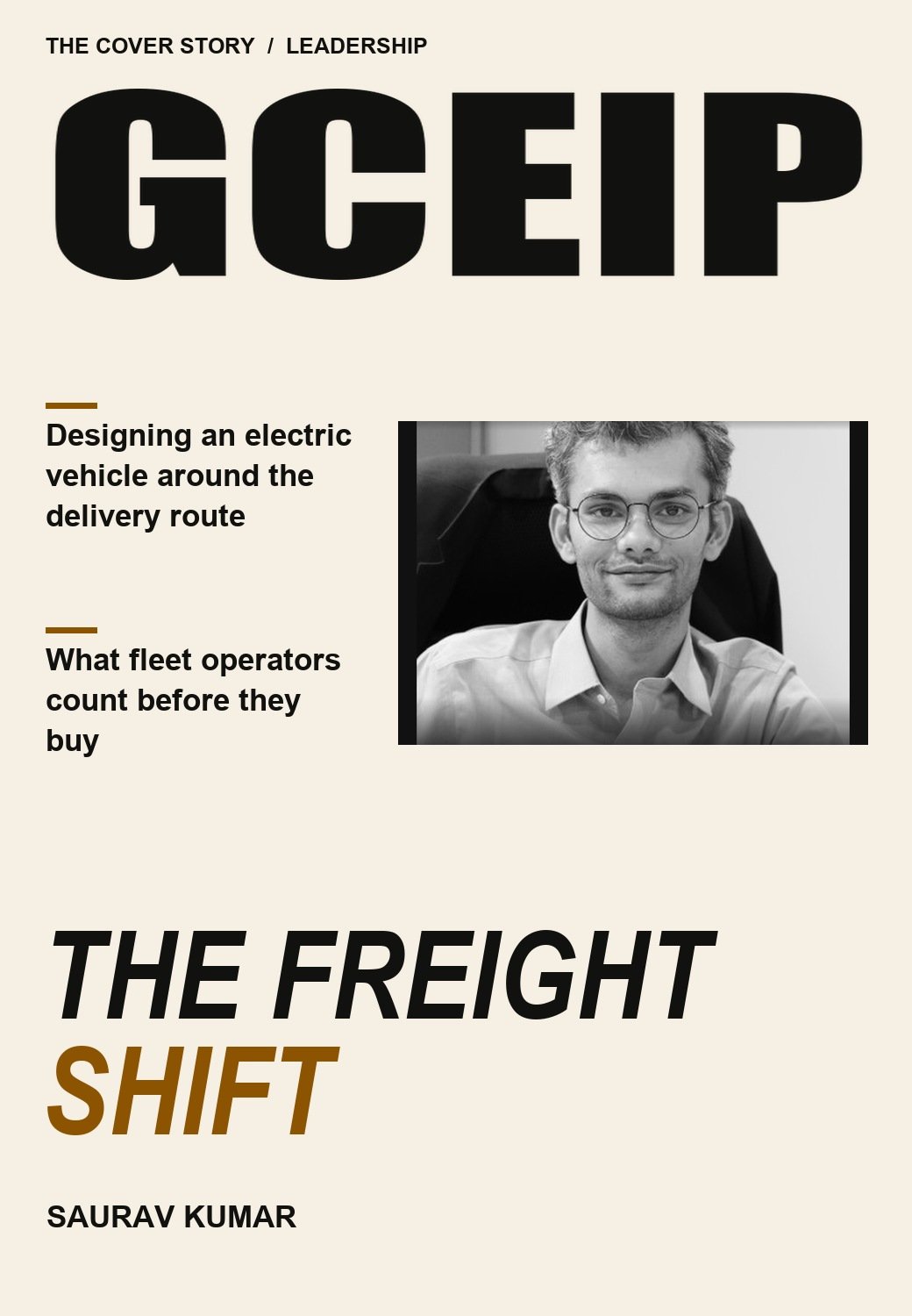
Saurav Kumar, founder and chief executive of India's Euler Motors, is building around this commercial reality. The company designs and manufactures electric cargo vehicles for logistics, retail and other delivery uses, with three- and four-wheeler products aimed at businesses that depend on moving goods.
The opportunity is significant. Electric commercial vehicles may offer favourable operating economics on some routes, but their adoption depends heavily on charging access, financing terms, utilisation and residual values. A manufacturer has to solve more than the engineering problem.
From Early Adoption to Manufacturing Scale
Euler Motors announced a major financing step on March 24, 2026: INR437.5 crore in Series E equity, led by Lightrock, alongside INR250 crore in debt financing. Participants in the equity round included Hero MotoCorp and Blume Ventures.
The company said the investment would support manufacturing capacity, product development and network expansion. Its plans included increasing monthly production capability and extending its distribution reach to more cities. These were stated targets, not proof that the planned capacity had already been installed or fully utilised.
The financing followed earlier investment, including the involvement of Hero MotoCorp. Such partners can contribute capital and industrial expertise, but a larger funding total also raises expectations around utilisation, profitability and delivery performance.
A 2026 interview with industry reporters described Euler's move into higher-payload four-wheel cargo vehicles and a growing network of sales and service touchpoints. The company's product strategy reflects a belief that electrification can be commercially attractive where vehicles travel frequently and where operating costs can be carefully modelled.
The Difficult Part: Vehicle Economics
Fleet buyers calculate more than a purchase price. They assess downtime, payload trade-offs, battery durability, charging arrangements, maintenance and the ability to finance vehicles on reasonable terms. A saving projected under an idealised scenario is not the same as a saving achieved by a real fleet.
That is why service infrastructure matters so much to Euler's growth. It needs dependable parts availability and technical support across more cities as well as products matched to the needs of operators. A rapid expansion that leaves customers waiting for repairs could weaken the very commercial argument on which adoption depends.
The company's accounts also demand a balanced reading. Public financial information has described continuing losses during the growth period. Reported fundraising and market-share figures therefore should not be mistaken for evidence that the underlying business has already achieved sustainable profitability.
Kumar has also called attention to policy, financing and charging barriers affecting commercial-EV adoption. His October 2026 comments about Delhi's EV policy highlighted how local regulations can influence investment decisions, but a supportive policy cannot replace competitive products and reliable service.
GCEIP Analysis
Euler's transformation lies in its movement from early vehicle development towards a broader industrial and service organisation. That transition requires production systems, research spending, distribution, financing partners and disciplined capital management.
Kumar's leadership is best assessed against the full economics of a commercial fleet. The company must deliver machines that earn their place in a customer's operations every day. Growth in manufacturing capability and fresh equity are enabling factors; vehicle uptime and customers' financial outcomes are the harder proof points.
GCEIP View
Saurav Kumar's journey illustrates a practical version of the electric-mobility transition. The goal is not merely to replace a diesel or petrol engine with a battery. It is to help logistics operators run dependable, competitive businesses while using electric vehicles.
Euler Motors has attracted substantial capital and developed a growing product portfolio. The leadership test ahead is whether that investment translates into consistent quality, stronger economics and sustainable execution. In commercial mobility, transformation succeeds when the technology works as hard as the customer does.
If this story is about you or your company, you are welcome to link to it. Copy either snippet below into your website, press page, email signature or post.
Where this story fits
Featured within GCEIP’s Transformational Leaders & Enterprises™ ecosystem.
Know a leader or enterprise like this? Nominate them for Transformational Leaders & Enterprises™, in Barcelona or London. Nominations for Dubai are closed.
From taking Nykaa offline to building its fashion business and now scaling House of Nykaa, Adwaita Nayar is helping transform one of India’s most recognised digital-first companies into a portfolio of enduring consumer brands.
From co-founding LogiNext to launching SiftHub, Manisha Raisinghani is using AI to solve one of enterprise sales’ oldest problems: too much information, too little usable context.
Three decades inside one company, and a career built in the categories that reach almost every Indian household. Priya Nair now runs the business she joined as a management trainee.
From a YouTube classroom in Prayagraj to building one of India’s most visible education platforms, Alakh Pandey has created a business around a simple idea: quality learning should not be limited by geography or affordability.


 Adwaita Nayar · Nykaa